Ferrari F10
Active: 01-02-2010 - 2010
Team: Scuderia Ferrari SpA
Team: Stefano Domenicali (TP), Mario Almondo (Director of Operations), Aldo Costa (TD), Nicolas Tombazis (CD), Luca Marmorini (HE)
Drivers: Felipe Massa (7), Fernando Alonso (8)
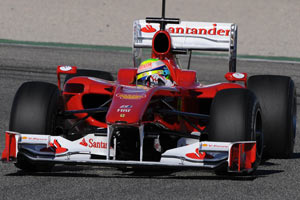
The Ferrari F10, codenamed 661 is the response to a failed 2009 where the team failed to make a very good impression. Even before Kimi Raikkonen secured their only win of 2009, the team decided to switch all development to the 2010 car.
Aldo Costa explained: "We think that it was necessary to interrupt working on the F60’s development, also because we didn’t have the possibility to win the Championship. Now we’re trying to forget last year and concentrate on 2010. But the decision was strategic, agreed on by the technicians and Stefano Domenicali."
Overall, the car is a major departure of the 2009 concept. "We analysed the reasons why we weren’t strong enough last year – car, organisation, approach", said Tombazis. "The development data regarding aerodynamics, simulator and test stand makes us think that lots of development has been done."
"The KERS is gone, but the minimum weight has been raised. There’s more ballast to adjust the weight in case there were problems with the distribution. In reality last year KERS worked very well, although it did create a certain deficit on the car’s overall package. That fact that it’s gone made us lose a performance delta, but by space-saving we gained what we lost with the KERS. The volume of the tank is much bigger than of the KERS."
The technical team also changed over the winter as Luca Marmorini rejoined as the Head of Engines and Electronics for the Scuderia Ferrari Marlboro. The Italian had been working at Toyota until for several years as Head of Engines. Gilles Simon, who previously held this role, left to work for the FIA under new FIA president and countryman Jean Todt.
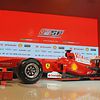
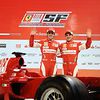
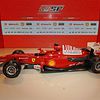
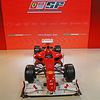
Ferrari presented its F10 at its headquarters in Maranello, on 28 January and first ran at Valencia, 1 February. Felipe Massa was the first to test the car for two days, with Fernando Alonso making his debut in the Ferrari on 3 February.
Reactions at the launch:
Technical analysis
The F10 is an extremely long car. While Ferrari have not officially unveiled any dimensions of the car, image comparisons have shown that it is even longer than the Renault R30 which the team claims to be 5050 mm long.

A longer car has several advantages, including the possibility to have a smoother airflow around your car. Along with it is the car's long wheelbase, an interesting philosophy as McLaren found a longer wheelbase ineffective in 2009. The manadatory larger fuel tank may have left Ferrari without another choice.
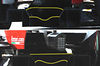
The nose cone is very pointy and rather unlike all Ferrari's of the last 10 years. The tip extends ahead of the front wing and is much higher than on the F60. The upper side is, as was expected, a copy of the Red Bull RB5's V-nose concept, with the outer edges of the nose higher than the central part.
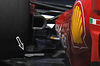
Around and behind the driver's position, all parts are more evolutionary. The sidepod cooling holes have largely been unchanged, as well as the airbox and the car's rear end. The engine exhaust have been relocated to be more forward, allowing the rear suspension components to stay a bit cooler.
After the season, Ferrari released an overview of its most important car updates throughout the season. Most importantly, Ferrari's inseason introduction of the F-duct, copied from McLaren, and the exhaust blown diffuser, following Red Bull Racing's design were the most important performance improvements.
Specifications
Chassis: Carbon-fibre and honeycomb composite structure
Gearbox: Ferrari longitudinal gearbox, semiautomatic sequential electronically controlled – quick shift
Differential: Limited-slip differential
Number of gears: 7 +Reverse
Brakes: Brembo ventilated carbon-fibre disc brakes
Suspension: Independent suspension, push-rod activated torsion springs front and rear
Weight: with water, lubricant and driver: 620 kg
Wheels: BBS Wheels (front and rear): 13”
Engine
Type: Ferrari 056
Number of cylinders: V8, 90°
Cylinder block: In sand cast aluminium
Number of valves: 32
Fuel feed: Pneumatic distribution
Total displacement: 2398 cm3
Piston bore: 98 mm
Weight: at least 95 kg (mandated by FIA)
Injection: Electronic injection and ignition
Fuel: Shell V-Power
Lubricant: Shell Helix Ultra