Lotus Renault R31
Active: 2011
Team: Lotus F1 Team
Team: James Allison (TD), Naoki Tokunaga (DTD), Tim Densham (CD), Dirk De Beer (HA), Gerard Lopez (Chairman), Eric Boullier (TP), Patrick Louis (COO), John Mardle (OD), Steve Nielsen (SD), Alan Permane (CRE)
Drivers: Robert Kubica (9), Vitaly Petrov (10)
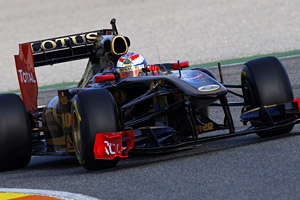
The R31 was presented by Lotus Renault GP on the 31st of January and debuted the day after that at Valencia. It immediately caught attention of the onlookers, not only because of its attractive livery, but also due to its technical design properties.
After starting from a clean sheet of paper for this car, the R31 features a clear V-shaped nose, a concept thought out by Adrian Newey for the Red Bull RB5. Renault's version however is nicely integrated and has no rough edges. The nose is also quite a bit higher than on the Renault R30 and lacks sidepanels under the nose - a feature which on the R30 created a venturi to gain frontal downforce.
The airbox then features the conventional air intake, but adds to that 2 small intakes on each side of the roll hoop, catching air to cool the hydraulics and gearbox. Last year, similar intakes on the R30 were introduced for the F-duct, a system that is banned in 2011.
The sidepods meanwhile are nothing alike previous Renault designs. The intakes are much larger compared to other cars. Each intake is also divided in 2 because the team have employed a split radiator system inside the sidepods. Towards the rear, the sidepod slope down quickly, with hot air exiting in a small but wide area just above the diffuser, trying to energize its airstream and increase rear downforce.
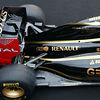
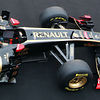
The combination of these design features were required or made possible by Renault running front exit exhausts (FEE). Rather than having exhaust pipes at the rear end of the sidepods, Renault's R31 has them below the sidepod inlets, blowing exhaust gases under the floor and around the sidepods. Talk in the paddock revealed that other teams have been looking into this design as well during the winter, but neither of them decided to use it.
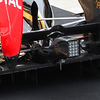
To further improve their concept of a low rear end, Renault redesigned the gearbox and adapted the rear suspension to make it a pull rod actuated system.
Comments from the launch:
- James Allison, Technical director
- Eric Boulier, Team principal
- Robert Kubica, Race driver
- Vitaly Petrov, Race driver
Front exit exhaust
Ahead of the Turkish GP, the team's technical director explained the car's unique front exit exhaust system in-depth. The idea of the FEE is to create a spiralling vortex of exhaust gases as the exhausts are blowing into the curved leading edge of the sidepod's floor.
This handily created a local low pressure area under the front of the sidepods, creating downforce there. Ahead of the season the team compared it with their own Red Bull-alike rearward exhaust (before they knew about it) and found it was generating more downforce than any of its own alternative designs.
The most interesting advantage perhaps of the FEE is also the location of the low pressure area, which for Renault is very close to the aerodynamic centre of the car, whereas the Red Bull system generates it downforce right at the back where the diffuser is.
At the German GP though, the team started experimenting with the rearward blowing exhaust similar to the layout on the Red Bull RB7. They tested it again during FP1 in Hungary, but decided to favour the FEE for the race. It was there where a crack in the exhaust caused chassis R31-04 to be written off as it had too much damage due to a fire on the left hand side of the car.
Specifications
Chassis: Moulded carbon fibre and aluminium honeycomb composite monocoque, manufactured by Lotus Renault GP and designed for maximum strength with minimum weight. RS27-2011 V8 engine installed as a fully-stressed member.
Front suspension: Carbon fibre top and bottom wishbones operate an inboard rocker via a pushrod system. This is connected to a torsion bar and damper units which are mounted inside the front of the monocoque. Aluminium uprights and OZ machined magnesium wheels.
Rear suspension: Carbon fibre top and bottom wishbones with pull rod operated torsion springs and transverse-mounted damper units mounted in the top of the gearbox casing. Aluminium uprights and OZ machined magnesium wheels.
Transmission: Seven-speed semi-automatic titanium gearbox with reverse gear. “Quickshift” system in operation to maximise speed of gearshifts.
Fuel system: Kevlar-reinforced rubber fuel cell by ATL.
Cooling system: Separate oil and water radiators located in the car’s sidepods and cooled using airflow from the car’s forward motion.
Electrical: MES-Microsoft Standard Electronic Control Unit.
Braking system: Carbon discs and pads, calipers by AP Racing, master cylinders by AP racing and Brembo.
Cockpit: Removable driver’s seat made of anatomically formed carbon composite, with six-point harness seat belt by OMP Racing. Steering wheel integrates gear change and clutch paddles, and rear wing adjuster.
KERS: Motor generator unit driving into front of engine with batteries as an energy store. Motor Generator supplied by Renault Sport F1. Electronic control unit by Magneti-Marelli.
Dimensions
Front track: 1450 mm
Rear track: 1400 mm
Overall length: 5100 mm
Overall height: 950 mm
Overall width: 1800 mm
Total weight: 640 kg, including driver, cameras and ballast
Engine
Designation: Renault RS27-2011
Capacity: 2400 cc
Architecture: 90° V8
Weight: 95 kg
Max rpm: 18,000 rpm
ECU: MES SECU
Fuel: TOTAL
Oil: Elf (a brand of TOTAL)
Oil tank: Lotus Renault GP
Battery: Lotus Renault GP