
- Login or Register
No account yet? Sign up

 The sound is very crucial. The cars are very slow as they are already. It wont help if they sound sluggish.
 I believe your knowledge is super ceded by the development of outward opening nozzles with high pressure and piezo drivers. The literature I quoted above says that they are much superior to twisting and multi hole injectors. They also overcome the need for helical intake flow by delivering a much finer spray that is more stable regarding penetration and is typically injected much later in the compression stroke.riff_raff wrote:Spray guided GDI is usually less effective, and also requires "helical" intake swirl for proper mixing. Helical swirl intake flow usually ends up being less efficient, and the centrally located injector means the sparkplug must be located in an undesirable position.
I remember that Gilles Simon (Jean Todt's new "Director of power trains and electronics" from Ferrari and Peugeot) has set a policy pro efficiency in his first FiA publication and that means pro direct injection and variable valves as well. He specifically mentioned downsizing and turbos which are obviously in the process of being decided by FOTA.ringo wrote:Whether the lean burn will be used or if the FIA even allows direct injection, we'll have to wait and see. The main issue is the NOx production, this is only remedied with catalytic converters. The cars will be releasing more NOx into the air than the current engines, though there will be less carbon.
It would be strange if Simon would turn away from the path he used to follow at Ferrari and which have now brought Ferrari one of the best direct injected V8 engines on the market.Gilles Simon wrote:Jean has the conviction that we need to have sustainability in motor sport and that we must push forward the idea. The primary area where this can be achieved is in the design of powertrains. We believe that we need to work closely with all of the manufacturers to have a sustainable economy, with the right level of investment and return, and a technical direction that is right for their general strategy.
The trend towards smaller turbocharged engines in passenger cars is going to make them less noisy. But I am an engineer and I love the noise as it’s a main part of the show.
We have to try to push forward with fuel efficiency. If, as an engine engineer, I am given a maximum fuel load, I will try to give the driver the maximum horsepower possible, building the most efficient engine I can. It is a technical competition, and as efficiency is obviously good for road cars, that could be good for them as well. So we want to try to adapt the rules we have in the run-up to the new engine formula.
I don't know what transient response it is referring to. An equivalence ratio of 1 is stoichiometric (fuel:air/ stoic fuel:air), but DI wasn't used then; maybe this transient response would be eliminated with piezo direct injection.regarding air to fuel ratio, peak power is reached at an equivalence ratio of 1.15, and power gradually reduces as the ratio falls bellow this number.
The leaner the mixture becomes, the better the B.S.F.C., as shown in Fig12.
However with a ratio lower than 1.02, unsatisfactory transient response may appear, thus making the engine insufficient for racing performance.
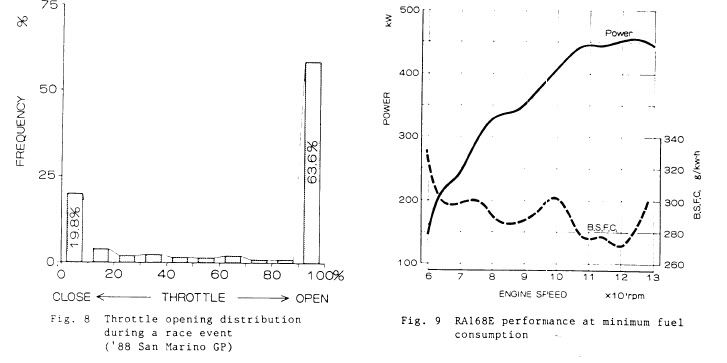
I believe that your example is not representative for today's technology. The old turbo engines had no variable vanes and massive turbo lag. They were practically driven with a binary throttle. Gerhardt Berger has told that story many times.ringo wrote:Partial throttle is few and far between in F1.
This is for the Honda ra168E engine at the san marino GP.
Engine is relevant to the discussion because it's a 1.5lt turbo engine. It revs fairly high at 13,500rpm.
http://www.zzw30.com/HondaRA168EEngine.pdf
By using stratified injection combustion the fuel air mixture is wrapped in air. They are also using EGR to keep the oxygen content and the temps lower.alexisgreene wrote:Lean mixtures result in higher cylinder temperatures. I can understand the use of ultra lean mixtures with DI for fuel efficiency, but how are the extreme temperatures being kept in check?

That is not what I have learned about throttle less engine management. The valves will be having a role in regulating the engine power but also the fuel injected and the ignition timing. For every throttle pedal position, load and ambient condition there will be different sets of valve, injection and ignition parameters. Very complex management programs indeed.ringo wrote:Throtless means the intake valve will be doing the throttling. This will be wired to the gas pedal. Throttle plate or intake valves, full or off throttle will be the order of the day.
The reason LeMans is not doing it is the use of air restricted diesels. If they would let the diesels run free they would be even more dominant than they are today. Essentially due to the different LMP and GT formulae LeMans cannot afford to really run fuel restricted.ringo wrote:Your taking this green thing too far. To what end? If production car racing or Lemans, which is more road relevant, is not doing what you prescribe, why should F1 cripple itself by taking up the burden of miserly fuel use?
I think you have the bolded words all mixed upWhiteBlue wrote:The ignition is actually some degree after TDC and the 12-15° ignition after injection is required to evaporate the fuel and help it cool the compressed air.
Injection starts 20° before TDCalelanza wrote:I think you have the bolded words all mixed upWhiteBlue wrote:The ignition is actually some degree after TDC and the 12-15° ignition after injection is required to evaporate the fuel and help it cool the compressed air.
