Page 8 of 74
Re: Exhaust Blown Floor - Forward Exhaust Exit
Posted: 04 Feb 2011, 17:08
by xpensive
kilcoo316 wrote:
...
xpensive wrote:
What I find interesting here, is what happens with the density under the car with an xhaust contraption such as Renault's?
Think about it.
rho = P/RT.
T goes up, P is constant and rho thus goes down. That means higher volumetric flow rates for an equivalent massflow rate = greater speeds = better dynamic pressures.
...
This is my humble thinking; if rho goes down it would also
decrease the dynamic pressure under the car
for the same air-speed, which in turn should
increase the static pressure under the same car. Is this a good thing?
Re: Exhaust Blown Floor - Forward Exhaust Exit
Posted: 04 Feb 2011, 17:51
by kilcoo316
xpensive wrote:This is my humble thinking; if rho goes down it would also decrease the dynamic pressure under the car for the same air-speed, which in turn should increase the static pressure under the same car. Is this a good thing?
Uhh, I think the conventions are a bit mixed up there, but yeah, in general it would be a good thing (assuming the diffuser can handle the greater volume flow rate).
Pt = Ps + Pd
Pd = - 0.5*rho* V^2
Ps is a constant defined by atmospheric conditions - (it does vary very slightly with temperature and humidity, but negligible compared to the difference of rho with temperature).
Pt is what actually "acts" on the surface.
Re: Exhaust Blown Floor - Forward Exhaust Exit
Posted: 04 Feb 2011, 17:55
by xpensive
In other words, you haven't understood one thing about Bernoulli, it's of course the static pressure alone that acts
on the solid surface creating force. Back to your books and try again. Good Lord...
Re: Exhaust Blown Floor - Forward Exhaust Exit
Posted: 04 Feb 2011, 18:02
by horse
kilcoo316 wrote:....the majority of its focus is on sealing that floor.
Can you explain how this works kilcoo? Hows does the exhaust gas stop air from entering from the sides? I've not really been convinced of this one yet.
Re: Exhaust Blown Floor - Forward Exhaust Exit
Posted: 04 Feb 2011, 18:23
by kilcoo316
xpensive wrote:In other words, you haven't understood one thing about Bernoulli, it's of course the static pressure alone that acts on the solid surface creating force. Back to your books and try again. Good Lord...

Im a dick.
Its Ps = Pt + Pd
Not Pt = Ps + Pd
(with Pd = -0.5*rho*V^2)
If you think thats bad, you'd be genuinely scared the number of times I have to keep double checking the difference between kinematic and dynamic viscosity.
Re: Exhaust Blown Floor - Forward Exhaust Exit
Posted: 04 Feb 2011, 18:27
by kilcoo316
horse wrote:Can you explain how this works kilcoo? Hows does the exhaust gas stop air from entering from the sides? I've not really been convinced of this one yet.
Stealing this from Ringo (good work BTW)
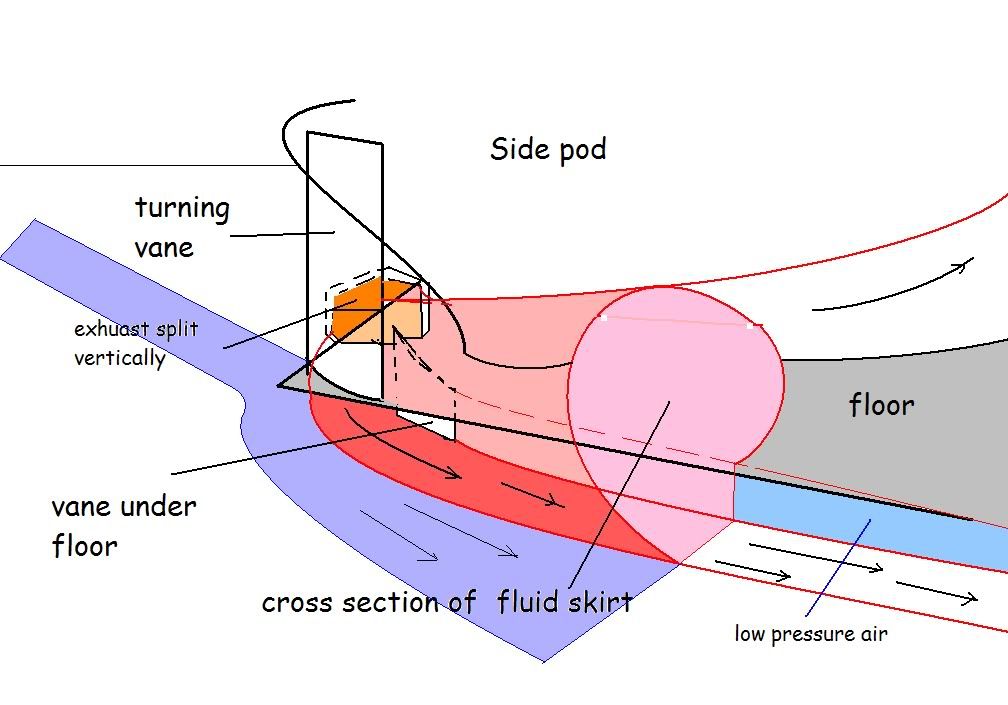
If that vortex, as we look at it, is rotating clockwise; then there is a velocity vector (nearest the track surface) acting away from the car's centreline - which is a momentum based sealant.
That vortex can in itself have a low pressure core (see LERX on say an F-16 or MiG-29), which then can have the effect of drawing yet more air out from under the floor (as well as drawing air into the vortex core from the freestream) - a pressure based sealant.
Re: Exhaust Blown Floor - Forward Exhaust Exit
Posted: 04 Feb 2011, 18:58
by horse
So if it's all about vortex generation then why bother with the exhausts? What do they give that a vortex generator can't?
Re: Exhaust Blown Floor - Forward Exhaust Exit
Posted: 04 Feb 2011, 19:16
by forty-two
horse wrote:So if it's all about vortex generation then why bother with the exhausts? What do they give that a vortex generator can't?
I presume (from my ignorant position!) that there are at least two possible reasons why the exhaust is being used for this purpose:
1. Exhaust gases are being pumped out of the engine, vortex generators would only have the free-stream air to work with.
2. Exhaust gases also carry heat with them, which of course free-stream air would not. I think there's something special about the temperature differential which makes an "air curtain" work, which wouldn't if it were ambient temperature.
Over to the experts!
Re: Exhaust Blown Floor - Forward Exhaust Exit
Posted: 04 Feb 2011, 19:23
by kilcoo316
forty-two wrote:horse wrote:So if it's all about vortex generation then why bother with the exhausts? What do they give that a vortex generator can't?
1. Exhaust gases are being pumped out of the engine, vortex generators would only have the free-stream air to work with.
Yep!
High energy air to work with...
Re: Exhaust Blown Floor - Forward Exhaust Exit
Posted: 04 Feb 2011, 19:36
by BreezyRacer
And note that the exhaust exits are about mid sidepods, not right along the tub. I'm sure someone spent a lot of time optimizing placement as much as possible in the wind tunnel on this. Also they point back maybe 5-10 degrees too.
The area between the tub and the exhaust is where the vortexing is arranged.
Re: Exhaust Blown Floor - Forward Exhaust Exit
Posted: 04 Feb 2011, 19:40
by kilcoo316
BreezyRacer wrote:And note that the exhaust exits are about mid sidepods, not right along the tub. I'm sure someone spent a lot of time optimizing placement as much as possible in the wind tunnel on this. Also they point back maybe 5-10 degrees too.
The area between the tub and the exhaust is where the vortexing is arranged.
There is also a vortex induced by the horn at the front of the sidepod floor's front corner (farthest from the centreline).
Re: Exhaust Blown Floor - Forward Exhaust Exit
Posted: 04 Feb 2011, 19:57
by BreezyRacer
kilcoo316 wrote:BreezyRacer wrote:And note that the exhaust exits are about mid sidepods, not right along the tub. I'm sure someone spent a lot of time optimizing placement as much as possible in the wind tunnel on this. Also they point back maybe 5-10 degrees too.
The area between the tub and the exhaust is where the vortexing is arranged.
There is also a vortex induced by the horn at the front of the sidepod floor's front corner (farthest from the centreline).
By my thinking that is being blown off to the side of the car, where, with the exhaust it helps to isolate the floor, which is what that vortex is used for anyways. And the horn is still very useful in isolating upper body and lower body flows of course.
Re: Exhaust Blown Floor - Forward Exhaust Exit
Posted: 04 Feb 2011, 20:44
by xpensive
kilcoo316 wrote:xpensive wrote:In other words, you haven't understood one thing about Bernoulli, it's of course the static pressure alone that acts on the solid surface creating force. Back to your books and try again. Good Lord...
Im a dick.
Its Ps = Pt + Pd
Not Pt = Ps + Pd
(with Pd = -0.5*rho*V^2)
If you think thats bad, you'd be genuinely scared the number of times I have to keep double checking the difference between kinematic and dynamic viscosity.
Im afraid you're going from bad to worse there kil, take a deep breath and try the following;
If you behold an air-stream horizontally separated by an object such as a wing-profile, or an F1 car for that matter:
Total pressure-pt, is static pressure-ps plus dynamic pressure-pd. Then if total pressure is constant over the passage:
ps1 + pd1 = ps2 + pd2
The above gives a static pressure differential, ps1 - ps2 (which creates Force), equal to pd2 - pd1.
When pd is Density * Speed squared / 2 and Force is static pressure differential times Area, resulting Up- or Downforce becomes:
Area * Density * (speed2^2 - speed1^2)/2.
Re: Exhaust Blown Floor - Forward Exhaust Exit
Posted: 05 Feb 2011, 00:05
by kilcoo316
xpensive wrote:Im afraid you're going from bad to worse there kil, take a deep breath and try the following;
Erm. Thats on two co-planar surfaces.
The important bit is me ballsing up the negative 0.5 *rho *V^2 (and its not the first time I've done that either!)
Re: Exhaust Blown Floor - Forward Exhaust Exit
Posted: 05 Feb 2011, 01:13
by forty-two
Can one of the esteemed members offer any suggestion as to the volume and temperature of exhaust gases at medium F1 revs, perhaps something like 15,000 revs?
Are we talking 10 litres of gas per minute or 1,000 litres?
If I had my brain in gear I would be able to work that out in a rudimentary form, something like:
15,000 x 2.4 Litres = 36,000 litres/min / 600 litres/second = 300 litres per side.
But I think that is wrong because I've taken the capacity of the combustion chambers rather than the expected volume of the products of combustion, so HELP!