Page 74 of 114
Re: 2017 F1 Aerodynamic Changes
Posted: 02 Apr 2017, 12:59
by djos
An interesting point of view:
https://drivetribe.com/p/auZby7jDQhuGAz ... ce=organic
Makes sense in my uneducated opinion.
Re: 2017 F1 Aerodynamic Changes
Posted: 02 Apr 2017, 13:10
by JonoNic
Thanks. That's a great article
Sent from my SM-A700F using Tapatalk
Re: 2017 F1 Aerodynamic Changes
Posted: 02 Apr 2017, 16:03
by Peter1919
Seems to make a lot of sense to me although I do not have a technical background.
Re: 2017 F1 Aerodynamic Changes
Posted: 03 Apr 2017, 06:13
by zac510
Nice article be Scarbs, thanks for linking us.
I wonder if there's not a massive goal to be kicked by a mid-field team by designing your car for minimum sensitivity in turbulence. I completely understand it's not simple to do that but the recurring theme in these kinds of articles is that the car is designed for clean air. There are all sorts of reasons why a team might not take this route, too, fear of failure one of them especially.
Obviously if you're expecting to qualify high up and run high up in the race you would prefer the clean air aerodynamic performance.
Re: Proposed 2017 F1 Aerodynamic Changes
Posted: 03 Apr 2017, 12:58
by Blackout
RacecarEngineering too did a serie of very interesting CFD studies on digital Formula 1 concept models carried out by Dynamic FlowSolutions. Here are 4 of the models they did (sept.2016)
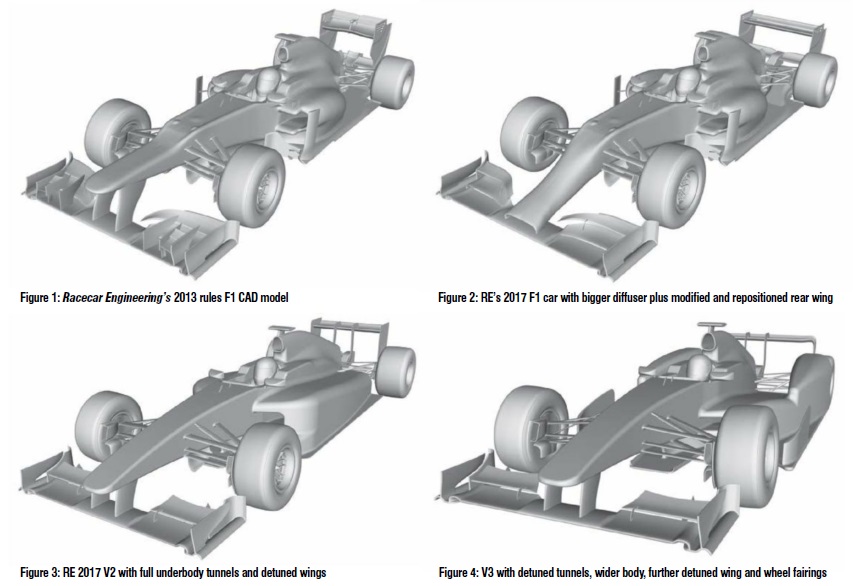
The car they named RE 2017 V1, which has skirts, a larger diffuser, and a modified and repositioned rear wing that produced less upwash and which aimed to produce more downforce with the underbody and also to improve the airflow on to a following car, produced the best results with comparable total downforce and balance to the 2013 car but generated less drag and a higher efficiency. The following car lost less downforce than the 2013 car at all separations, and there was negligible balance change at any separation tested.
So I hope they'll do a similar prototype but based on a modified 2017 car.
Their 2017 study:
Re: 2017 F1 Aerodynamic Changes
Posted: 03 Apr 2017, 14:09
by djos
I used to watch CARRY on the 90's before it self destructed and those cars generated a lot of downforce using tunnels plus the diffuser and as a result the racing was quite good iirc.
Re: 2017 F1 Aerodynamic Changes
Posted: 03 Apr 2017, 18:47
by pipoloko
hey
what is the math for down force of
a car at 350 km/h
cl 4.6
A 1 m2
thanks
Re: 2017 F1 Aerodynamic Changes
Posted: 03 Apr 2017, 19:25
by 3jawchuck
pipoloko wrote: ↑03 Apr 2017, 18:47
hey
what is the math for down force of
a car at 350 km/h
cl 4.6
A 1 m2
thanks
http://bfy.tw/B0yy
Re: 2017 F1 Aerodynamic Changes
Posted: 03 Apr 2017, 21:52
by SR71
zac510 wrote: ↑03 Apr 2017, 06:13
Nice article be Scarbs, thanks for linking us.
I wonder if there's not a massive goal to be kicked by a mid-field team by d
esigning your car for minimum sensitivity in turbulence. I completely understand it's not simple to do that but the recurring theme in these kinds of articles is that the car is designed for clean air. There are all sorts of reasons why a team might not take this route, too, fear of failure one of them especially.
Obviously if you're expecting to qualify high up and run high up in the race you would prefer the clean air aerodynamic performance.
I think this might be RBs objective.
Re: 2017 F1 Aerodynamic Changes
Posted: 04 Apr 2017, 21:43
by SectorOne
zac510 wrote: ↑03 Apr 2017, 06:13
I wonder if there's not a massive goal to be kicked by a mid-field team by designing your car for minimum sensitivity in turbulence.
By doing that you will most likely take away performance potential in clean air which means you start even further back the grid.
And everytime you're in clean air you're running a less then optimal aero package.
Re: 2017 F1 Aerodynamic Changes
Posted: 05 Apr 2017, 10:04
by zac510
SectorOne wrote: ↑04 Apr 2017, 21:43
zac510 wrote: ↑03 Apr 2017, 06:13
I wonder if there's not a massive goal to be kicked by a mid-field team by designing your car for minimum sensitivity in turbulence.
By doing that you will most likely take away performance potential in clean air which means you start even further back the grid.
And everytime you're in clean air you're running a less then optimal aero package.
Yes I acknowledged that compromise in my original post, but if you're STR or FI, forever mid-pack team with only a chance of a podium at best once or twice a year, you're not often in clean air. Being able to pass cars might a massive asset. Not so much an asset for Mercedes!
Re: 2017 F1 Aerodynamic Changes
Posted: 05 Apr 2017, 18:46
by RicME85
You tend to be in clear air during qualifying though. Would have to employ tactics to get the best out of your car, like following other cars, essentially the opposite of what you want on a Saturday
Re: 2017 F1 Aerodynamic Changes
Posted: 06 Apr 2017, 00:49
by GM7
Why not doing something like this ?
 Explanation :
It's basically a 2017 car with a bigger diffuser, but some of the front wing parts are standardized (Parts in red), the goal of these parts is to reduce drag and turbulences.

Re: 2017 F1 Aerodynamic Changes
Posted: 06 Apr 2017, 01:04
by djos
Probably because that would be aerodynamically inefficient and rather ugly.
Re: 2017 F1 Aerodynamic Changes
Posted: 06 Apr 2017, 01:44
by RicME85
Front wing taken from a Formula E car, where its use is form over function.