Hi Chris,
thank you for the update.
cdsavage wrote:Sorry about the lack of input from us. Julien has had to wipe his PC and he won't be ready for round 2 for a bit longer - we'll need to postpone round 2 by at least a week, probably a bit more. I'll announce the new date as soon as possible.
I would have a problem in case Race 2 will be post-poned, beacuse I am leaving for at least a month and I can't do any simulation after next Thursday (the official/original submission date). Indipendentley from the new date for Race two,
I would need to know as soon as possibile the new cooling rules, or I will have to submit the car completely guessing the cooling aerodynamics. Considering that there is a proposal to partially not consider the results of race 1, it would be a significative impairement.
cdsavage wrote:For round 1, if we were going to award full points, we would need to find a fix, and then re-simulate every entry. I don't think this is likely to happen in any reasonable amount of time, so we're probably going to need to stick with the numbers we already have. The only decision is how to award points, I would lean towards awarding no more than 50% points, but if there's a clear majority opinion on what we should do, I have no problem following that.
I think that there is no need to re-compute the cars or to invalidate Race 1 ot to reduce points.
The cooling issue (=not physical behaviour of the inlet, caused by the bc) affects only the cars that have not enough pressure on the inlets, they could not use full power anyway. Re-computing the simulations with different bc would be the same as changiging the rule retrospectively. Please consider that
the first 4 o 5 cars had acceptable cooling results because their teams simulated and checked it with OCCFD or equivalent OpenFOAM environements. In my case: I excluded a promising design (even superior to Mantium "monster" results about downforce), just because it showed the odd cooling issue.
The situation for teams that have geometry issue is different and not related to the proposed "solution".
cdsavage wrote:The porous option is unlikely to be ready for round 2. Getting rid of the boundary conditions, while still measuring the pressure integrals, is a good possibility for the upcoming rounds if we can verify that it improves things. I'd also like to make a change to the submission process to make the inlet/outlet geometry less of an issue - this would probably involve asking for body.stl to be a single, solid body, and then producing the inlet and outlet surfaces a different way.
I completed a test to compare the two possibilities: "opt1" taken from the KVRC 2016 rules and "opt1b (?)" obtained suppressing the imposed flow bc. The results are encouraging:
1) The original car, has a pressure differential of 50 Pa*m2 without any issue (the average pressure is high enough to avoid local "suction" effect over the inlets)
2) The "opt1b" car cooling capabilities have been measured using the "force resultant" function in openFOAM: the same we can use to have separate results for the wings. I used a customized OpenFOAM configuration, but I think that it would be possible to obtain the measurement in OCCFD without changing anything of the code, just including all the cooling surfaces (inlets/outlets) into a file names as "*_wing_*" and looking into the "other wings" folder after the post processing.
3) The results of the "opt1b" car are comparable with the "opt1" car, considering that the absence of the imposed flow makes the pressure on the inlets higher (and lower on the outlets).
I obtained 60N (pa*m2) that is a very reasonable value compared to 50 pa*m2 obtained by "Opt1" car.
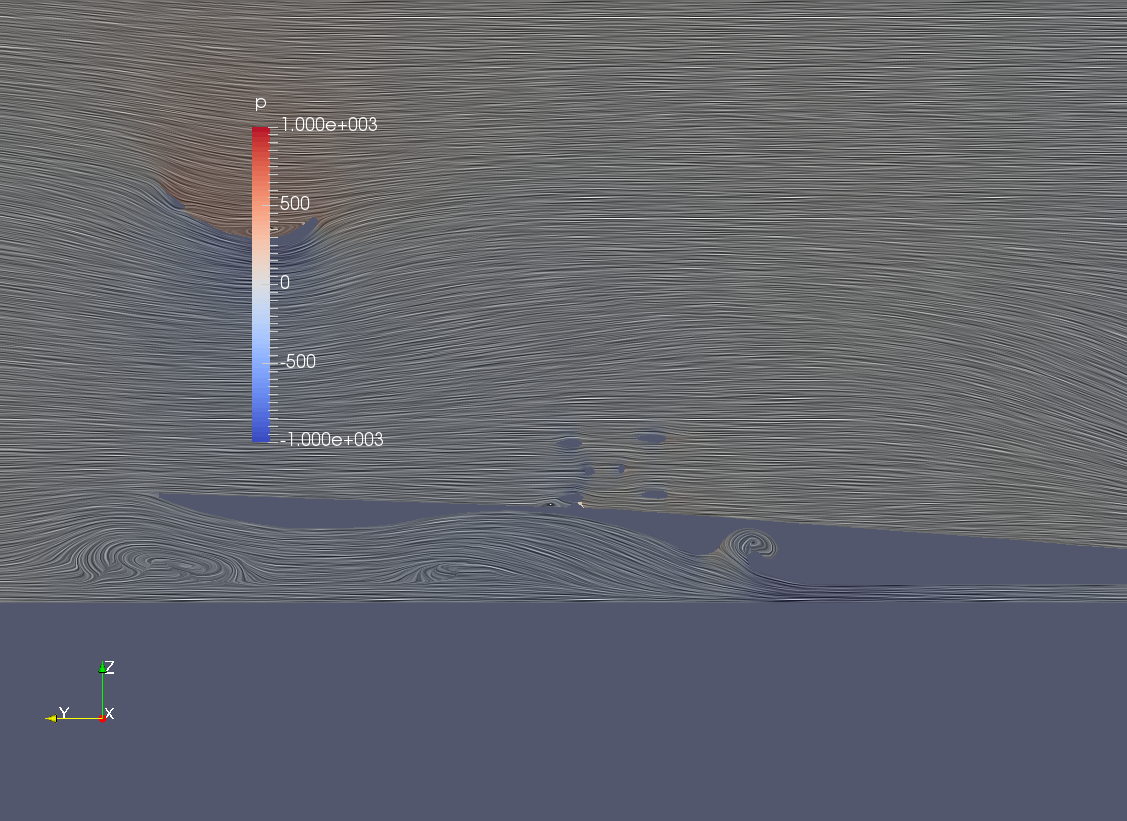
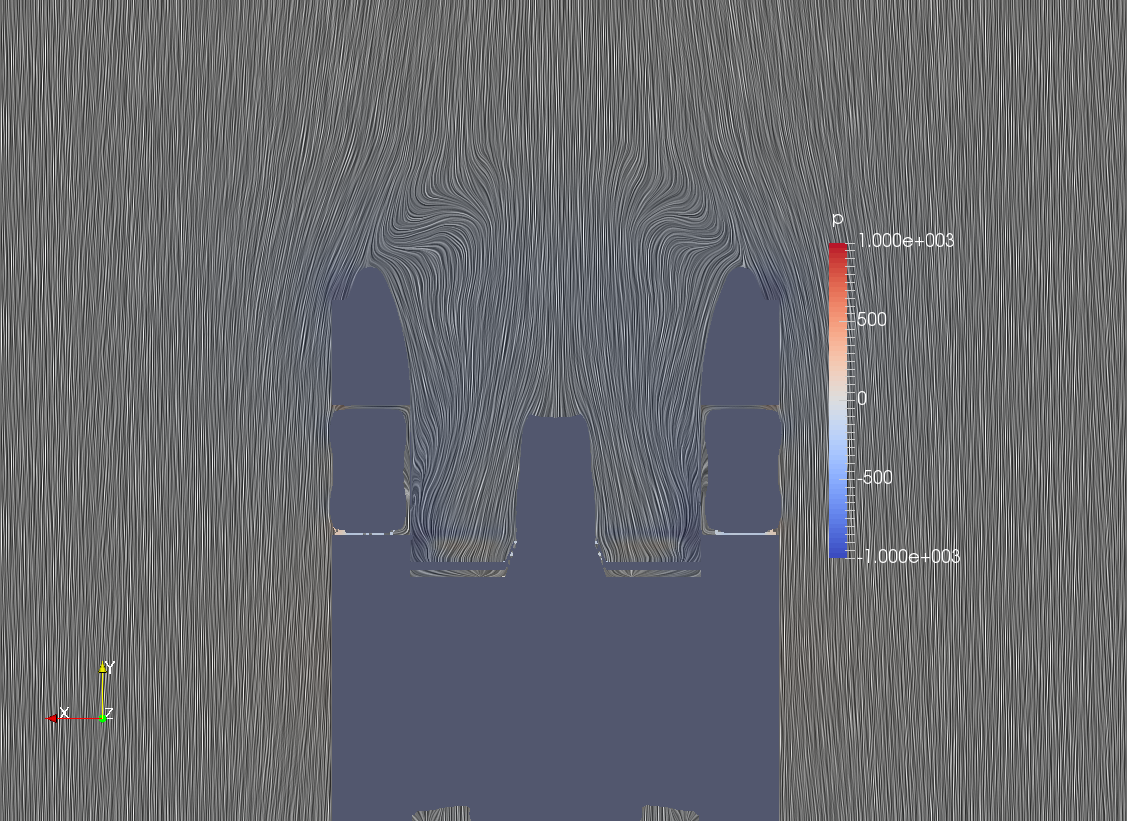
4) I run a test modeling a (partially occluding) wall in front of the inlets: the "opt1" car showed the "not physical behaviour" (negative pressure, convergence difficulties, not repeateble results, geometry and meshing sensitivity), "opt1b" car showed a reasonable behaviour (pressure near to zero, no strange effects).
5) The pressure (force) estimation is written into the log files even during the preliminary simulation and not only in the final html report (that often fails to be generated). That is good thing because the preliminary simulation (500 quick iterations) often gives significant information in a short time and with small hardware resources.
The two CAD model are available for the KVRC staff. I can't share them because it is the car that I would have submitted next Thursday.
PS: To avoid problems, I would apply the new simplified simulation model to the engine inlets/outlets too