Page 86 of 216
Re: Renault V6 Power Unit
Posted: 06 Feb 2017, 20:20
by Pierce89
hurril wrote:godlameroso wrote:It would lighten the burden on the energy store, allowing for longer deployment per lap. This system would not replace the gear driven MGU-K it would supplement it.
It's simple if your competition can only deploy for 35 seconds and you can deploy for 40 seconds that's an extra 5 seconds that you have 120kw more than the competition.
Not to mention more time spent at full throttle and shorter braking distances would put MGU-K harvesting at a premium. It would certainly be an advantage for the new regulations.
Anyway it's just an idea, the extra weight and space the system would occupy probably makes it impractical.
We are missing each other here. Where is this energy coming from? "Recovery" is not the answer to that. What energy is being recovered with your suggestion that cannot or is not recovered at this point?
The MGU-k is driven by the ICE. You are suggesting a system also driven by the ICE. Aren't you just adding suspenders to the belt to keep the pants up, so to say?
Godlameroso normally makes more sense than this. Is he suggesting that hydrostatic drive would be more efficient than a geared connection? I don't get it. Well, he said in addition to, so... How would that work when the thing is geared to the crank anyway? I'm confused... Or at least I think I am
Re: Renault V6 Power Unit
Posted: 06 Feb 2017, 20:37
by godlameroso
You have an accumulator act as a reservoir to store hydraulic pressure, much like the fuel pump is driven by the engine to create 500bar pressure, you could charge an accumulator with hydraulic pressure from a gear driven by the transmission input shaft or crankshaft or like any other engine ancillary. You would store this hydraulic pressure independent of the ES and release it to directly drive the MGU-K when needed. This system would be completely separate from the ERS system.
According to the energy flow chart, the engine ancillaries can send power to and from the MGU-K
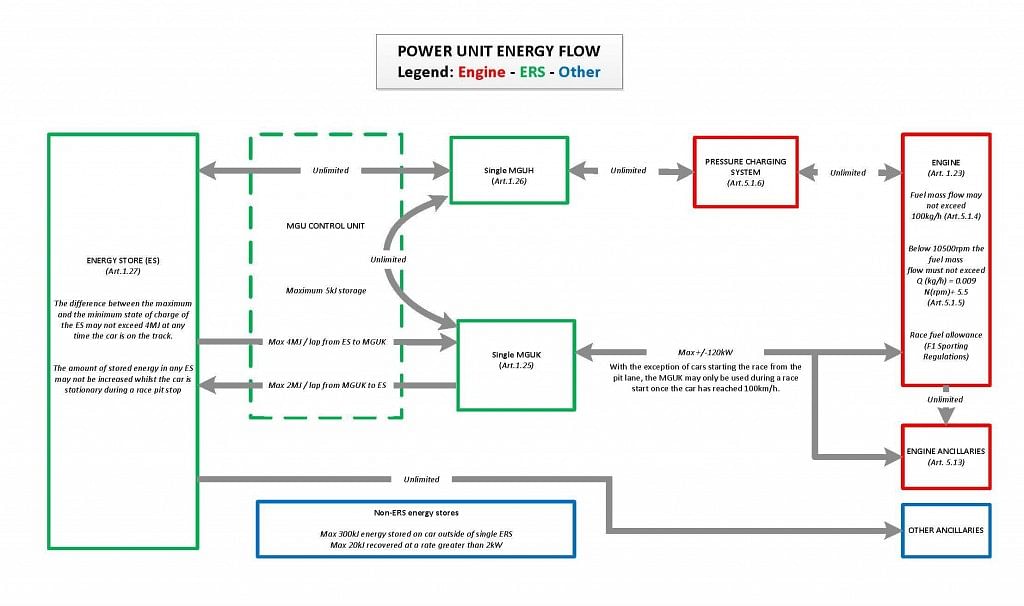
And any non ERS energy storage can recover up to 300kJ. Or about 2 seconds of extra deployment. Although those 300kJ don't specify if they have the same per lap requirement as the ES to MGU-K
Here are the regulations regarding 5.13
5.13 Engine ancillaries :
All coolant pumps, oil pumps, scavenge pumps, oil/air separators, hydraulic pumps and fuel pumps delivering more than 10bar must be mechanically driven directly from the engine and/or MGU-K with a fixed speed ratio.
Re: Renault V6 Power Unit
Posted: 06 Feb 2017, 21:59
by roon
I believe that extra store is meant to be inclusive of a traditional vehicle battery powering the low voltage ancillaries. 300kJ may be stored in it ahead of time. i.e. the initial charge of the battery in the pits. The diagram states that only 2kj may be recovered at a rate of 2kW i.e. the sort of charge rate you would expect from a traditional alternator. The potential motive power of this store seems limited.
Re: Renault V6 Power Unit
Posted: 06 Feb 2017, 22:26
by godlameroso
roon wrote:I believe that extra store is meant to be inclusive of a traditional vehicle battery powering the low voltage ancillaries. 300kJ may be stored in it ahead of time. i.e. the initial charge of the battery in the pits. The diagram states that only 2kj may be recovered at a rate of 2kW i.e. the sort of charge rate you would expect from a traditional alternator. The potential motive power of this store seems limited.
It states that up to 20kJ can be recovered at a rate greater than 2kW, say with 150kW from the braking energy of the front brakes, after 20kJ the recovery rate is 2kW max allowed up to 300kJ, so yes you're right, it would be allowed but horribly impractical. But don't be fooled about hydrostatic motors, they're wonderfully efficient and powerful. If you understand German, you should check out the MAN hydrodrive.
Re: Renault V6 Power Unit
Posted: 06 Feb 2017, 22:42
by roon
Yeah, typo, sorry. Dropped a zero. Still, the 2kW charge rate topping off a 20kJ reserve is pretty limiting. Once the 300kJ on the non-ERS store is depleted it can't be recharged beyond 20kJ, which leaves you carrying around a lot of dead weight. I don't disagree with your comments on hydrostatic drives.
Re: Renault V6 Power Unit
Posted: 06 Feb 2017, 23:14
by PlatinumZealot
Glad i am not the only onw that think so!
Re: Renault V6 Power Unit
Posted: 06 Feb 2017, 23:21
by hurril
godlameroso wrote:You have an accumulator act as a reservoir to store hydraulic pressure, much like the fuel pump is driven by the engine to create 500bar pressure, you could charge an accumulator with hydraulic pressure from a gear driven by the transmission input shaft or crankshaft or like any other engine ancillary. You would store this hydraulic pressure independent of the ES and release it to directly drive the MGU-K when needed. This system would be completely separate from the ERS system.
According to the energy flow chart, the engine ancillaries can send power to and from the MGU-K
http://static.sportskeeda.com/wp-conten ... 24x606.jpg
And any non ERS energy storage can recover up to 300kJ. Or about 2 seconds of extra deployment. Although those 300kJ don't specify if they have the same per lap requirement as the ES to MGU-K
Here are the regulations regarding 5.13
5.13 Engine ancillaries :
All coolant pumps, oil pumps, scavenge pumps, oil/air separators, hydraulic pumps and fuel pumps delivering more than 10bar must be mechanically driven directly from the engine and/or MGU-K with a fixed speed ratio.
Ohh I understand completely now. Like an elastic and controlled coupling between engine and MGU-k of sorts.
Re: Renault V6 Power Unit
Posted: 06 Feb 2017, 23:26
by PlatinumZealot
Hydraulics are too inneficient and heavy. Almost used in cases where loads are extremely high and where speeds a slow or the driven components are remote.
The casings have to be heavy walled for high pressure too.
Interesting idea.. But i don't think it is a good appication for the high speeds involved. Too much speed reductions and such would be needed. You have to increase gearing ratio to go down to haudraulic friendly speeds (viscous losses and many moving parts). Then after that you have to have another gearset to go back to mguk speeds..
Not very elegant.
Re: Renault V6 Power Unit
Posted: 06 Feb 2017, 23:33
by roon
hurril wrote:godlameroso wrote:You have an accumulator act as a reservoir to store hydraulic pressure, much like the fuel pump is driven by the engine to create 500bar pressure, you could charge an accumulator with hydraulic pressure from a gear driven by the transmission input shaft or crankshaft or like any other engine ancillary. You would store this hydraulic pressure independent of the ES and release it to directly drive the MGU-K when needed. This system would be completely separate from the ERS system.
According to the energy flow chart, the engine ancillaries can send power to and from the MGU-K
http://static.sportskeeda.com/wp-conten ... 24x606.jpg
And any non ERS energy storage can recover up to 300kJ. Or about 2 seconds of extra deployment. Although those 300kJ don't specify if they have the same per lap requirement as the ES to MGU-K
Here are the regulations regarding 5.13
5.13 Engine ancillaries :
All coolant pumps, oil pumps, scavenge pumps, oil/air separators, hydraulic pumps and fuel pumps delivering more than 10bar must be mechanically driven directly from the engine and/or MGU-K with a fixed speed ratio.
Ohh I understand completely now. Like an elastic and controlled coupling between engine and MGU-k of sorts.
5.2.3 The MGU-K must be solely and permanently mechanically linked to the powertrain before the main clutch. This mechanical link must be of fixed speed ratio to the engine crankshaft.
Might influence this discussion.
Re: Renault V6 Power Unit
Posted: 07 Feb 2017, 00:29
by godlameroso
Not really, it doesn't say anything about a supplemental power source to the MGU-K. It only says that the MGU-K must be mechanically and permanently geared to the crankshaft. It doesn't specify where energy from the MGU-K must come from. If you look at the energy flow chart it outlines where the MGU-K can send power to, or sent power from. Again, it was only an idea, but as PZ has outlined hydraulics aren't light, or compact enough for an F1 environment. There are high speed hydraulic oil pumps, like the vane type.
Anyway so much for that idea.

Re: Renault V6 Power Unit
Posted: 07 Feb 2017, 01:33
by roon
Depends on the application and optimization. I don't think it's accurate to say that hydraulic transmissions are necessarily larger or heavier than other drive types. It certainly wouldn't be the main limit to your idea—that would be the 2.7 hp & 20kJ you have to play with, spent in one second at max discharge rate. The hydraulic stuff you posted is interesting though and hints at what's left within optimization. In an less regulated formula with big funding I think we'd see sophisticated, lightweight, efficient hydraulic drive systems. Their flexibility seems valuable to me. Sort of the mechanical equivalent to electric drive.
Re: Renault V6 Power Unit
Posted: 07 Feb 2017, 02:20
by godlameroso
roon wrote:Depends on the application and optimization. I don't think it's accurate to say that hydraulic transmissions are necessarily larger or heavier than other drive types. It certainly wouldn't be the main limit to your idea—that would be the 2.7 hp & 20kJ you have to play with, spent in one second at max discharge rate. The hydraulic stuff you posted is interesting though and hints at what's left within optimization. In an less regulated formula with big funding I think we'd see sophisticated, lightweight, efficient hydraulic drive systems. Their flexibility seems valuable to me. Sort of the mechanical equivalent to electric drive.
That little blue box is very confusing to people.
I think it means that max external ES is 300kJ and that you can charge up to 20kJ of the 300 at whatever rate you want, but for the last 280kJ the rate is capped at 2kW. At least that's what I got from it.
Re: Renault V6 Power Unit
Posted: 07 Feb 2017, 05:40
by roon
Gotcha. So the discharge rate isn't regulated but the charge rate is at 2kW. Every 2.3 minutes you'd have 280kJ (78 W-h) to discharge into an ancillary device of some sort.
However:
5.2.1 The use of any device, other than the engine described in 5.1 above, and one MGU-K, to propel the car, is not permitted.
Perhaps there's another opportunity to use that 300kJ for benefit elsewhere. Powered aero or suspension devices are a no-go. Maybe a coolant or oil pump which can be powered by reversing flow through it. Is this what you were getting at before?
Might even forget about the 300kJ ancillary-ES and build it into the oil circuit or coolant circuit for greater capacity. For example: a coolant pump that only pumps during braking. Give it two or more stages. One for pumping to charge up reservoir pressure, another acting as a motor to expend the charge. Both modes could involve moving fluid through the engine block, thus could be defended as primarily a low-parasitic loss coolant pump.

Re: Renault V6 Power Unit
Posted: 07 Feb 2017, 07:38
by Nickel
roon wrote:Gotcha. So the discharge rate isn't regulated but the charge rate is at 2kW. Every 2.3 minutes you'd have 280kJ (78 W-h) to discharge into an ancillary device of some sort.
However:
5.2.1 The use of any device, other than the engine described in 5.1 above, and one MGU-K, to propel the car, is not permitted.
Perhaps there's another opportunity to use that 300kJ for benefit elsewhere. Powered aero or suspension devices are a no-go. Maybe a coolant or oil pump which can be powered by reversing flow through it. Is this what you were getting at before?
Might even forget about the 300kJ ancillary-ES and build it into the oil circuit or coolant circuit for greater capacity. For example: a coolant pump that only pumps during braking. Give it two or more stages. One for pumping to charge up reservoir pressure, another acting as a motor to expend the charge. Both modes could involve moving fluid through the engine block, thus could be defended as primarily a low-parasitic loss coolant pump.
IMO 5.2.1 does not preclude powering the mgu-k from any source you want. It just states the ICE and MGU-K are the only things that can directly drive the rear wheels. There may be some other rule that precludes it, but so long as the power goes through the MU-K, it should pass this particular rule.
Re: Renault V6 Power Unit
Posted: 07 Feb 2017, 08:23
by FW17
Rather than a hydraulic system they could use a open pneumatic system connected to the front wheels to store energy in a pressure vessel during braking. Then the same air can be let out into the exhaust to blow the turbine there by
1)reducing backpressure and increasing power
2)increasing generation from MGUH
(But I think there are regulations about feeding air into the exhaust and intake system)