Page 871 of 1336
Re: Honda Power Unit
Posted: 17 Feb 2018, 01:49
by roon
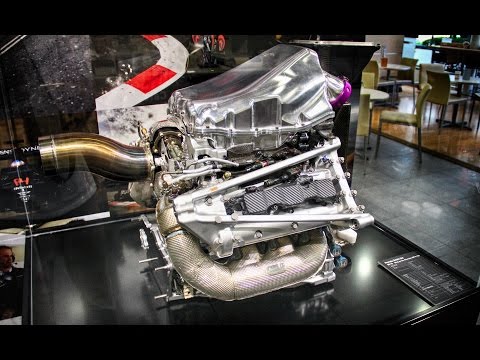
Wastegate is the bulb on top of the turbine. Horizontal actuator to the right of it.

Re: Honda Power Unit
Posted: 17 Feb 2018, 12:36
by HPD
Re: Honda Power Unit
Posted: 17 Feb 2018, 14:53
by PlatinumZealot
The last two photos are of the RA616H.
Re: Honda Power Unit
Posted: 17 Feb 2018, 19:00
by HPD
PlatinumZealot wrote: ↑17 Feb 2018, 14:53
The last two photos are of the RA616H.
Solved. Thanks @Platinum
Re: Honda Power Unit
Posted: 19 Feb 2018, 04:14
by godlameroso
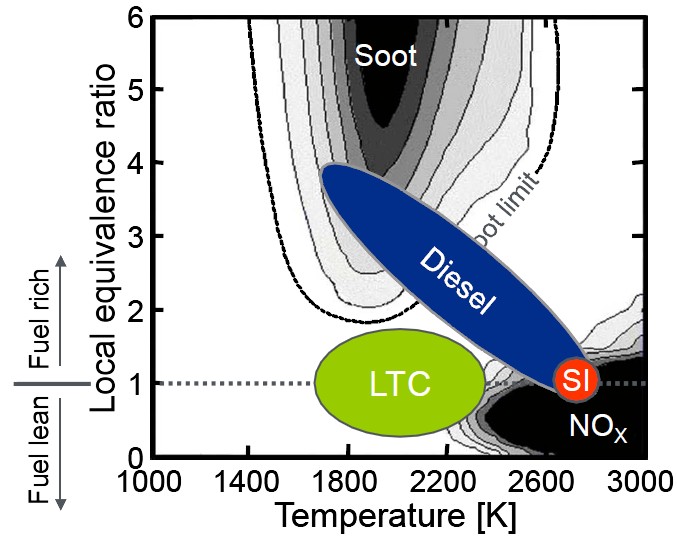
Wazari mentioned high NOx, if so then likely they're operating ~16-17:1 AFR as typically higher than this, NOx tends to taper off.
Re: Honda Power Unit
Posted: 19 Feb 2018, 14:24
by dren
Re: Honda Power Unit
Posted: 20 Feb 2018, 01:09
by godlameroso
Somewhere in between SI and NOx but a little to the left, is my best guess. They're inching their way to the lower left of the graph from their position.
Re: Honda Power Unit
Posted: 20 Feb 2018, 02:15
by PlatinumZealot
There probably at 0.75 equivalence. Smack dab in the NOx.
Re: Honda Power Unit
Posted: 20 Feb 2018, 06:42
by gruntguru
That chart is a little misleading because it shows "local" equivalence ratio which only goes above 1 in a Diesel because the fuel spray has insufficient air around it until it progresses further into the chamber and fans out. Turbulence and swirl also help by bringing the air to the fuel.
In the SI case, you have to remember that flame temperature is highest at ER=1 and drops significantly as you move away and NOx reduces - particularly as you go below 0.8 which these engine most certainly do.
On the other hand, the very high effective compression ratio (everybody is guessing on this one but possibly as high as 4.0 x 18 = 72:1) would increase the charge temp significantly (by about 900*C). Even with very effective intercooling you still have up to 18:1 compression heating the charge (by about 500*C).
Re: Honda Power Unit
Posted: 20 Feb 2018, 11:06
by Tommy Cookers
this seems like a good time to ask .......
wouldn't the real compression normally be 'only' 4 x (c.60% of 18) ? as of course in-cylinder compression starts at valve closure
(leading to lower temperature and pressure than the 2000 deg C and 220 bar suggested by gg on P 864 ?)
the free supercharging thus (from 'tuned' inlet & exhaust systems and valve timing) available is very helpful to H recovery
but valve closure could be earlier than race-normal or later than race-normal - which of the 3 possibilities is it ??
of course the relationship between AFR and required induction air pressure eg 4 bar will also depend on this
Re: Honda Power Unit
Posted: 20 Feb 2018, 13:00
by stevesingo
I suppose it will depend on,
1, Exhaust Back pressure. The combined load of the compressor and MGU-H may generate significant back pressure.
2, Intake charge inertia. When you consider that an NA engine can make VE >100%, there is no reason why these turbo engines can't.
Re: Honda Power Unit
Posted: 20 Feb 2018, 13:24
by dren
Is there benefit in closing the intake valves at different times between the two for some sort of swirl effect, or would it be better to keep them in unison for max cylinder fill?
How much overlap is needed with the exhaust valves? TC, the Honda unit is trying to use e-boost as much as possible, so the overlap may not be needed and would be wasted if that's the main goal, but to the detriment of H recovery?
Re: Honda Power Unit
Posted: 20 Feb 2018, 14:46
by godlameroso
Overlap is tiny like the intake valve opens just as the EV is almost fully closed, if at all. And yes staggered valve opening can promote swirl, however tumble and swirl are effective at different modes of operation, for high rpm high load you want tumble/squish, for lower loads and lower engine speed swirl is preferred. I wouldn't be surprised if these engines try to take advantage of both, and the transition from swirl to tumble is critical. Perhaps that's why Honda is looking at having "innovative" intake ports, to give them more control over swirl vs tumble.
Re: Honda Power Unit
Posted: 20 Feb 2018, 16:05
by godlameroso
stevesingo wrote: ↑20 Feb 2018, 13:00
I suppose it will depend on,
1, Exhaust Back pressure. The combined load of the compressor and MGU-H may generate significant back pressure.
2, Intake charge inertia. When you consider that an NA engine can make VE >100%, there is no reason why these turbo engines can't.
Both of these things can be controlled, the wastegates to relieve back pressure, or the MGU-H acting as a choke, there's also the pop off valve on the intake, sometimes it may be beneficial to bleed off a small amount of boost to maintain ideal fuel mixture, for example during small moments of boost creep.
The fact they need hydraulic wastegates means they use very fine control to manage the interplay between the MGU-H and wastegates.
Re: Honda Power Unit
Posted: 20 Feb 2018, 23:49
by PlatinumZealot
It is probably safer to control swirl by making one intake valve slightly smaller, because I am thinking that making one intake valve open slightly quicker than the other one can lead to problems on the exhaust stroke? Not to mention torsional vibrations on the camshaft. What do you think?
I think there was an VW engine that adjusted valve lift on one of the intake valves only, but I can't quite remember if both valves still closed at the same time despite that.