Page 91 of 1331
Re: Honda Power Unit
Posted: 04 Sep 2015, 17:57
by PeterSW
Maybe we can conclude something along these lines:

I'm not sure they give much indication of where the compressor is.
Re: Honda Power Unit
Posted: 04 Sep 2015, 19:23
by dren
Those pictures really do not show anything new. And yes, those are the charge pipes to and from the intercooler.
Re: Honda Power Unit
Posted: 05 Sep 2015, 08:26
by gruntguru
Tommy Cookers wrote:gruntguru wrote: .....Higher boost pressure does not have a turbine recovery cost. If the exhaust back pressure is increased by the same amount, the turbine power will increase by roughly the same as the compressor power ie no change in recovery. This is for compressor and turbine efficiencies of 80%. At higher efficiencies the recovery will improve with an increase in boost and BP. This also assumes intercooling to ambient. At higher CAT the turbine recovery will improve. Thermal loading of the combustion chamber will not increase due to the additional surplus air offsetting the higher CAT.
in your examples the compressor work doubles going from 2.5 to 3.3 PR
so, for a given CAT, the charge cooling requirement (heatflow) doubles
yes, the gas temperature during the compression stroke will rise equally for both PRs
yes, during combustion the temperature will rise less with the higher PR
so a somewhat higher CAT seems possible with the higher PR
but surely the charge cooling requirement remains much greater ?
of course, because of the small temperature differences, the charge cooler is relatively much bulkier than other coolers
I think the compressor work doubles going from 2.5 to 3.5. Not sure if that is your typo or a mistake in my earlier calculations.
Yes the charge cooling requirement doubles (for charge cooling to ambient) however the compressor discharge temperature has increased from 109 above ambient to 158 so the same size cooler will reject about 45% more heat.
In addition the combustion temperature reduces by 700*C (for a given CAT.)
Even if we increase CAT by 50*C the compression temperature will only increase by about 100*C (for a 10:1 CR) so combustion temp would still be 600*C lower at 3.5 bar MAP.
Re: Honda Power Unit
Posted: 05 Sep 2015, 12:46
by Tommy Cookers
gruntguru wrote: ....... Even if we increase CAT by 50*C the compression temperature will only increase by about 100*C (for a 10:1 CR) so combustion temp would still be 600*C lower at 3.5 bar MAP.
compression temperature is somewhat indicative of the liklihood of (self-ignition) problems during combustion ?
combustion temperature is also, but yours are conceptual/'theoretical' values that would not obtain here due to piston movement ??
or does the reduction in (conceptual) combustion temperature mean most in respect of reduced heat loss ?
btw
these days there's frequent mention of combustion efficiency, but vagueness on the what and the how-it-will-work in this F1 context
Re: Honda Power Unit
Posted: 06 Sep 2015, 07:41
by gruntguru
Tommy Cookers wrote:gruntguru wrote: ....... Even if we increase CAT by 50*C the compression temperature will only increase by about 100*C (for a 10:1 CR) so combustion temp would still be 600*C lower at 3.5 bar MAP.
1. compression temperature is somewhat indicative of the liklihood of (self-ignition) problems during combustion ?
2. combustion temperature is also, but yours are conceptual/'theoretical' values that would not obtain here due to piston movement ??
3. or does the reduction in (conceptual) combustion temperature mean most in respect of reduced heat loss ?
1. Temperature and AFR of the end-gas are the principle determinants of detonation. We are talking some time into the combustion process and 100*C increase in the initial temp (of the end-gas) would likely be more than offset by the 600*C reduction in final gas temperature. In particular, stratification will produce an end-gas which is significantly leaner and therefore significantly reduce the temperature of the approaching flame front. Finally, the auto-ignition temperature of the end-gas reduces significantly with increasing lambda.
2. Yes. Some large simplifications in my calculations:
- combustion occurs entirely at TDC
- the entire combustion energy is used to heat the air (no heat loss, fuel mass neglected)
Temperature rise due to combustion was about:
- 2400*C at 0.5 kg/s intake airflow (18:1 AFR)
- 1700*C at 0.7 kg/s intake airflow (25:1 AFR)
I accept these numbers might be slightly lean but they do illustrate the point.
3. I believe reduced heat loss is very significant (to piston work and turbine work) but completeness of combustion and detonation resistance are perhaps equally important.
Re: Honda Power Unit
Posted: 07 Sep 2015, 11:24
by Jikumo
Re: Honda Power Unit
Posted: 07 Sep 2015, 13:28
by GoranF1
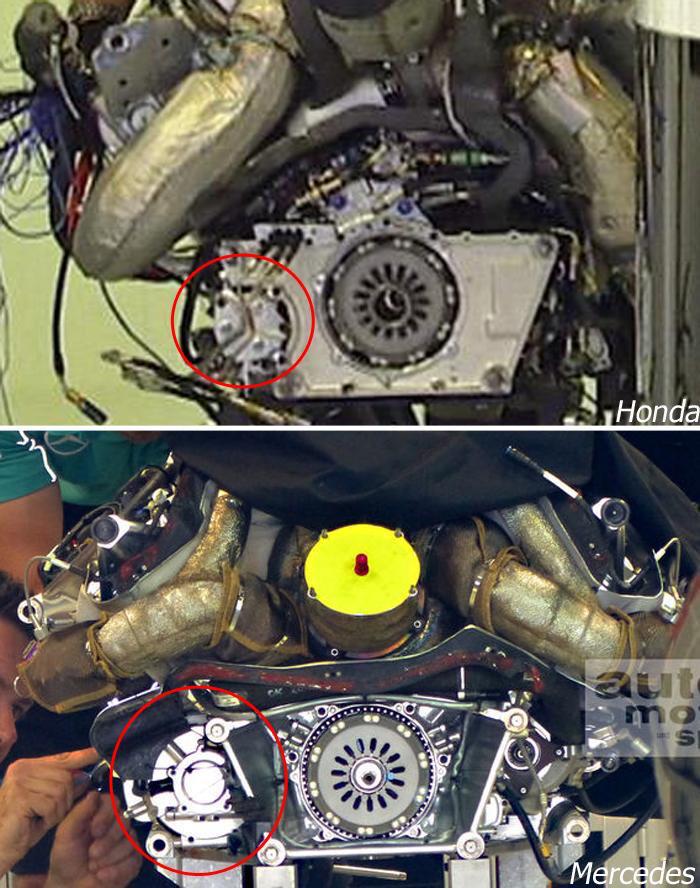
Honda MGU-K alot almost double smaller size from Mercedes
Re: Honda Power Unit
Posted: 08 Sep 2015, 01:39
by PlatinumZealot
Wow.. nice work.
It is so much smaller. No matter why it has cooing problems.
Look at how much higher honda's turbo is too.
Re: Honda Power Unit
Posted: 08 Sep 2015, 01:46
by PlatinumZealot
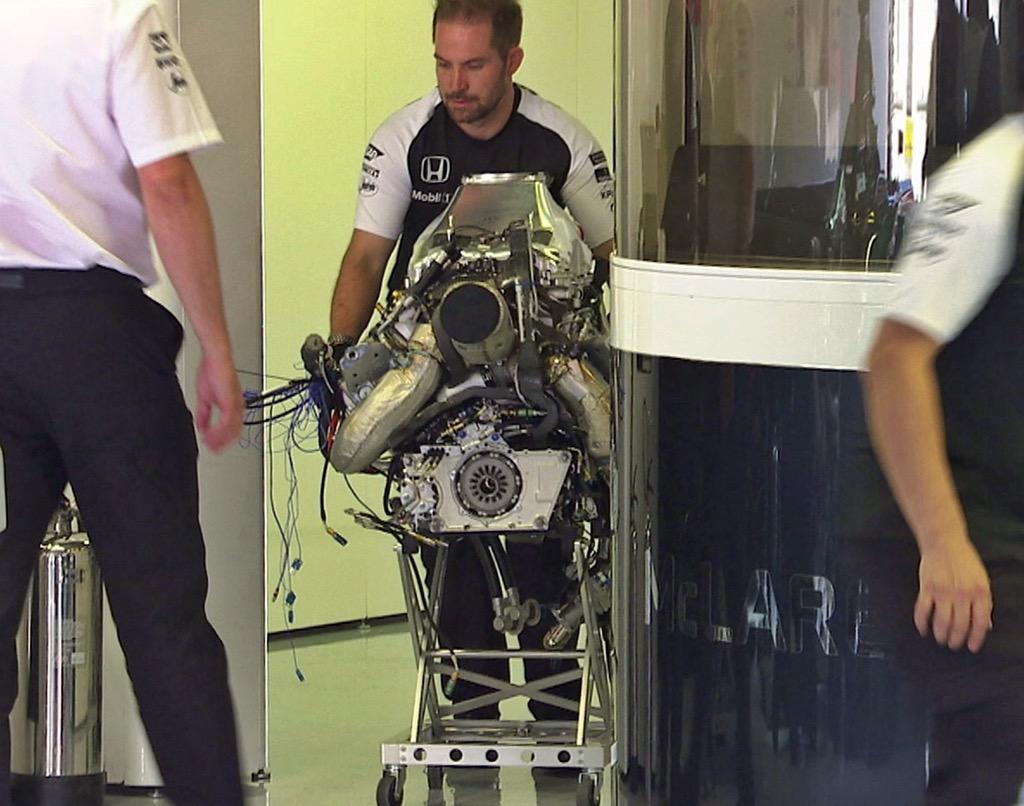
The split turbo is so high it makes me wonder if it was only positioned that high during the later stages of the design. The Mercedes turbo is so neatly nestled between the banks. Mercedes must have had the turbo tunnel put very close to the cylinders with the necessary strengthening to to allow such a close fitment. When you look at the honda engine, they didn't take the risk of putting the turbo tunnel down into the block.
Re: Honda Power Unit
Posted: 08 Sep 2015, 02:49
by wuzak
PlatinumZealot wrote:The split turbo is so high it makes me wonder if it was only positioned that high during the later stages of the design. The Mercedes turbo is so neatly nestled between the banks. Mercedes must have had the turbo tunnel put very close to the cylinders with the necessary strengthening to to allow such a close fitment. When you look at the honda engine, they didn't take the risk of putting the turbo tunnel down into the block.
https://pbs.twimg.com/media/COEH5uMWEAEDLta.jpg:large
It may be that the Honda has the compressor in the vee, whereas Mercedes have theirs at the front of the engine.
Ferrari and Renault both have their compressor and turbine behind the engine.
Re: Honda Power Unit
Posted: 08 Sep 2015, 06:56
by riff_raff
Location of the turbine is likely more of a concern than location of the compressor.
Re: Honda Power Unit
Posted: 08 Sep 2015, 07:40
by wuzak
riff_raff wrote:Location of the turbine is likely more of a concern than location of the compressor.
My point being that the location of the compressor (in the vee) dictates the location of the turbine - ie higher than desirable.
Re: Honda Power Unit
Posted: 08 Sep 2015, 09:24
by Abarth
wuzak wrote:riff_raff wrote:Location of the turbine is likely more of a concern than location of the compressor.
My point being that the location of the compressor (in the vee) dictates the location of the turbine - ie higher than desirable.
Since
5.4.2 The centre of gravity of the power unit may not lie less than 200mm above the reference plane.
we can safely assume that this is not too much of a concern.
Re: Honda Power Unit
Posted: 08 Sep 2015, 10:41
by knabbel
Abarth wrote:wuzak wrote:riff_raff wrote:Location of the turbine is likely more of a concern than location of the compressor.
My point being that the location of the compressor (in the vee) dictates the location of the turbine - ie higher than desirable.
Since
5.4.2 The centre of gravity of the power unit may not lie less than 200mm above the reference plane.
we can safely assume that this is not too much of a concern.
There is one issue with the split turbo design that's used by Mercedes. Because of the bigger distance between the compressor and turbine, the shaft need to be stiffer and heavier so it will increase the inertia and turbo lag, Although this will probably be counter balanced with the aid of the electric motor on the shaft.
The split turbo design with the compressor in front of the engine was on the table by other engine manufacturers too but a they discarded it because of the extra strain on the shaft.
Re: Honda Power Unit
Posted: 08 Sep 2015, 13:07
by Blackout
A small drawback that is largely 'offset' by the other advabtages of the split turbo design...
but a they discarded it because of the extra strain on the shaft.
or they discarded it because they didnt have anough ressources to make a shaft that can handle the extra straint... like Renault...
