Page 917 of 1332
Re: Honda Power Unit
Posted: 17 Apr 2018, 18:19
by godlameroso
MrPotatoHead wrote: ↑17 Apr 2018, 13:27
Easy. Simply continue the fantasy engine thread that this has become lately.
Do you know if the pre-chambers are the barrel type? Or are they more like those natural gas spark plugs? Or more like a spark plug non-fouler type, big inlet and smaller holes. Do the piston domes channel fuel into the pre-chamber, or do the fuel injectors try to aim some in the prechamber vicinity. Maybe the exhaust side placement of the injectors plays into this as the intake charge would be meeting the fuel spray, depending on the tumble/swirl characteristics of the intake ports.
Are F1 injectors allowed to have different spray patterns or is it fixed?
Re: Honda Power Unit
Posted: 17 Apr 2018, 19:20
by MrPotatoHead
godlameroso wrote: ↑17 Apr 2018, 18:19
MrPotatoHead wrote: ↑17 Apr 2018, 13:27
Easy. Simply continue the fantasy engine thread that this has become lately.
Do you know if the pre-chambers are the barrel type? Or are they more like those natural gas spark plugs? Or more like a spark plug non-fouler type, big inlet and smaller holes. Do the piston domes channel fuel into the pre-chamber, or do the fuel injectors try to aim some in the prechamber vicinity. Maybe the exhaust side placement of the injectors plays into this as the intake charge would be meeting the fuel spray, depending on the tumble/swirl characteristics of the intake ports.
Are F1 injectors allowed to have different spray patterns or is it fixed?
I should be careful what on say on the subject. But I will say this, all of the parts you mentioned have to work together to get the pre chamber to work correctly.
Simply adding one of the 70s spark plug anti fouling devices on a plug does not "TJI" make.
As far as injectors go the rules are fairly open - I don't know of any rules on the spray pattern.
Must be a single Direct Injector, Fuel pressure must not exceed 500 bar, Internal volume of any part must not exceed 10% (important rule added recently) and fuel parts must be pre approved.
Re: Honda Power Unit
Posted: 17 Apr 2018, 19:51
by godlameroso
MrPotatoHead wrote: ↑17 Apr 2018, 19:20
godlameroso wrote: ↑17 Apr 2018, 18:19
MrPotatoHead wrote: ↑17 Apr 2018, 13:27
Easy. Simply continue the fantasy engine thread that this has become lately.
Do you know if the pre-chambers are the barrel type? Or are they more like those natural gas spark plugs? Or more like a spark plug non-fouler type, big inlet and smaller holes. Do the piston domes channel fuel into the pre-chamber, or do the fuel injectors try to aim some in the prechamber vicinity. Maybe the exhaust side placement of the injectors plays into this as the intake charge would be meeting the fuel spray, depending on the tumble/swirl characteristics of the intake ports.
Are F1 injectors allowed to have different spray patterns or is it fixed?
I should be careful what on say on the subject. But I will say this, all of the parts you mentioned have to work together to get the pre chamber to work correctly.
Simply adding one of the 70s spark plug anti fouling devices on a plug does not "TJI" make.
As far as injectors go the rules are fairly open - I don't know of any rules on the spray pattern.
Must be a single Direct Injector, Fuel pressure must not exceed 500 bar, Internal volume of any part must not exceed 10% (important rule added recently) and fuel parts must be pre approved.
So multiple stages(with inserts that house pre-chambers), spray nozzles etc are all allowed as long as it's on just one injector?
For the amount of energy and research involved in developing it, would it be worth it for car manufacturers to stick it in their road cars so some schmo can go an extra day or two without filling up their tank?
Would this tech be worth it on small displacement forced induction engines in a road car? Can you get it to work without an MGU-H?
Re: Honda Power Unit
Posted: 17 Apr 2018, 20:59
by MrPotatoHead
godlameroso wrote: ↑17 Apr 2018, 19:51
So multiple stages(with inserts that house pre-chambers), spray nozzles etc are all allowed as long as it's on just one injector?
For the amount of energy and research involved in developing it, would it be worth it for car manufacturers to stick it in their road cars so some schmo can go an extra day or two without filling up their tank?
Would this tech be worth it on small displacement forced induction engines in a road car? Can you get it to work without an MGU-H?
The rules don't break down what is legal as far as an Injector goes surprisingly.
But if I were to speculate my interpretation would be that the Injector could have directionality to the spray through different orifices but could only contain a single coil and a single feed.
As for road car use the Mahle papers and publishings on the matter make it clear that road cars would benefit from TJI. SAE paper 2012-01-0823 is a great read on the subject.
Re: Honda Power Unit
Posted: 17 Apr 2018, 21:58
by godlameroso
MrPotatoHead wrote: ↑17 Apr 2018, 20:59
godlameroso wrote: ↑17 Apr 2018, 19:51
So multiple stages(with inserts that house pre-chambers), spray nozzles etc are all allowed as long as it's on just one injector?
For the amount of energy and research involved in developing it, would it be worth it for car manufacturers to stick it in their road cars so some schmo can go an extra day or two without filling up their tank?
Would this tech be worth it on small displacement forced induction engines in a road car? Can you get it to work without an MGU-H?
The rules don't break down what is legal as far as an Injector goes surprisingly.
But if I were to speculate my interpretation would be that the Injector could have directionality to the spray through different orifices but could only contain a single coil and a single feed.
As for road car use the Mahle papers and publishings on the matter make it clear that road cars would benefit from TJI. SAE paper 2012-01-0823 is a great read on the subject.
I posted a thread containing a summary science article outlining all the different pre-chamber technologies that have sprouted up over the years. It makes some interesting insights, for one that forced induction is necessary to make the process work correctly. Ie allowing power while extending the lean limit.
Re: Honda Power Unit
Posted: 17 Apr 2018, 22:00
by MrPotatoHead
To be fair every engine should be forced induction anyway

Re: Honda Power Unit
Posted: 17 Apr 2018, 23:39
by Tommy Cookers
for road cars TJI etc appears sense as the usual (low) powers can be developed with leaner mixture and so less throttling loss
but TJI efficiency gain simply means further throttling is needed to keep power down to demand (aka driving the car)
and/or CVT or CVT-emulating automatic is needed to increase the load automatically to lessen the throttling
and/or more cylinder cutting is needed to lessen the throttling
ie TJI etc doesn't cancel the economy downside of the public's habit of buying a 200 hp engine to do a 20 hp job
we SI drivers drive by continuously varying the degradation of efficiency from using a thing called the accelerator pedal
TJI only makes sense in applications where the engine is sized correctly
(in gas fuelled power generation and marine use it's already here but no doubt will help sell 200 hp, 300 hp, and 400 hp cars)
and NOx catalysis won't work with fulltime lean running - and however little NOx you have 'they' will want it halved
Re: Honda Power Unit
Posted: 18 Apr 2018, 00:54
by trinidefender
Tommy Cookers wrote: ↑17 Apr 2018, 23:39
for road cars TJI etc appears sense as the usual (low) powers can be developed with leaner mixture and so less throttling loss
but TJI efficiency gain simply means further throttling is needed to keep power down to demand (aka driving the car)
and/or CVT or CVT-emulating automatic is needed to increase the load automatically to lessen the throttling
and/or more cylinder cutting is needed to lessen the throttling
ie TJI etc doesn't cancel the economy downside of the public's habit of buying a 200 hp engine to do a 20 hp job
we SI drivers drive by continuously varying the degradation of efficiency from using a thing called the accelerator pedal
TJI only makes sense in applications where the engine is sized correctly
(in gas fuelled power generation and marine use it's already here but no doubt will help sell 200 hp, 300 hp, and 400 hp cars)
and NOx catalysis won't work with fulltime lean running - and however little NOx you have 'they' will want it halved
Between cylinder cutting and using electronic boost control (variable nozzle turbine turbochargers would be a good fit), the torque output can be controlled for the most part with much less use of a throttle blade. This has the added advantage of reducing the pressure in the exhaust pre-turbine reducing the work required by the crankshaft to pump the exhaust gasses out of the cylinder.
AFAIR, the main problem with VNT turbochargers in petrol (gasoline for the yanks) engines is the high exhaust temperature. The high lambda numbers in a diesel (where VNT turbochargers have been commonplace for the last 15 years) and in a lean burn engine reduce the exhaust temperature much improving the viability of their use in this application.
All the same slightly off topic as far as F1 goes.
Re: Honda Power Unit
Posted: 19 Apr 2018, 13:26
by anthonyfa18
hey is it true the honda in is running repsol fuel in toro rosso str13 or is it running esso just like the big redbull team ???
Re: Honda Power Unit
Posted: 19 Apr 2018, 16:39
by Revs84
anthonyfa18 wrote: ↑19 Apr 2018, 13:26
hey is it true the honda in is running repsol fuel in toro rosso str13 or is it running esso just like the big redbull team ???
Late last year it was reported that Toro Rosso Honda would be switching to Exxon Mobil for 2018 as opposed to Castrol/BP as in 2017. It's not clear whether Honda actually did the switch.
I don't believe that they were running Repsol at any point since their return unless I'm mistaken.
Re: Honda Power Unit
Posted: 19 Apr 2018, 17:00
by anthonyfa18
will i found this on wikipedia
This was the first Formula One car since the Arrows A21 to run on Repsol fuel.
https://en.wikipedia.org/wiki/Scuderia_Toro_Rosso_STR13
Toro Rosso-Honda is poised to agree a partnership with oil company ExxonMobil in the 2018 Formula 1 season, Motorsport.com understands.
https://www.motorsport.com/f1/news/toro ... 18-982226/
Re: Honda Power Unit
Posted: 19 Apr 2018, 17:03
by godlameroso
Revs84 wrote: ↑19 Apr 2018, 16:39
anthonyfa18 wrote: ↑19 Apr 2018, 13:26
hey is it true the honda in is running repsol fuel in toro rosso str13 or is it running esso just like the big redbull team ???
Late last year it was reported that Toro Rosso Honda would be switching to Exxon Mobil for 2018 as opposed to Castrol/BP as in 2017. It's not clear whether Honda actually did the switch.
I don't believe that they were running Repsol at any point since their return unless I'm mistaken.
I saw Esso fuel containers being unloaded by Toro Rosso during testing, so I'd say they're using Esso/Mobil
Honda Power Unit
Posted: 19 Apr 2018, 23:47
by ScrewCaptain27
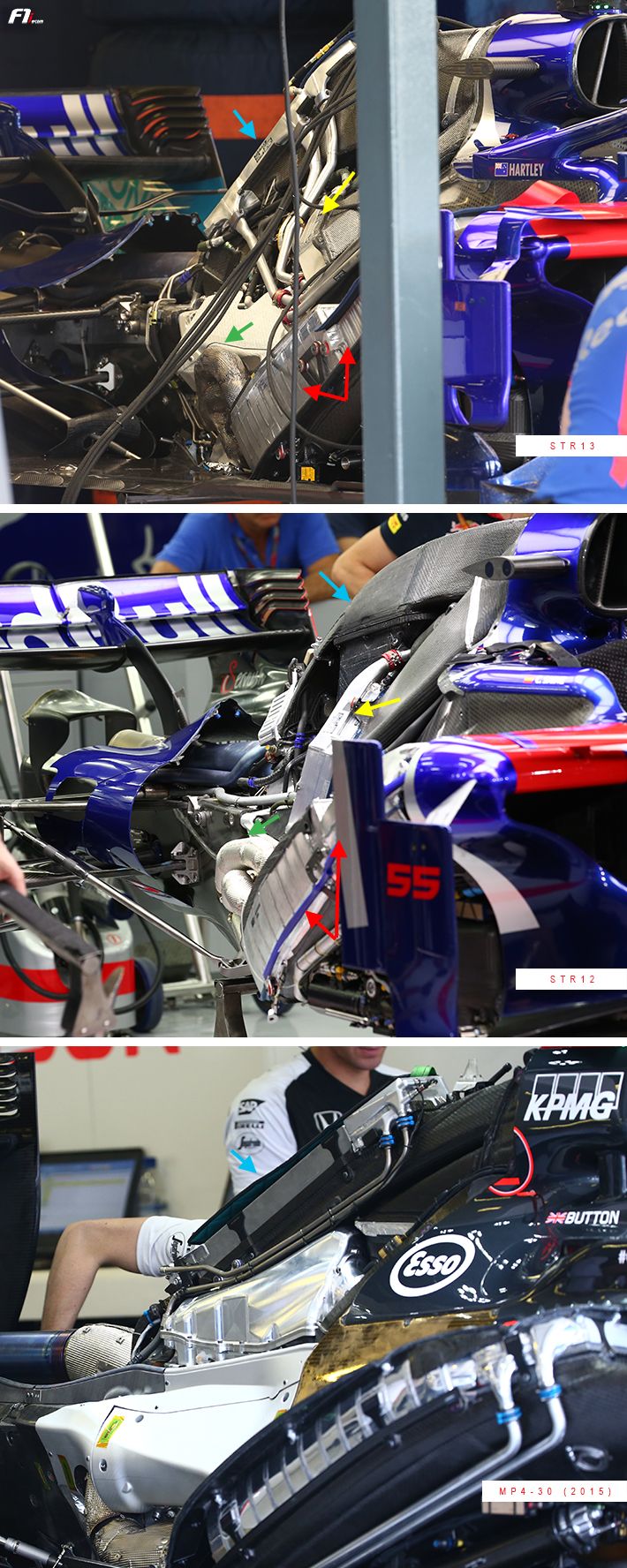
First look at the 2018 PU in the Toro Rosso:

Much closer in layout to the 2016 unit than last year it seems, the ERS radiators are back on top of the airbox but it’s not clear where the compressor is located.
Re: Honda Power Unit
Posted: 20 Apr 2018, 05:11
by techman
i believe esso is decent fuel. i am happy honda is back with them.
Re: Honda Power Unit
Posted: 20 Apr 2018, 10:40
by Marti_EF3