Page 95 of 99
Re: 2014 Design
Posted: 12 Mar 2014, 21:36
by idfx
turbof1 wrote:I dont think that works. The nose tip is considered the most forward part of the crash structure. So you can't assign a piece of crash structure somewhere in the middle and convince the fia that crash structure just got bended in front of the nose tip.
I also have no doubt, the tips and advice here are precious
The tip of the nose and must meet a cross section 9000mm2 centered on 185 mm high.
The regulation defines the area in which we can make the nose and not an exact location or direction for it to be done. The maximum extreme is only one alternative. my alternative is to use the other extreme maximum.
15.4.3 An impact absorbing structure must be fitted in front of the
survival cell.
This structure need not be an integral part of the survival cell but must
be solidly attached to it.
No part of this structure may lie more than 525mm above the reference plane.
It must have a single external cross section, in horizontal projection, of more than 9000mm² at a point 50mm behind its forward-most point.
Furthermore:
a) No part of this cross-section may lie more than 250mm or less than 135mm above the reference plane.
b) The centre of area of this section must be no more than 185mm above the reference plane and no less than 750mm forward of the front wheel centre line.
Re: 2014 Design
Posted: 12 Mar 2014, 22:02
by turbof1
This is the most important part:
It must have a single external cross section, in horizontal projection, of more than 9000mm² at a point 50mm behind its forward-most point.
Note that the rules don't use the term "nose tip" but "impact absorbing structure". The whole nose, safe for a vanity panel, is impact absorbing crash structure. You might define the keel in the middle of the nose as "nose tip", but what you bended in front of it still is "impact absorbing structure". Therefore, the rules do not apply on your keel as it isn't the "forward-most-point". This doesn't allow your interpretation, unfortunaly.
Re: 2014 Design
Posted: 12 Mar 2014, 22:10
by idfx
edit
Developed a model in 3d car Mclaren 2014. Using a car legal, help to better understand and explore the rules

This is the front wing. Consider that this object satisfies the rules of 2014.

Reversed the object doing a 180. The focus is on the bottom of the steps.
This image by comparing the two parts.
The height of the noise is maintained but the construction and reverse direction.

This image shows the location of the noise. The next step was to simplify has two sessions. Subsequently simplified everything to stay within legal limits.

this image I used a Keel Nose. I can make a model based on the example above.
This is the only image shows internal session. the selected part is the front of that concept

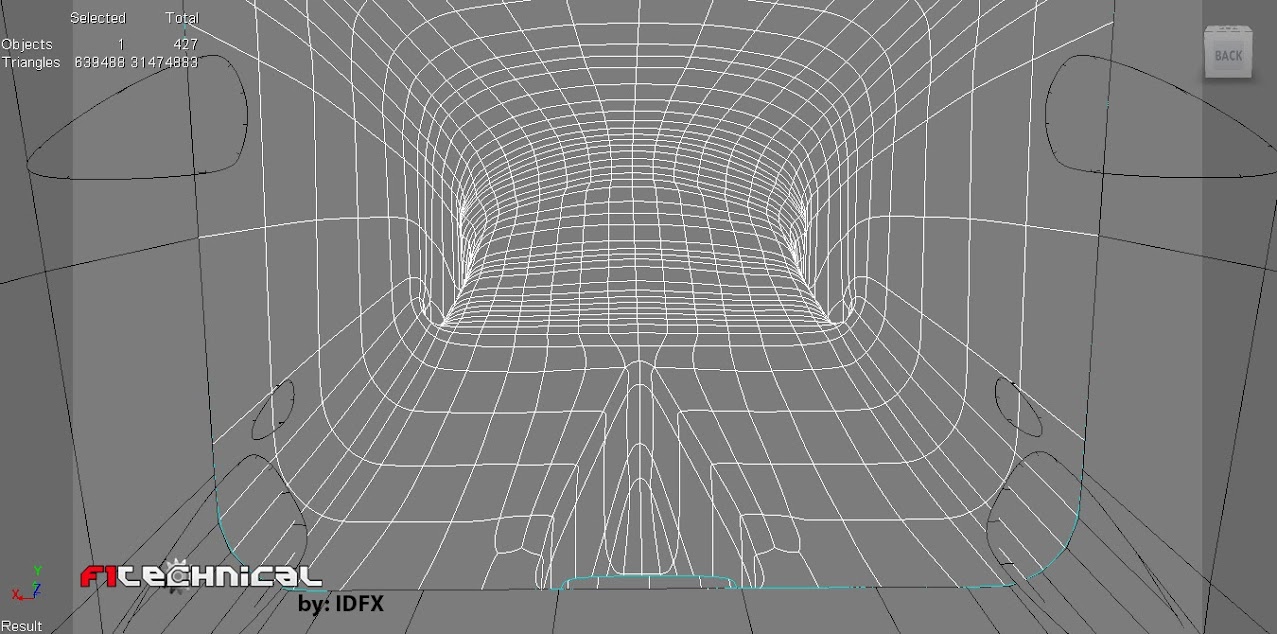
Final
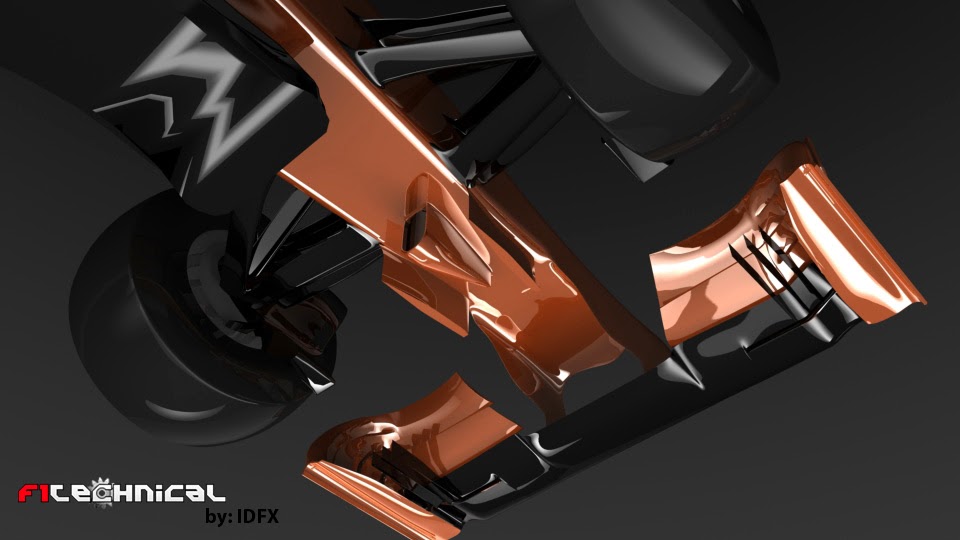


I have doubts and this is normal, the regulation may be flawed, when we explore the meaning and orientation of objects.
Thanks
Re: 2014 Design
Posted: 12 Mar 2014, 22:27
by turbof1
Now I understand your idea much better. Sorry, I didn't fully understood your point of view earlier on.
I have to say that's
really thinking out of the box. A big applause for that, mate.
I still foresee issues. First of all this:
The centre of area of this section must be no more than 185mm above the reference plane
Since you still have impact absorbing structure way above the nose, the centre of area will be above this. That looks solvable though.
Second, at your crash test you'll not be able to pass due various reasons

.
The resistance of the test structure must be such that during the impact either :
- The peak deceleration over the first 150mm of deformation does not exceed 10g.
- The peak deceleration over the first 60kJ energy absorption does not exceed 20g.
- The average deceleration of the trolley does not exceed 40g.
- The peak deceleration in the chest of the dummy does not exceed 60g for more than acumulative 3ms, this being the resultant of data from three axes.
Or :
- The peak force over the first 150mm of deformation does not exceed 75kN.
- The peak force over the first 60kJ energy absorption does not exceed 150kN.
- The average deceleration of the trolley does not exceed 40g.
- The peak deceleration in the chest of the dummy does not exceed 60g for more than acumulative 3ms, this being the resultant of data from three axes.
Furthermore, there must be no damage to thesurvival cell or to the mountings of the safetybelts or fire extinguishers.
Thirdly, while the rules don't explicitly forbid reversing the nose cone, I think the FIA will not accept this.
You should ask Steven to have a frontpage article. Clearly you are talented: beautiful renders, wonderful insight.
Re: 2014 Design
Posted: 12 Mar 2014, 23:12
by idfx
turbof1 wrote:Now I understand your idea much better...
No problem. I'm learning a lot with advice and tips from everyone. The merit is of all the forum.
Thank
Re: 2014 Design
Posted: 13 Mar 2014, 10:56
by SidSidney
Just a question.
I was watching the Scalabroni video on pull and pushrods, and wondered why the wishbones and push/pullrods couldn't be curved to smoothe airflow over the suspensions arms i.e., when you look at them from the front they are bowed up or down to create a free flowing air tunnel to the sidepods through the suspension members, rather than interefering directly in the middle. The angles of the curve - which could also be complex - would then be aligned to shdow the front wing on the lower arm and the top of the sidepod entry for the upper arm/pushrod.
I can see some structural issues in making arms that don't break, but nothing that couldn't be solved with materials/clever design. Is that in principle illegal, if the profile is a simple neutral aerofoil?
Re: 2014 Design
Posted: 14 Mar 2014, 16:03
by FW17
WilliamsF1 wrote:raymondu999 wrote:WilliamsF1 wrote:If the power band is so wide, then all the gears can be made tall, why only 8th?
ALL of them will be tall - but remember that they have better acceleration (less drag, more torque) and also less RPM. You will hit the top of the tall 7th gear, quicker than you would have hit the top of the short 7th gear (V8)
As per that logic it defeats the purpose of having 8th gear at all. 8th gear was allowed so that the fixed gear ratios for the season is workable. So to say that you will be on 8th gear often is quiet misleading just as the meter long throttle pedal.
[youtube]
http://www.youtube.com/watch?v=EWCKjwnHXx0[/youtube]
Williams on-board video shows VB never shifting to 8th gear around the OZ track, he does a max of 317kmph while still of 7th and 11250 rpm
Re: 2014 Design
Posted: 14 Mar 2014, 18:19
by Blanchimont
I think it's just the TV graphic that is wrong. At 0:15/0:16 into the video there is an additional upshift, the revs drop a bit but the gear display still shows 7th gear.
Re: 2014 Design
Posted: 14 Mar 2014, 18:23
by FW17
Blanchimont wrote:I think it's just the TV graphic that is wrong. At 0:15/0:16 into the video there is an additional upshift, the revs drop a bit but the gear display still shows 7th gear.
That onboard looks so weird; never have i seen an driver so feather footed or so many short shifts
Re: 2014 Design
Posted: 14 Mar 2014, 18:48
by Just_a_fan
There does appear to be an up shift to 8th a couple of times in that video judging by the way the revs / engine note drops.
As for short shifting - don't forget that these engines have a fatter torque curve (more torque at lower revs) so you get meaningful acceleration in lower revs compared to the old engines. A bit like comparing a road going performance petrol and diesel car in effect.
Re: 2014 Design
Posted: 14 Mar 2014, 19:11
by SectorOne
That´s strange, i can hear what you have mentioned but i thought that data was coming straight from the car´s ECU?
Maybe it´s just FOM or whoever it is that does graphics has forgotten something in the visualization of the data.
(like the program does not recognize gears above 7th)
Or do we have any videos showing any car reaching 8th? GUI-wise.
Re: 2014 Design
Posted: 14 Mar 2014, 20:20
by BanMeToo
I don't know if there is any online video, but I know for a fact that during P2 they showed an onboard shot and the graphics went up to 8th gear.
Re: 2014 Design
Posted: 14 Mar 2014, 20:58
by bhall
WilliamsF1 wrote:That onboard looks so weird; never have i seen an driver so feather footed or so many short shifts
It makes sense, though.
Reduced downforce has increased the range of speeds in which the cars are traction-limited, so drivers will need a delicate touch on the throttle this year to avoid unsettling the car and/or destroying the tires.
Similarly, fuel restrictions have increased both the need for efficiency and the reward for getting it. Since friction and pumping losses build exponentially as engine RPM rises, as much as 1/5 of total power output will be lost due to inefficiency. Short-shifting directly addresses that, and it's a fairly practical strategy this year, because engine output at 15,000 RPM is only nominally greater than output at 10,500 RPM. So, unless you really,
really need to, why even bother going that high if you're not gonna get anything good out of it?
Get low instead.
Re: 2014 Design
Posted: 16 Mar 2014, 02:41
by ringo
Question:
Will ferrari change to a nose similar to the other teams?
Suppose they feel their car is not where it needs to be at the moment (not to say the nose is the performance differentiator) but can we expect an upgrade similar to the other teams if ferrari doesn't find itself on the front row?
Re: 2014 Design
Posted: 16 Mar 2014, 03:55
by bhall
How big of a change is that, though?
I started thinking about it after the latest Newey-machine unveiled a camera-less form. Ferrari and Mercedes appear to use the camera pods to direct air flow around the nose toward the rear of the car, and one would think (re)moving them could cause problems downstream, where it's hard to know what depends on that function. The same can be said for any changes made to the nose.
I know McLaren raised the nose of the MP4-27 mid-season with good results. But, for some reason, that strikes me as an easier change to make, even though that solution was inherently compromised by an inability to modify the chassis.