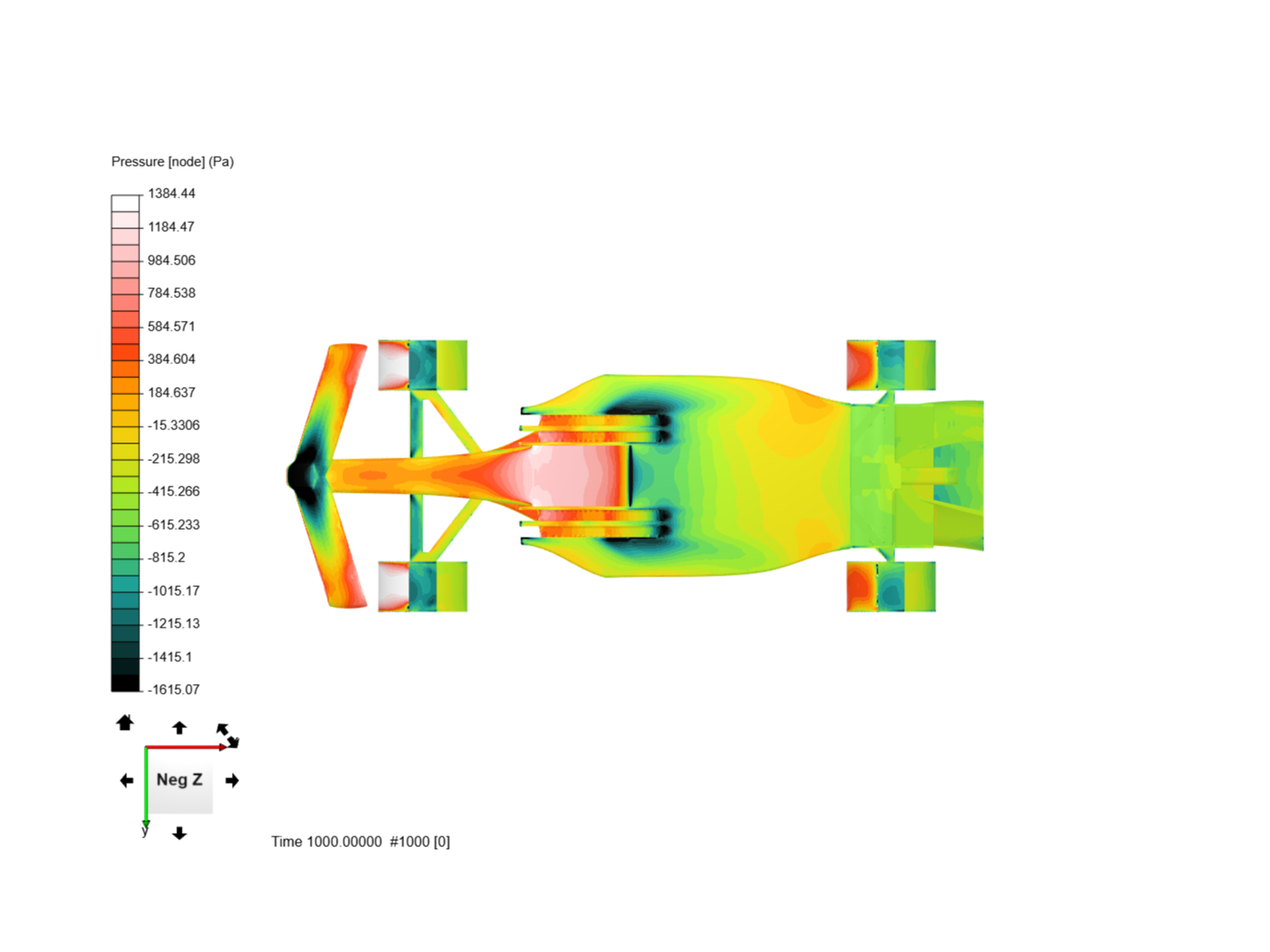
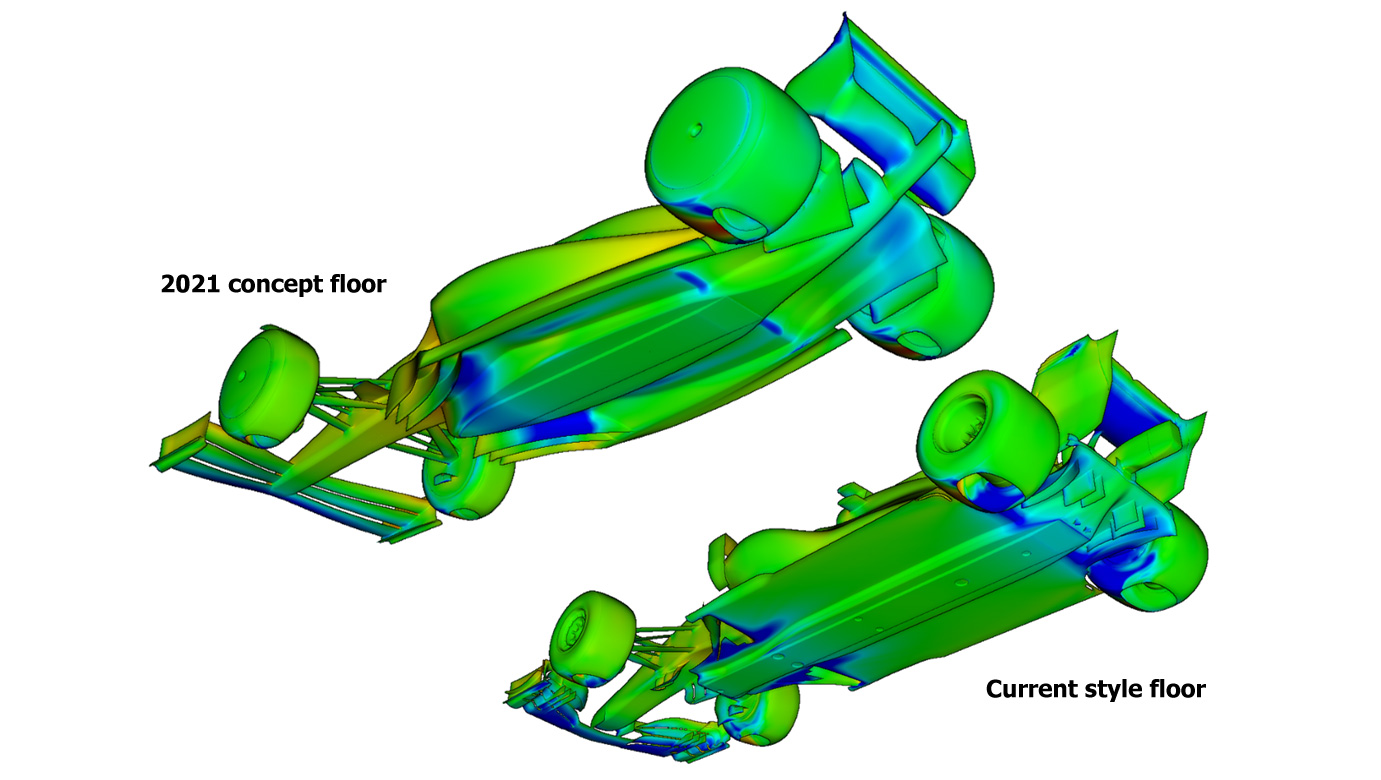
If I'm not mistaken the rear wing interacts with the diffuser and enhances its performance.
The nose length is proportional to the amount of energy it can absorb in a front impact, so it's purpose for safety is quite important I'd say. Unfortunate because the shorter cars were fun to watch, but it's one of the more reasonable sacrifices.
I believe the return of the beam-wing has far more interaction with the diffusor than the rear wing. Although, the rear wing will help with the total upwash/extraction from the diffusor.
It's going to be interesting to see how well they can follow each other.
If I'm not mistaken the rear wing interacts with the diffuser and enhances its performance.
The nose length is proportional to the amount of energy it can absorb in a front impact, so it's purpose for safety is quite important I'd say. Unfortunate because the shorter cars were fun to watch, but it's one of the more reasonable sacrifices.
I believe the return of the beam-wing has far more interaction with the diffusor than the rear wing. Although, the rear wing will help with the total upwash/extraction from the diffusor.
It's going to be interesting to see how well they can follow each other.
This is what I was getting at, maximise the beam wing/floor, minimise the big draggy bits.
Re: 2022 Aero Thread
Posted: 24 Dec 2021, 21:54
by wesley123
If your intent is to blow the dirty air over a car following a more aggressive beam wing would do f-all since it's wake would still fit in the base area of the car following it. The rear wing as is described per 2022 rules will blow it's dirty air over a following car in every rational AoA.
And then we come to more practical things. With the beam wing as the 'main' wing you create an aerodynamic element that would be much more sensitive to setup changes, both in it's own right, as well as CoP. An AoA change will have a much larger effect over the draw from the tunnels, and because of this affect, it will also have a bigger effect on front load.
In terms of effect in it's own right, it'll probably be more effective, but for the goals it is trying to achieve it will only complicate things more.
Re: 2022 Aero Thread
Posted: 24 Dec 2021, 23:21
by Mattchu
So I was wondering if next year Haas will have any advantage owing to the fact their chassis is produced by Dallara. Next years cars use a lot more ground effect, which is something Indy have been using for a while now.
Will they possibly have an small edge in helping assist the Haas designers/engineers in what the better ways to utilize such a method of creating downforce is?
I suppose the same goes for McLaren with their Indy program...will much methodolgy be crossed over or are they so different that very little can be garnered.
"Rake is likely to disappear as the cars will run low and flat." - Hm. This is quite the opposite to the opinions I saw on this forum.
He also says "most downforce created from underfloor". Which makes me wonder, can't that result in the overhangs and wings and such length decreasing?
If they can make most of the downforce they want with the underbody, why make huge drag-generator wings?
And if you don't need much wings, why make long noses?
Newey has claimed the high rake philosophy is dead for 2022
I think one of our resident aero experts mentioned that a few degrees of rake is about the max you can run before the tunnels stop working.
So I was wondering if next year Haas will have any advantage owing to the fact their chassis is produced by Dallara. Next years cars use a lot more ground effect, which is something Indy have been using for a while now.
Will they possibly have an small edge in helping assist the Haas designers/engineers in what the better ways to utilize such a method of creating downforce is?
I suppose the same goes for McLaren with their Indy program...will much methodolgy be crossed over or are they so different that very little can be garnered.
Just wondering!
I doubt it, Lola was the chassis that dominated CART/IndyCar until they went to a spec chassis.
Re: 2022 Aero Thread
Posted: 26 Dec 2021, 13:33
by Blackout
I have a feeling, these rules/the nose and front wing volumes do not outlaw "pelican noses". Am I wrong?
"Rake is likely to disappear as the cars will run low and flat." - Hm. This is quite the opposite to the opinions I saw on this forum.
He also says "most downforce created from underfloor". Which makes me wonder, can't that result in the overhangs and wings and such length decreasing?
If they can make most of the downforce they want with the underbody, why make huge drag-generator wings?
And if you don't need much wings, why make long noses?
Newey has claimed the high rake philosophy is dead for 2022
I think one of our resident aero experts mentioned that a few degrees of rake is about the max you can run before the tunnels stop working.
That all depends on how you shape them, obviously they'll work due to ground effect so generally a lower car will work the tunnels harder. However it is a matter of aero balance, do you want them working as hard at 240kph as you do at 140kph? If they work harder at lower speeds they may create understeer at higher speeds, if they work better at higher speeds the car may lack grip at lower speeds.
With 18 inch wheels and lower profile tires, the damping of the cars will also change from the legacy car's overdamped suspensions towards more critical damping. This can have an influence on the balance of the car at certain speeds. Pitch sensitivity will become a bigger issue than it's been recently.
I have a feeling, these rules/the nose and front wing volumes do not outlaw "pelican noses". Am I wrong?
Depends how you define a pelican nose?! I think something like the 2014 Ferrari might be possible or even desirable.
The more air you can feed into the tunnels the easier it is to create above ambient pressure at the throat. The ground effect tunnels remind me an awful lot of the SR-71 engine inlets.
I have a feeling, these rules/the nose and front wing volumes do not outlaw "pelican noses". Am I wrong?
Depends how you define a pelican nose?! I think something like the 2014 Ferrari might be possible or even desirable.
The more air you can feed into the tunnels the easier it is to create above ambient pressure at the throat. The ground effect tunnels remind me an awful lot of the SR-71 engine.
Below ambient but yes. And without so many flow conditioners it will be much harder to do. These rules are quite tricksy, simple means you can't just bung on another widget to push the air about.
Depends how you define a pelican nose?! I think something like the 2014 Ferrari might be possible or even desirable.
The more air you can feed into the tunnels the easier it is to create above ambient pressure at the throat. The ground effect tunnels remind me an awful lot of the SR-71 engine.
Below ambient but yes. And without so many flow conditioners it will be much harder to do. These rules are quite tricksy, simple means you can't just bung on another widget to push the air about.
I meant at the entrance to the tunnels, the turning vanes at the tunnel inlet serve to increase the static pressure, shoveling air out of the way and by consequence creating a low pressure inlet at the main opening for the tunnels.
The more air you can feed into the tunnels the easier it is to create above ambient pressure at the throat. The ground effect tunnels remind me an awful lot of the SR-71 engine.
Below ambient but yes. And without so many flow conditioners it will be much harder to do. These rules are quite tricksy, simple means you can't just bung on another widget to push the air about.
I meant at the entrance to the tunnels, the turning vanes at the tunnel inlet serve to increase the static pressure, shoveling air out of the way and by consequence creating a low pressure inlet at the main opening for the tunnels.
Depends how you define a pelican nose?! I think something like the 2014 Ferrari might be possible or even desirable.
The more air you can feed into the tunnels the easier it is to create above ambient pressure at the throat. The ground effect tunnels remind me an awful lot of the SR-71 engine.
Below ambient but yes. And without so many flow conditioners it will be much harder to do. These rules are quite tricksy, simple means you can't just bung on another widget to push the air about.
Right, the overall shape dictates the flow path to a greater extent than now.
Below ambient but yes. And without so many flow conditioners it will be much harder to do. These rules are quite tricksy, simple means you can't just bung on another widget to push the air about.
I meant at the entrance to the tunnels, the turning vanes at the tunnel inlet serve to increase the static pressure, shoveling air out of the way and by consequence creating a low pressure inlet at the main opening for the tunnels.
I don't agree but okay.
If the turning vanes are turning air, the pressure increases on the leading/outboard surface. Slowing down air raises its pressure, this is basic stuff. All diffusers work to increase air pressure, any time you make air turn it slows down, it's like going up a hill. The energy it takes for air to go around an obstruction reduces its kinetic energy.
The floor entrance is lower pressure, but only because the turning vanes are out-washing air raising the pressure outboard.
The tunnels work because the inlet is above static pressure and the outlet is at static, while the tunnels are below static. It's sort of like the pressure drop across an intercooler core. The pressure pre and after the heat exchanger are above static, the increased volume of the cooler creates a pressure drop that is partially recovered at the outlet.