Page 2 of 15
Re: Diffuser Profile - Convex or Concave?
Posted: 16 Nov 2011, 18:38
by DRCorsa
Here's the velocity plot:

and here's the flow on the diffuser's surface. It seems that the velocity is very low on the concave part.

Re: Diffuser Profile - Convex or Concave?
Posted: 16 Nov 2011, 18:40
by DRCorsa
Tozza Mazza wrote:Interesting stuff.
I reckon you could get the concave diffuser up to the DF levels of the convex one, with much lower drag!
I am not sure, but th fact is that the design need a lot of work.
Re: Diffuser Profile - Convex or Concave?
Posted: 16 Nov 2011, 18:52
by hardingfv32
For F1, could this arrangement be an attempt to move the DF levels forward?
Brian
Re: Diffuser Profile - Convex or Concave?
Posted: 16 Nov 2011, 19:17
by marekk
@DRCosa: how do you calculate net downforce ?
Re: Diffuser Profile - Convex or Concave?
Posted: 16 Nov 2011, 19:24
by DRCorsa
marekk wrote:@DRCosa: how do you calculate net downforce ?
It's an automated process. You enter the needed expressions and the software gives you the net downforce and drag.
Re: Diffuser Profile - Convex or Concave?
Posted: 16 Nov 2011, 20:06
by DRCorsa
hardingfv32 wrote:For F1, could this arrangement be an attempt to move the DF levels forward?
Brian
Maybe yes.
Maybe they are "restricted" to use a concave style diffuser because possibly the angle of a convex diffuser would have been very high due to regulations (maximum length and height of the diffuser).
We can only speculate.
Re: Diffuser Profile - Convex or Concave?
Posted: 16 Nov 2011, 20:27
by Just_a_fan
Don't forget that the diffuser is not an isolated item. A ,ot of work goes in to linking the diffuser to other parts of the car in order to maximise downforce. We see diffusers designed to link to the wake of the rear tyres and the beam wing is also used to help drive the diffuser.
It's possible that the concave diffuser just gives the best downforce available in the restricted dimensions set by the regs.
As with all aero designs, there will be a trade off between downforce, drag, regs, practicality etc.
Re: Diffuser Profile - Convex or Concave?
Posted: 16 Nov 2011, 22:47
by scarbs
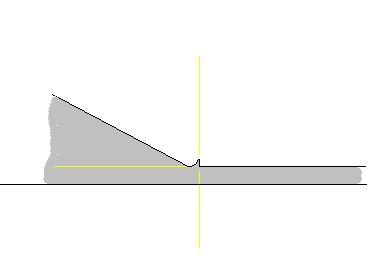
The transistion between flat floor and diffuser is often more complex than a simple kink. Teams will often fit steps or rounded sections at the transistion. this detailing I imagine is to get the flow to attach to the steepest part of the diffuser, in a similar way to a gurney at the trailing edge of a flap.
Re: Diffuser Profile - Convex or Concave?
Posted: 16 Nov 2011, 23:08
by scarbs
This is an example of what I'm talking about, based on a Jordan from the mid nineties.
Re: Diffuser Profile - Convex or Concave?
Posted: 16 Nov 2011, 23:28
by hardingfv32
That exact shape is modeled in this paper on intake diffusers.
Brian
Re: Diffuser Profile - Convex or Concave?
Posted: 17 Nov 2011, 00:11
by marekk
Tozza Mazza wrote:Very little info out there on the web, and pictures of Diffuser profiles are hard to come about.
Which shape is best for the aerodynamics of the diffuser, and why?
There was some info in the diffuser confusion thread, but it was so clogged up with babble and opinion I couldn't make sense of it.
So let's add something to this confusion, babble and opinion we've made in diffuser thread:
1. Basicaly what really counts at first approx is expansion ratio. As long as flows stay attached, all shapes/designs are born equally for uncompressible flows.
But:
2. There is huge build-up of boundary layer along this long, flat floor, which obviously didn't help to keep the flows attached to the diffuser ceiling. Sharp edge on the kink line helps to get rid of this. That's my understanding of how the weird shapes mentioned by scarbs work.
3.
Downforce: Low pressure on the flor/diffuser surface means thers is a force
perpendicular to ths surface. But we are looking (more or less, depending on the suspension geometry) only for the ground-facing part of this force - horizontal component is just drag, nothing more. So maybe it's better to have most acceleration/pressure drop on the parts of the car parallel to the ground, where all the force means
downforce ?
4...
Re: Diffuser Profile - Convex or Concave?
Posted: 17 Nov 2011, 00:38
by hardingfv32
1) #3 is a very good point......
So it compromise between how parallel of the roof is to the track vs flow efficiencies.
2) Why is it in the engine intake diffuser referenced above generates a pressure gain and the rear diffuser being discussed generates a negative pressure?
Brian
Re: Diffuser Profile - Convex or Concave?
Posted: 17 Nov 2011, 01:43
by ringo
DRCorsa wrote:
CONVEX (TRADITIONAL) DIFFUSER
Downforce: 546N
Drag: 85N
CONCAVE DIFFUSER
Downforce: 394N
Drag: 47N
The air velocity was 50m/s (180kph)
First of all, we see that the drag with the concave diffuser is alost half!
Downforce is less but this could be improved with more development.
Looking at the static pressure images, i would say that for the traditional diffuser the pressure is more evenly distributed along the length of the diffuser, while on the concave one, the negative pressure is more "concentrated" on its front (horizontal) part.
Your thoughts?
I have had similar results. That's why i found the shape counter intuitive.
I think it has to do with the blowing exhausts. Maybe the exhaust gases make the concave floor work better when a secondary mass flow is introduced to the system.
You must be careful with the drag figures though. Make sure the drag is only for the underside and not for the top and bottom together.
Re: Diffuser Profile - Convex or Concave?
Posted: 17 Nov 2011, 02:17
by hardingfv32
How does the exhaust come into play when the outlet is very close to the inlet of the diffuser and aimed outward toward the tire side wall? Without doubt it has no effect on the center of the diffuser. So if you believe the exhaust plays some role why would the roof in the center be the same as the roof on the out edges? Would you not expect the exhaust interaction to require a different roof shape if in fact there was such an interaction?
Brian
Re: Diffuser Profile - Convex or Concave?
Posted: 17 Nov 2011, 02:17
by Just_a_fan
scarbs wrote:The transistion between flat floor and diffuser is often more complex than a simple kink. Teams will often fit steps or rounded sections at the transistion. this detailing I imagine is to get the flow to attach to the steepest part of the diffuser, in a similar way to a gurney at the trailing edge of a flap.
I believe that the rules allow(ed?) for a radius at the transition but it is quite limited in size. Some teams just used the radius as a nice smooth transition between horizontal floor and angled diffuser. I think it was Ferrari who first turned the radius around so that it created a concave transition. This has the benefit of increasing the volume of the diffuser, reducing the effective angle of the diffuser thus giving an effective increase in diffuser length. Overall it gave an increase in L/D.