Page 2 of 4
Re: Rapid Brake Bias Adjuster
Posted: 21 Dec 2012, 11:08
by Tim.Wright
From what I've heard, they use a screw adjuster for the fine control, and then the lever (rapid adjuster) for the large changes from corner to corner.
My guess is that they are put in series. Then rapid adjuster is a lever which operates a push pull cable that is then moved again by the screw adjustment.
Re: Rapid Brake Bias Adjuster
Posted: 21 Dec 2012, 19:51
by gato azul
hardingfv32 wrote:gato azul wrote:Ask yourself what would happen, if after a bit of travel, one MC could not move anymore, or only against a spring (which would mean that one , is taken up by the spring), but the pedal and other MC still move.
What would that mean to the brake force/pressure distribution and the bias? Maybe the bias is not constant over the full range of pedal movement &/or brake pressure range?
And please stop with this, "but I have never seen it in a shop/catalog , so I doubt it exist" way of thinking,
1) I would question 'one MC could not move anymore'. This would seem against the basic safety premise of a dual master cylinder system... that you have one circuit available in the other circuit fails.
2) Losing 'part of the force coming from the pedal' is not acceptable with the forces required to stop a F1 car.
3) The quote is "If a lever system was easy to do, I would expect it to be commercially available." This statement is accurate when discussing the easy of designing a lever type system. IF it were easy, it would become commercially available. This say nothing about wether it is possible or not.
Brian
1) If the circuit with the limited travel cylinder fails, it would not matter, if the other circuit fails, you would still be able to apply pressure in the circuit which has the travel/pressure limit, whats the problem with that? What would be the benefit to be able to apply more pressure, if you have allready reached the point where the wheel starts to lock?
2) says who? - You?!!! what you be the benefit of increasing pressure at one/the axle which has reached their lock up threshold? Would it not be benefical to be able to limit the pressure build up in this axle, so that you can increase the pressure at the other end/axle until it reaches it's limit too?
3.) If it's very easy to design&produce, in fact so easy that any team can do it on their own, why would they bother spending money getting it from a supplier. To make something comercial viable, would mean being able to sell lots of it,
if the overal demand is limited ( 12 teams in F1) and the product is easy to make, low price/profit margin, why would someone bother to turn it into a business? Who says, that parts for such a system are not allready available?
As yourself, better draw a diagram and post it here, what the "optimum" brake force/pressure distrubution F/R would look like during a F1 style braking event. Is it a straight line or a parabel or what other slope has the line?
Then try to reach this distribution, with a fixed ratio F/R ( you can draw the effect of different ratios).
A standard 2MC with a balance bar setup with always have a fixed ratio for a given setting, you can change the ratio but it will always be fixed during the braking event ( assuming sufficent system stiffness, which in practice in not always given, but thats another matter).
But if you have already made uop your mind, and this is just another "Brian wants to argue a bit" thread, then enjoy it, maybe someone else wants to take up the task.
Re: Rapid Brake Bias Adjuster
Posted: 22 Dec 2012, 00:26
by hardingfv32
OK
1) Expand on: 'if after a bit of travel, one MC could not move anymore' What is the perceived benefit of such a situation? What does this have to do with the design of a 'rapid' brake bias adjuster. 'Rapid' being under one second.
2) "What you be the benefit of increasing pressure at one/the axle which has reached their lock up threshold? Would it not be benefical to be able to limit the pressure build up in this axle, so that you can increase the pressure at the other end/axle until it reaches it's limit too?" Again what does this have to do with a 'rapid' brake bias adjuster'? If this is some theory of bias adjustment, please expand.
3) Why is the proposed demand for this type of system limited to F1? Again, if it was easy someone would be making it for the general racing public.
4) I say 'that parts for a complete system are not available'. The lever system for the driver actuation in the cockpit is very common as a sway bar system, BUT there is NOTHING available to convert the levers motion into a brake bias adjustment. Feel free to challenge this statement with some product listings.
Brian
Re: Rapid Brake Bias Adjuster
Posted: 22 Dec 2012, 02:05
by gato azul
Brian,
to move forward from here, what is your definition of "Brake Bias"?
my one is Bias [%]= Pfront/(Pfront+Prear)
P= Brake Line Pressure
Do you agree with this, or if not please propose a alternative definition of Brake Bias, otherwise we may don't talk about the same thing, and that will let to some misunderstanding.
If you agree, with the above definition, you can ask yourself what happens to the pressure in the circuit, where the MC stops moving after a defined travel.
You may get hang up to much on the idea, that they modify the balance bar setting.
There are other ways (better? faster/easier) to change the brake bias, but again, it boils down, to your definition of "Brake Bias".
If for you, it is the "Balance Bar Position" (only), chances are, that no one is using a "Quick Adjustment System" to alter the Balance Bar Setting.
Mind about the other question, I have ask you, and try to come up with an answer, it will help to understand the idea behind it.b Also mind about what Tim has said.
Re: Rapid Brake Bias Adjuster
Posted: 22 Dec 2012, 03:01
by Jersey Tom
hardingfv32 wrote:4) I say 'that parts for a complete system are not available'. The lever system for the driver actuation in the cockpit is very common as a sway bar system, BUT there is NOTHING available to convert the levers motion into a brake bias adjustment. Feel free to challenge this statement with some product listings.
Brian
I almost don't know what to say to this. The beauty is there's no conversion necessary! Are you familiar with the twist knob style bias adjusters? THAT common system is the one that requires translating a rotationof the knob to a linear ddisplacement at the bias bar. A push pull cable is MORE simple.
Dig up whatever Carroll Smith book has some bias bar diagram and it should be pretty easy to see.
Re: Rapid Brake Bias Adjuster
Posted: 22 Dec 2012, 03:36
by hardingfv32
Jersey Tom wrote:[THAT common system is the one that requires translating a rotationof the knob to a linear ddisplacement at the bias bar. A push pull cable is MORE simple.
Really... Are you proposing replacing the threaded shaft of the normal balance bar with a mechanism that has a simple linear sliding motion?
or converting the, say 45 deg, motion of the cockpit lever to a 45 deg shaft rotation at the normal threaded balance bar mechanism?
Brian
Re: Rapid Brake Bias Adjuster
Posted: 22 Dec 2012, 03:40
by hardingfv32
Tim.Wright wrote: Then rapid adjuster is a lever which operates a push pull cable that is then moved again by the screw adjustment.
So what could the balance bar design be like if it is getting input from a screw knob and push cable?
Brian
Re: Rapid Brake Bias Adjuster
Posted: 22 Dec 2012, 03:50
by hardingfv32
gato azul wrote:to move forward from here, what is your definition of "Brake Bias"?
If you agree, with the above definition, you can ask yourself what happens to the pressure in the circuit, where the MC stops moving after a defined travel.
I am mainly concerned with the design of the balance bar system. Know if you can demonstrate other methods to modify brake bias, as you have defined, I am interested. So far your attempts have not sound satisfactory.
For example I do not understand how a 'MC stops moving after a defined travel' can possibly be of benefit. Anytime that I have had a mechanical issue with a brake balance bar system that limited travel of one side, it was effective situation.
Brian
Re: Rapid Brake Bias Adjuster
Posted: 22 Dec 2012, 05:36
by gato azul
You seem not too interested to put in some legwork/thinking, and I'm not really going to drag it all out your nose.
Have a look at this, and see if it makes any sense to you, if not, then sorry I'm sorry but I can't help you.
If you get the idea, we can talk about ways to make it work, and where to buy the parts.
But unless, you can define, what your desired/ideal brake balance is "during a braking maneuver" (from start to finish), and if it would be beneficial if it could be changed, then we are going nowhere.
If you just look for a different way, to adjust the position of your balance bar, then this is o.k. , but I will leave it to others
to discuss this with you.

I think, Tim said something about two systems in "series", that's the point I was getting at, by saying, keep in mind what he said. I don't necessarily agree with his last sentence, but the beginning of his post leads in the right direction - IMHO
you may have something different in mind Brian, and that's o.k., but this does not look like, that it has anything to do with a balance bar adjuster.
Re: Rapid Brake Bias Adjuster
Posted: 22 Dec 2012, 13:29
by Pierce89
In the 2007 Macca_Ferrari saga, there was discussed a system where a spring is mounted in series on either front or rear master cylinder so you got a gradually changing bias as the driver slowly released the brake as downforce reduced with speed.
http://www.f1fanatic.co.uk/2007/09/20/f ... -document/
Re: Rapid Brake Bias Adjuster
Posted: 22 Dec 2012, 17:33
by gato azul
yes, which would (could) look something like this, depending which parameters you chose.

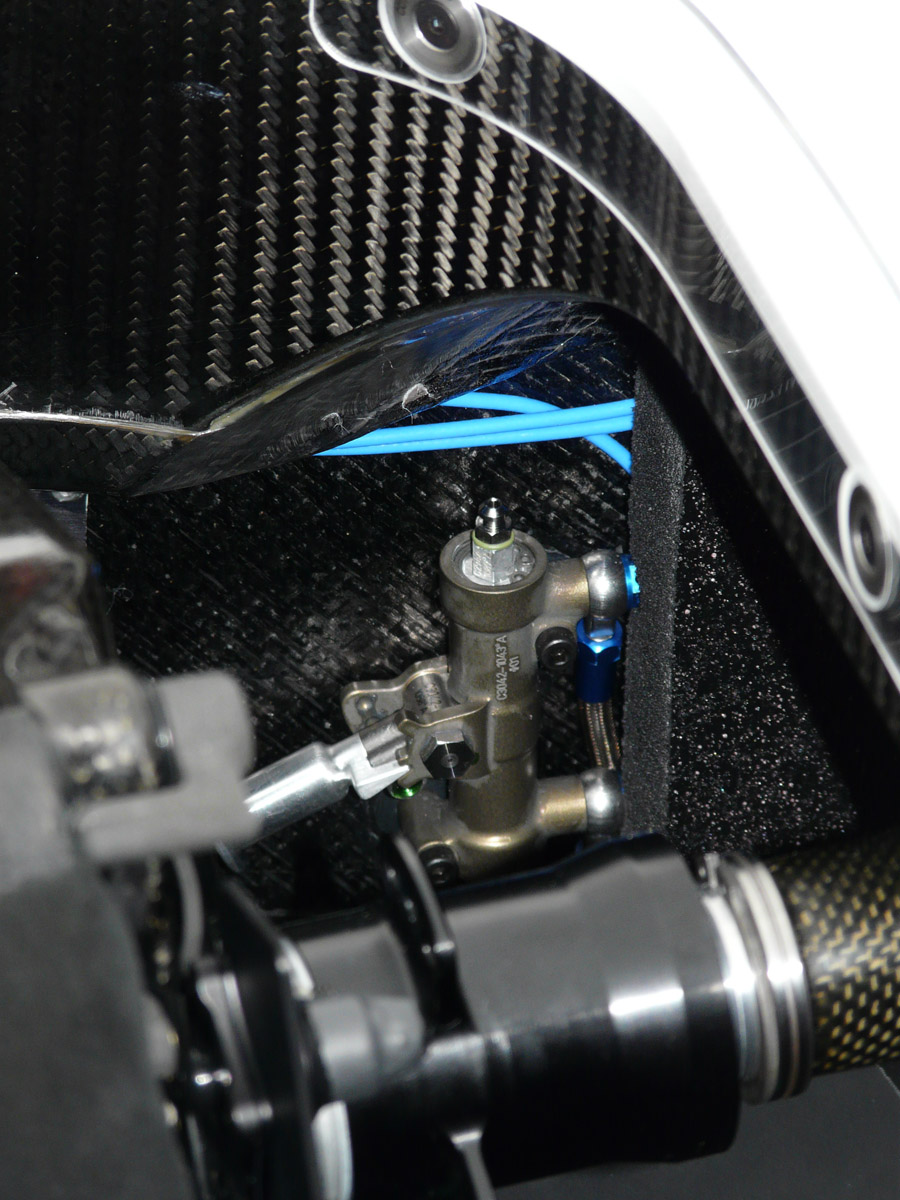
There is a couple of ways to implement such a system, you can do it external mechanical, or via valves in the brake circuit hydraulical. The underlying concept is the same. The photo posted, IMHO, shows a hydraulic implementation, which is perhaps easier, and more robust.
a simple implementation, which off the shelve parts , would give a characteristic like this.

offsetting the blow off/knee point, would have this effect, and can be easily achieved with the lever shown, in the photo

Adjustable pressure relieve valves have been around for ages, and you can get them in most race shops, no big deal
combine one, with your balance bar, and you are almost there.
example:


Re: Rapid Brake Bias Adjuster
Posted: 22 Dec 2012, 18:02
by xxChrisxx
hardingfv32 wrote:Tim.Wright wrote: Then rapid adjuster is a lever which operates a push pull cable that is then moved again by the screw adjustment.
So what could the balance bar design be like if it is getting input from a screw knob and push cable?
Brian
You don't appear to be putting much thought into this. There are about a million ways you can do it, as its a pretty simple problem. The exact design is irrelevant, you just need to imagine the 'system'.
The fundamental thing to take away from this is that you are separating out the one goal into two optimized systems. As large adjustments trade accuracy for speed, and fine adjustments trade speed for accuracy. Now from that, we can imagine the problems separately.
A push-pull cable operating a slider with detents (or some other locking mechanism) set to a nominal increment, lets say 1%.
So at the 0, 90 and 180 positions. We have 3 fixed points that represent a shift of 3%. Having a discreet step is far easier than having something infinitely adjustable. Then a threaded bar is mounted onto this slider, with a knob that provides 10 incremental clicks with 0.1% adjustment.
Is it that you are just having trouble visualising the solution?
Re: Rapid Brake Bias Adjuster
Posted: 22 Dec 2012, 19:19
by hardingfv32
xxChrisxx wrote:You don't appear to be putting much thought into this. There are about a million ways you can do it, as its a pretty simple problem. The exact design is irrelevant, you just need to imagine the 'system'.
I have given it thought but lack the imagination to solve. I am a great fabricator, but all the mechanical pieces I am familiar with will not create an acceptable solution for a rapid brake bias system. I have fabricated a few brake pedal assemblies and have a clear picture of the physical constraints. I currently use a High Efficiency ‘PUSH TYPE’ master cylinder with a high efficiency balance bar system. Available from Tilton or AP. Note: My goal is not to implement a rapid brake bias system, just to understand how it might be designed.
So far all I have heard is a bunch of hand waving about how simple it is. Yes, it would be ideal to integrate slow and rapid system in serious, but how is the mechanically or hydraulically possible?
Getting the normal push/pull cable usually found on sway bar systems to bend 90 degs so that its linear motion is on the same axis as the balance bar is NOT possible inside the foot well of a F1 car without encumbering the free motion of the MC shafts. The MC of most the current F1 cars seem to have a conventional spacing between cylinders and a center location in the bulkhead.
Is it possible that the mounting base of one of the MC is being moved to create an angle that changes the force level?
Brian
Re: Rapid Brake Bias Adjuster
Posted: 22 Dec 2012, 19:31
by hardingfv32
gato azul wrote:But unless, you can define, what your desired/ideal brake balance is "during a braking maneuver" (from start to finish)
I have no desire to define the 'ideal brake balance during a braking maneuver'. You are free to take the thread that direction if you wish.
Your use of a hydraulic pressure regulator/check valves shown are an inferior solution to brake balance. They function by reducing the pressure available to one of the circuits. This means a reduction in the total force available for the brake system. This is not acceptable to F1 designers or in my personal applications.
Brian
Re: Rapid Brake Bias Adjuster
Posted: 22 Dec 2012, 19:55
by gato azul
hardingfv32 wrote:gato azul wrote:But unless, you can define, what your desired/ideal brake balance is "during a braking maneuver" (from start to finish)
I have no desire to define the 'ideal brake balance during a braking maneuver'. You are free to take the thread that direction if you wish.
Your use of a hydraulic pressure regulator/check valves shown are an inferior solution to brake balance. They function by reducing the pressure available to one of the circuits. This means a reduction in the total force available for the brake system. This is not acceptable to F1 designers or in my personal applications.
Brian
This may is not acceptable for you, fair enough. At least Ferrari, may disagree with your point of view.
I think the shuttle system which xxChrisxx has mentioned, is easy enough to understand and build.