I think it would be great if it is removed. Just adapt Halo's points of attachment slightly !! Does the same job
no it doesn't. perhaps take the effort of looking at the video again.
Re: 2018 Aerodynamic Technical Regulations
Posted: 13 Jan 2018, 19:31
by GM7
Thank you for all your answers !
Re: 2018 Aerodynamic Technical Regulations
Posted: 24 Jan 2018, 19:09
by godlameroso
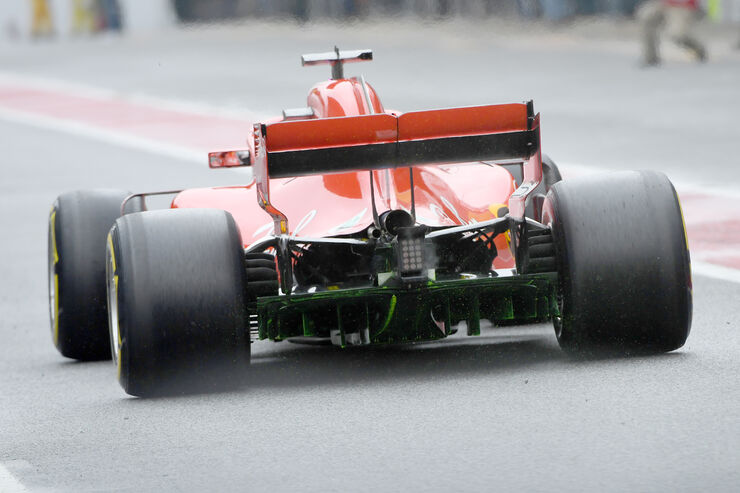
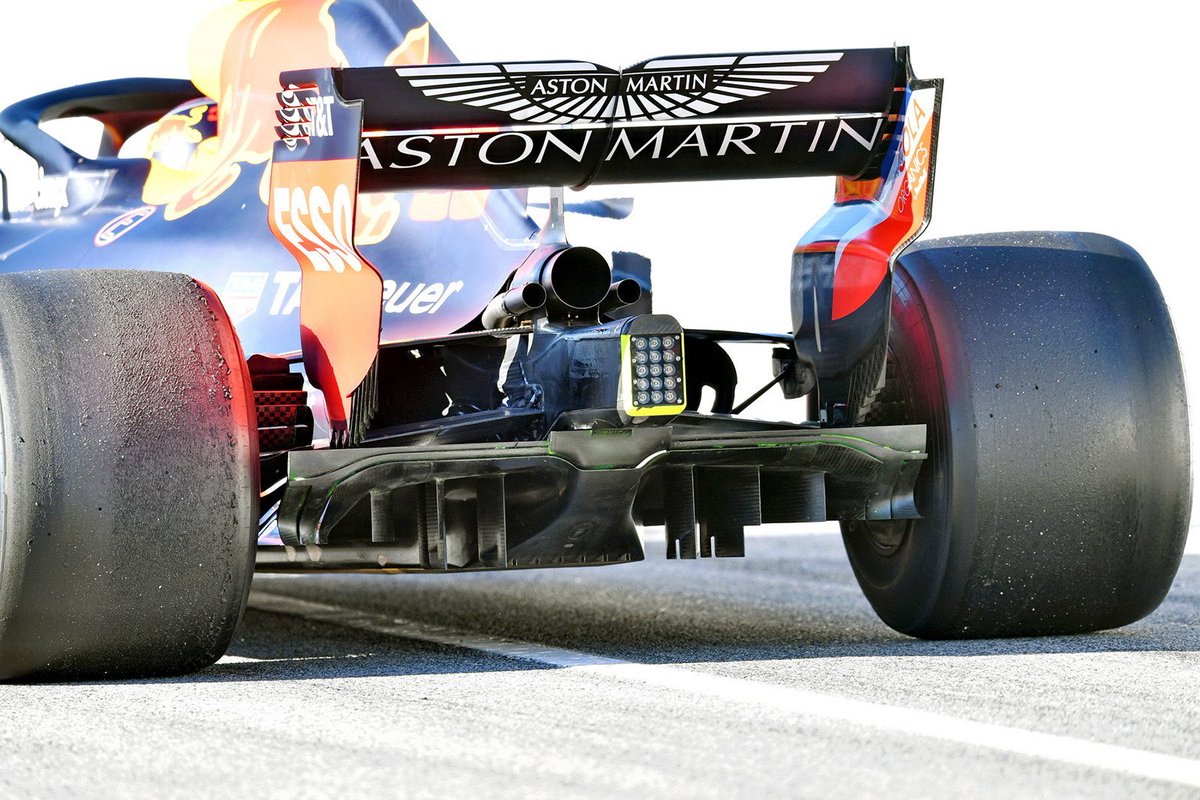
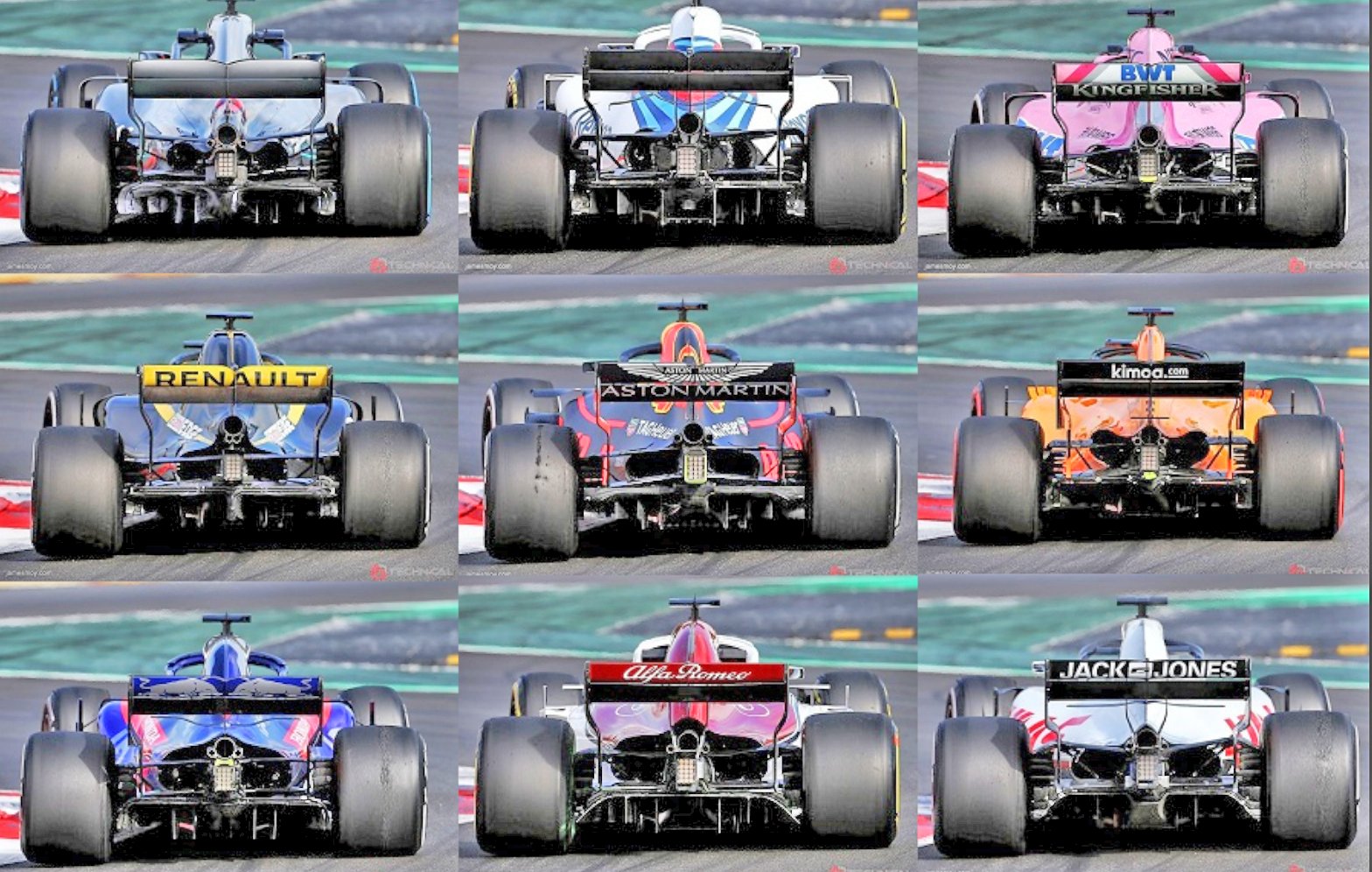
I wonder how many teams were and still are being plagued with diffuser instability? The previous generation diffusers were shallower, and smaller, but the teams had experience with them. Transitioning to a larger volume means that not only geometry has to be adapted but the flow structures feeding the diffuser need to be tweaked as well(at least if you're trying to get the most out of it).
Re: 2018 Aerodynamic Technical Regulations
Posted: 04 Mar 2018, 04:41
by Brenton
Seeing the sidepods crash structure stick out on some of the 2018 cars I wonder if they're ironically a safety risk? Because instead of being part of a broad surface, it's a narrow spear like wing instead.
To help explain what I mean conceptually: Imagine having an extremely tough, extremely narrow bumper, and that other cars did too. You could imagine that bumper ripping deep into another car in a crash.
It seems like something designed to pass a very specific crash test, while being negligent for many variations of real world collisions. Instead of the test being broadly relevant, it's only checking a very small percentage of collision impacts.
Should this be a safety concern?
What if this continues, to an extreme degree? Non-existent sidepods and instead these super narrow and strong sword like appendages. Like scythed chariot wheels.
Re: 2018 Aerodynamic Technical Regulations
Posted: 04 Mar 2018, 20:47
by godlameroso
They're crash structures, they're designed to absorb impact, they're not indestructible.
Please show us the diffusor on that bird and maybe you'll get an answer
Look at the diffusers, then look at the bird, it's body looks like the central section. The hawks wings have the same general shape as the diffuser in this picture, and if the bird was flying backwards I guarantee it would be generating downforce.
The bird is exploiting aero better than the cars can with its feathers, is it any surprise all the aero appendages on these cars look more and more like feathers?
Re: 2018 Aerodynamic Technical Regulations
Posted: 16 Mar 2018, 17:13
by PhillipM
To be honest, you're seeing patterns where they don't exist, not only is the central section on the car purely there to house the gearbox, the diffuser is working in ground effect and backwards.
The tips and spread feathers on the bird are for a completely different effect to that of outward turn and flaps on the diffuser, which are mainly there to link into the low pressure tyre wakes - how many tyres do you see on the bird?
To be honest, you're seeing patterns where they don't exist, not only is the central section on the car purely there to house the gearbox, the diffuser is working in ground effect and backwards.
The tips and spread feathers on the bird are for a completely different effect to that of outward turn and flaps on the diffuser, which are mainly there to link into the low pressure tyre wakes - how many tyres do you see on the bird?
Correlation is not causation
The central section of the diffuser has massive performance implications, why bother with vortex generators in that region?
Birds don't need to have tires for the concepts they exploit to be applicable to f1. They have been flying far longer than we have.
Re: 2018 Aerodynamic Technical Regulations
Posted: 16 Mar 2018, 20:22
by PhillipM
Put the diffuser in the air. How efficient will it be out of ground effect when the control of vortices has gone to pot?
It'd be terrible, you'd build a completely different shape.
How many fast animals look like an F1 car? None.
Remove the need for the gearbox space and the floor regs there - that central section that you're drawing resemblance from would disappear, are the FIA regulating bird bodies now?
Saying that they don't need tyres to exploit the same effect is ludicrous - the spread and angle wingtip feathers are generally to reduce vortex speeds, to reduce pressure gradients, to reduce drag and lift at the tips.
The outer turned elements on a diffuser are to hook into the lower pressure area behind the tyres, to drive the diffuser harder and increase downforce.
Not to mention that a bird will open and close them, angle, etc, depending on what it needs at the time
You want to see a ground effect bird? Go look at large seabirds.
edit: here you go, wait until he's gliding in ground effect...rather less resemblance now, eh?
Wing flattened out, straightened, primary feathers bunched back together.... https://www.youtube.com/watch?v=_YEyzvtMx3s
Saying that they don't need tyres to exploit the same effect is ludicrous - the spread and angle wingtip feathers are generally to reduce vortex speeds, to reduce pressure gradients, to reduce drag and lift at the tips. The outer turned elements on a diffuser are to hook into the lower pressure area behind the tyres, to drive the diffuser harder and increase downforce. Not to mention that a bird will open and close them, angle, etc, depending on what it needs at the time
Isn't that a bit contradictory? Birds have active aero, these cars are fixed, there's no comparison. My point this whole time is that there are areas on these cars that are sensitive and big performance differentiators, and seeing the resemblance in nature pays off in these areas. Mercedes has sculpted this area and put a lot of work in shaping it, it seems minor, but due to the split turbo it means the engine and transmission is further back than with a Ren/Ferr layout.
The outer turned elements on a diffuser are to hook into the lower pressure area behind the tyres, to drive the diffuser harder and increase downforce.
That's a little simplistic, there is a lot going on in that area, it's not entirely low pressure, the shape of the diffuser and floor means that area has to deal with a lot, there is a high pressure pocket on the slope of the diffuser facing the tire along with the rear tire turbulent wake. There's different philosophies of what to do around here.
Re: 2018 Aerodynamic Technical Regulations
Posted: 18 Mar 2018, 15:59
by PhillipM
You're right, there are, and that just proves the point even further - because only one or two of those solutions bares even a passing resemblance to your soaring bird.
If you cut an umbrella in half that'd bare a resemblance to a diffuser too - hell, it even has strakes, lets study racing umbrellas!
Or maybe we should be telling the birds to stick their legs out as vertical vortex generators because F1 cars are doing it.
Re: 2018 Aerodynamic Technical Regulations
Posted: 18 Mar 2018, 19:13
by godlameroso
The birds aren't the ones copying...the bird brains in F1 are, to good effect no less. The fluid motion of bird wings, when flying in ground effect(like you showed(which could be where Red Bull got their diffuser gurney/flick up from) and in other scenarios(remember they have active aero on a level an F1 car or any man made contraption can only dream of) shows the most efficient way to deal with different air flows.
Do you suppose a goshawk is worried about drag as it spears through openings the size of your fist at 30+kph? The birds are masters of airflow and they do it without thinking. We could learn a thing or 2.