Page 2 of 3
Re: Downforce dropoff with yaw (F1)
Posted: 23 Feb 2009, 01:31
by Jersey Tom
kilcoo316 wrote:Jersey Tom wrote:Dude, you're asking for data no one here either has or would be allowed to release.
I could venture a guess,
Why not venture a guess - it shouldn't be all that hard to work out!
Jersey Tom wrote:
but WHY do you want to know?
Why so defensive?

kensaundm31 wrote:
So what yaw angle would an f1 car be at when negotiating 'Stowe' at Silverstone?
What is the corner angle?
What is the time taken to negotiate corner?
There you have average yaw rate. Transient traces will be different of course, but not overly so - figure a peak yaw rate 20-30% higher than average.
As for yaw angle - depends on how hard the driver is pushing...
In race:
Very small (not near the extreme of the tyre friction circle).
In qualifying:
Who knows... depends how good the driver is and how willing they are to push it.
It's an odd question to ask. I'm curious why. What would you possibly want it for?
Yaw rate, yes, is easy.
Chassis sideslip angle ("yaw angle").. you won't be able to even guess without knowing some detailed tire data, and probably kinematics as well.
Re: Downforce dropoff with yaw (F1)
Posted: 23 Feb 2009, 05:51
by flynfrog
why not do it the easy way and find an over head shot
measure the angle tangent to the corner
Re: Downforce dropoff with yaw (F1)
Posted: 23 Feb 2009, 06:17
by Jersey Tom
In any event I'd bet 3-6 degrees. But I'm really curious why he wants to know..
Re: Downforce dropoff with yaw (F1)
Posted: 23 Feb 2009, 15:33
by kensaundm31
It's an odd question to ask. I'm curious why. What would you possibly want it for?
No special reason I'm afraid.
As for yaw angle - depends on how hard the driver is pushing...
In race:
Very small (not near the extreme of the tyre friction circle).
In qualifying:
Who knows... depends how good the driver is and how willing they are to push it.
How come you never hear the tyres squeal. Does the sound of the engine drown it out? Because all the cars under/over steer which means they've used all lateral grip.
Re: Downforce dropoff with yaw (F1)
Posted: 23 Feb 2009, 15:50
by Fil
not all tyres squeal. all depends on the makeup of the tyre.
i've had many a tyre which squealed when, ahem, i 'warmed' up the rears on a, ahem, 'private closed' road.. :-" i've also had many a tyre which did not squeal under the same warmup procedures..
Re: Downforce dropoff with yaw (F1)
Posted: 23 Feb 2009, 17:47
by kilcoo316
kensaundm31 wrote:How come you never hear the tyres squeal.
They may squeal... just that it is outside our hearing range.
Re: Downforce dropoff with yaw (F1)
Posted: 14 Mar 2009, 16:32
by avatar
kensaundm31 wrote:
How come you never hear the tyres squeal. Does the sound of the engine drown it out? Because all the cars under/over steer which means they've used all lateral grip.
On the initial introduction of the grooved dry's I seem to remember they where a bit more screechy (mainly when someone dropped it)...
I think the compounds/structures evolved in a way that mostly dialed that out.
Re: Downforce dropoff with yaw (F1)
Posted: 06 Jun 2009, 19:32
by silverbullet
Sorry to raise this from the grave. After google searching, this is one of the only forum and thread that is at all useful to me.
miqi23 wrote:Well an extreme case for an LMP1 car at 160 kph..
At Zero Yaw
3119.1 N (Total)
1258.0 N (Front)
1865.4 N (rear)
At 10 degree Yaw
2698.6 N (Total)
1122.9 N (Front)
1575.6 N (Rear)
At 20 degree Yaw
1799.4 N (Total)
566.7 N (Front)
1232.7 N (Rear)
Hope this helps a little!
Is there any data of slightly lower speeds (100 - 150 km/h)and higher yaw angles (20-45 degrees)? I'm specifically looking at a large span wings, and perhaps front end splitters.
I plotted that data on a spread sheet, and it looks like the downforce reduces in a fairly linear fashion as the yaw angle increases. I understand the lift coefficient changes exponentially at different speeds due to velocity^2 being a variable of dynamic pressure. So anyways, im expecting a fairly small number with my conditions, but I'm still interested in a range of possible values.
//edit: any info on angle of attack on that rear wing?
Re: Downforce dropoff with yaw (F1)
Posted: 06 Jun 2009, 19:52
by wesley123
For lower speeds you can check the mulsannes corner database, there are some pretty modern cars in there ich can give you an idea, and also you can make a simple formula wich gives a indication aboutt he downforce under the amount of degrees in yaw.
I dont know if this formula is correct for this one, no calculator around here and i havent thought aboutt he 10 and 20 degrees yaw as i have to know the percent of dropoff.
3119.1×(2698.6/3119.1)^Y Y here is the yaw, it is probably in single decimals so 10 degrees is 1.0 here. 45 degrees yaw(wich i believe the cars never manage to do) is 4.5 then, you might try it first over the known levels, so fill in the 10 degrees yaw and see if it is correct.
Note that the numbers might slightly differ around there as the 3119.1 is rounded on 1 decimal so it might be 3119.1040234402 or 3119.0945232 for example, as those decimals still get rounded to 3119.1, so take this in mind.
This Formula might(and im pretty sure) be incorect and it is only ment to give an indication if it works right here.
Re: Downforce dropoff with yaw (F1)
Posted: 06 Jun 2009, 20:30
by silverbullet
^
Where is that formula from? Is it some type of generic interpolation formula or from some aero material?
I feel like there needs to be a factor added in to account for the side fences if the test product is a wing.
Incase your wondering, this isn't for any type of FSAE or open wheel car design. I'm trying to analyze aero effects on drift cars. Why? I feel many drift teams neglect aerodynamics, or use conventional aero techniques that are not effective at high yaw or slip angles. Many cars such as the on below uses splitters and dive plates, however I believe they do almost nothing in areas that need down force the most.
Rhys Millen, Formula D - Long Beach 2009

The inside tires get unloaded on a vehicle traveling in an arc. In drifting, since the car is at an angle, the inside wheel (1 wheel) gets unloaded the most. Refering to the pic, it is the front driver side. You can even see the roll in the pic. On that corner, the splitter does not do a whole lot since there is no stagnant air from nothing being directly behind the splitter to create extra pressure on the top side. The dive plates do some down force since the side lip becomes a gurney flap at that angle, but the surface area of the dive plate is not that large.
I am thinking about trying an open wheel style front wing on the front of the car in place of the splitter. The biggest challenge will be getting enough air flow to make it act like a wing rather than a splitter, but that is all assuming a wing can create a decent amount of down force at low speeds and high yaw angle. I believe it will since rear wings work great on drift cars.
Another idea I have is angling side curtains on the front that would direct maximum down force on the inside wheel at high yaw angles. Of course, it would dramatically increases the coefficient of drag when going in straight line however.
Re: Downforce dropoff with yaw (F1)
Posted: 06 Jun 2009, 22:17
by wesley123
Where is that formula from? Is it some type of generic interpolation formula or from some aero material?
I made it up by myself with the information i had, thats why it is so simple, it does the percentage in downforce loss in a factor and multiplies it with the beginning, so at 10 degrees you get Y=1.0, if you fill that in you will get ~2698.6 etcetera.
The factor actually is 0.865185470167657337052354845949, that is a huge amount of decimals so im just gonna take 0.8652 to make it easier, but then the results will become wronger while the yaw increases, so at 50 it will be lots off.
When using this and filling in Y=1 the answer will come correctly, rounded it comes on 2698.6 But at 20 degrees it comes 2334.87 so we can state it is actually a wrong formula.
For a good formula we need alot more wich here, is unknown and wich i cant do(im 16 years old actually)
Re: Downforce dropoff with yaw (F1)
Posted: 06 Jun 2009, 22:28
by speedsense
silverbullet wrote:^
Where is that formula from? Is it some type of generic interpolation formula or from some aero material?
I feel like there needs to be a factor added in to account for the side fences if the test product is a wing.
Incase your wondering, this isn't for any type of FSAE or open wheel car design. I'm trying to analyze aero effects on drift cars. Why? I feel many drift teams neglect aerodynamics, or use conventional aero techniques that are not effective at high yaw or slip angles. Many cars such as the on below uses splitters and dive plates, however I believe they do almost nothing in areas that need down force the most.
Rhys Millen, Formula D - Long Beach 2009
The inside tires get unloaded on a vehicle traveling in an arc. In drifting, since the car is at an angle, the inside wheel (1 wheel) gets unloaded the most. Refering to the pic, it is the front driver side. You can even see the roll in the pic. On that corner, the splitter does not do a whole lot since there is no stagnant air from nothing being directly behind the splitter to create extra pressure on the top side. The dive plates do some down force since the side lip becomes a gurney flap at that angle, but the surface area of the dive plate is not that large.
I am thinking about trying an open wheel style front wing on the front of the car in place of the splitter. The biggest challenge will be getting enough air flow to make it act like a wing rather than a splitter, but that is all assuming a wing can create a decent amount of down force at low speeds and high yaw angle. I believe it will since rear wings work great on drift cars.
Another idea I have is angling side curtains on the front that would direct maximum down force on the inside wheel at high yaw angles. Of course, it would dramatically increases the coefficient of drag when going in straight line however.
The car in the picture has some serious sized dive planes, and appear to be positioned correctly for the yaw angle, though I wonder at what size would you need to go to plant the inside wheel.
Maybe the approach needs to be mechanical...
Ever thought of replacing the anti roll bar with a Z bar? as the object isn't so much handling as it is keeping the wheels on the ground at these yaw angles.
And other thought, with the increased steering angles achieved on drift cars, steep caster angles (caster gain) might help with the cambers achieved on the inside wheels and the seemily postive gain of the outside front wheel in the picture?
Re: Downforce dropoff with yaw (F1)
Posted: 17 Jun 2010, 08:32
by n_anirudh
http://www.ansys.com/industries/automotive/TPL10715.pdf
A good article about the sauber c22..(2003)
From my experience with Formula SAE, where drastic yaw angles are seen, downforce
hardly changes upto 15 deg of yaw, for wings with different types of endplates. This was confirmed by wind tunnel tests.
Re: Downforce dropoff with yaw (F1)
Posted: 17 Jun 2010, 18:39
by ringo
Down force at yaw angles, is not something i think can be calculated.
And Yaw is not the same thing as a car going through a corner. When the F1 car goes through a corner the heading of the car is mostly tangential to the curvature, so it can still be considered aerodynamically the same as going straight.
Yaw is when the heading is not in the direction of movement, which is under slippage.
Which was already cleared up earlier.
I just mentioned this because i saw someone saying DF is not needed in a straight line but only in yaw, as if a turn = yaw, which is not accurate. Yaw condition is not something desirable in a car, it means the car is slipping. Though it is unavoidable.
To answer the question, one will need a wind tunnel. Downforce changes in yaw are dependent on the profile of the car and it's length; or basically the shape and apendages on the car. It's not something that can be calculated. I suppose if it were to be calculated, it would only be likely for a plain rear wing and the front wing, without endplates. The endplates complicate things a lot.
This is an example, it is a wing with appendages on it vs one without. When under yaw the flow gets pretty complicated. You have to deal with transients, and eddies and all those kind of things. This gets even more complicated if we consider any part of the car that will be shadowed in yaw. The leeward flank of the car, the shark fin, the mirrors, the wheels, behind the end plates, little flik ups on the front wings ect. All these things interact with the flow differently as compared to when the the car is heading straight.
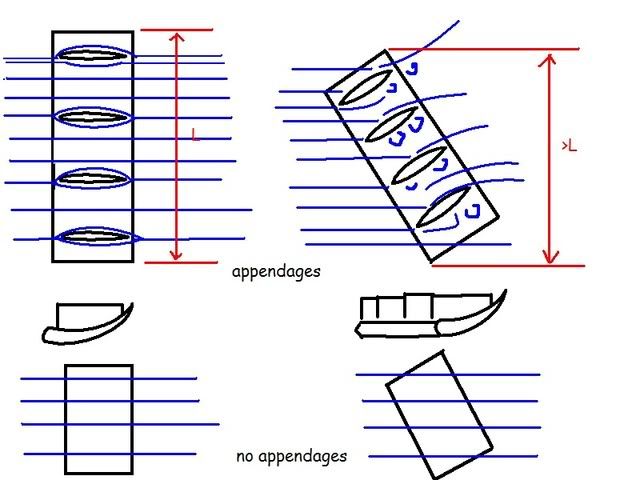
There are studies on these things, and i think there are correlations existing for simple shapes in an array like cubes and rods, (common on stuff like heat exchangers, buildings etc) but all these were derived from wind tunnel experimenting.
Re: Downforce dropoff with yaw (F1)
Posted: 17 Jun 2010, 19:39
by wrcsti
I think the real question should be what can be done to keep the cars from going in yaw. The new rear wing endplates and the long shark fins seem like a good step to keep them going straight but i feel there is more left on the table. On a high speed track you could have a oversteer prone setup but counteract it with downforce allowing for a car that can go anywere the driver wants mid turn.