Page 1091 of 1331
Re: Honda Power Unit Hardware & Software
Posted: 29 Nov 2019, 00:29
by gruntguru
saviour stivala wrote: ↑28 Nov 2019, 09:34
gruntguru wrote: ↑28 Nov 2019, 00:43
saviour stivala wrote: ↑27 Nov 2019, 11:41
But how is it possible to use a gearbox on the other two which have the turbine at one end of the block and the compressor at the other end and the turbine/compressor shaft mandated to be 'one piece' with said shaft having to pass right through the 'H' drive tube?.
Easy. The MGUH would have a hollow shaft. The turbo elements would have a smaller diameter shaft that passes through the middle of the hollow shaft. Have a look at any multi spool gas turbine.
https://www.google.com/search?q=multi+s ... e&ie=UTF-8
"With the one piece turbo shaft having to pass through the 'H' drive tube". Yes. "Easy. The MGU-H would have a hollow shaft". What is the difference between the 'H' having a hollow shaft and the 'H' having drive 'tube'?.
Apologies - I misunderstood your question.
The gearbox is easy too. Epicyclic.
Re: Honda Power Unit Hardware & Software
Posted: 29 Nov 2019, 00:36
by gruntguru
saviour stivala wrote: ↑28 Nov 2019, 14:28
When it comes to ‘connection/connecting’ both the MGU-K with crankshaft and the MG-H with turbo shaft the ‘wording used by the rules is the same (must be of ‘FIXED SPEED RATIO’). In the case of the MGU-K connection to crankshaft. While the MGU-K is limited to a maximum of 50k rpm. The crankshaft is limited to a maximum of 15k rpm. When these two items are connected together, clutch or no clutch being used, they run at a ratio of 3.333 to one another which means there must be gearing in between which provides said ratio, it also means that ratio is ‘fixed’ (cannot change). In the case of the MGU-H connection to turbo shaft. While the MGU-H is limited to a maximum of 125k rpm. The turbo shaft speed is not limited by the rules. Although the ‘wording’ used is the same as for the ‘K’ (must be of FIXED SPEED RATIO). This MGU-H to turbo speed situation born out of the wording used in the rules is akin to the maximum turbo boost situation. The rules does not restrict turbo boost directly, but they sure does “indirectly” by the maximum fuel flow rule permitted.
Two points to add:
1. The MGUK to Crankshaft ratio can be any number less than 3.333 eg no problem to run it 1:1 if you had a high torque, low speed MGUK. You could also run a ratio > 3.333 if you were prepared to reduce your rpm limit to say 14,000.
2. Turbo boost is restricted by a combination of fuel flow limit, best AFR and turbomachinery efficiency.
Re: Honda Power Unit Hardware & Software
Posted: 29 Nov 2019, 00:43
by gruntguru
PlatinumZealot wrote: ↑28 Nov 2019, 01:20
On the compressor map the turbo charger may not spin close to maximum speeds for efficiency reasons.
We only will know if we have that information.
But anyway mexico city is 80% the air density at sea level.
Meaning to get the same pressure inside of the plenum you need a 25% higher pressure ratio than normal.
It is a good idea to examine the compressor map of a turbo that would be similar to the ones used in F1.... Maybe garret gtx4088r? Or likely bigger because of the lean conditions.
Yes the GTX4088R flow doesn't even come close at sea level, let alone +25% at altitude where flow required is equivalent to 115 lb/min at sea level.
Re: Honda Power Unit Hardware & Software
Posted: 29 Nov 2019, 01:04
by henry
In the past I’ve used Rotrex data when looking at inertia levels. The version in this link,
https://rotrex.com/wp-content/uploads/2 ... e_V1.0.pdf is close to the flow needed although a little slow in RPM.
Re: Honda Power Unit Hardware & Software
Posted: 29 Nov 2019, 06:48
by PlatinumZealot
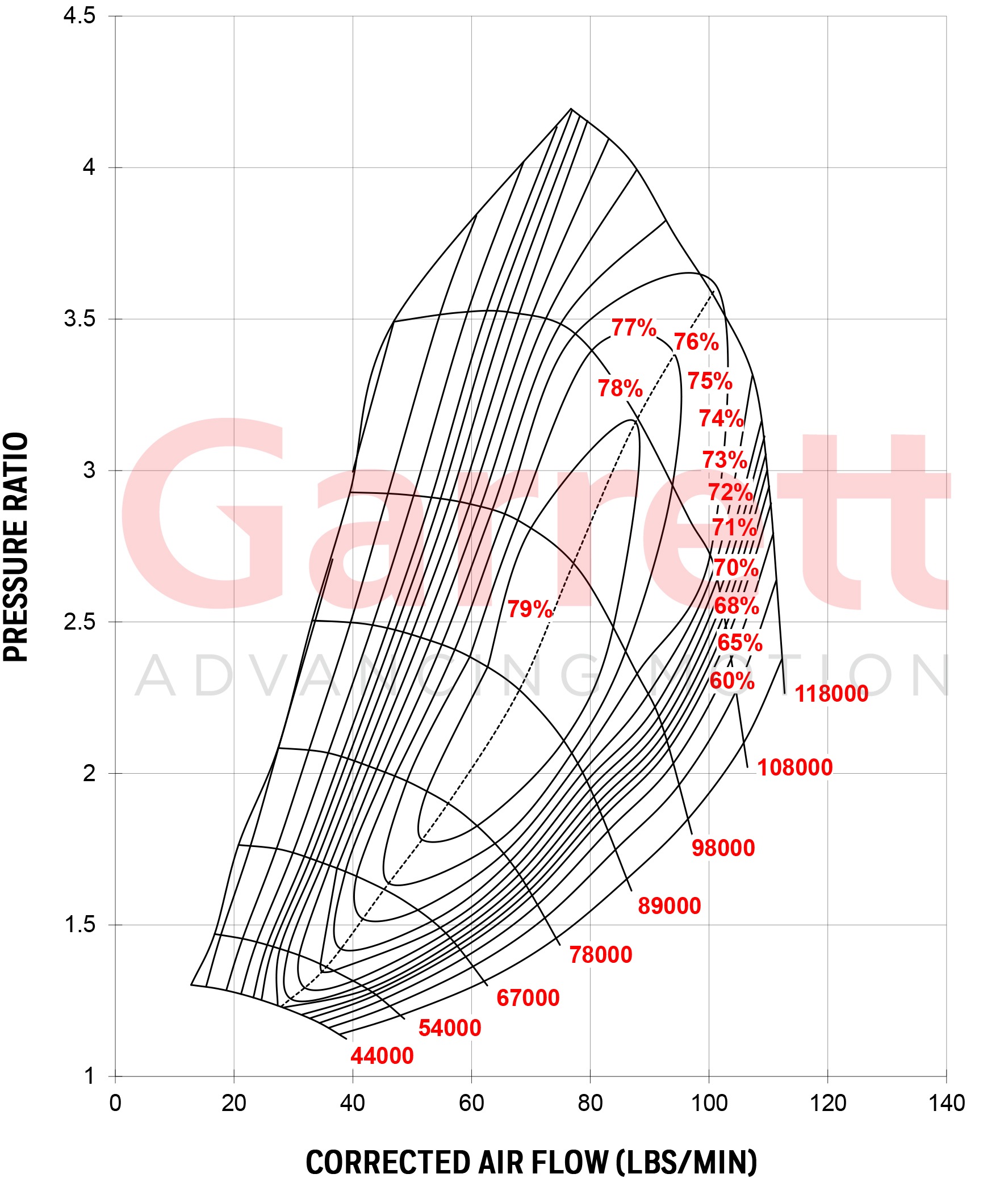
Ok So I used 100kg/hr of fuel and assumed air fuel ratio of 22 to 1.
Got about 80 lbs/min or 0.61 kg/s.
Usign the garrett G42-1200 wheel (This is good for 1200hp) to land in the middle efficiency island of the map. Slightly to the right - because in the race the cars don't run max boost all the time of course.
By examining the map below you can see plenty of head room in terms of turbine speed. at 80lbs/min you go from 2.8 pressure ratio (assuming BEP) to 3.5 for Mexico. Still a lot of head room left in terms of rpm.
Re: Honda Power Unit Hardware & Software
Posted: 29 Nov 2019, 10:33
by saviour stivala
“The MGU-K to crankshaft can be any number (ratio) less than 3.333”. Yes. Because that ratio is the results of the maximum RPM allowed by the rules. And the same reasoning goes for the maximum RPM allowed for the MGU-H. Meaning the MGU-H can be run at any maximum RPM less than that permitted. Technically speaking my personal opinion is that the design targets will be to use the minimum RPM possible to achieve designed output targets. This my personal opinion goes to not only as regards MGU-K and MGU-H maximum RPM but also as regards the TURBO and ICE maximum RPM. This design target aim of running rotating components element of the power unit at the least possible RPM is driven by the search to achieve the highest efficiency possible. It is worth repeating again on here what was said earlier and elsewhere about the ICE maximum power speed subject, namely, that the maximum of ‘100kg/h @ 10500 RPM fuel flow rate’ rule was originally added to the final formulation of the back then new power unit formula when the rule makers realized that the original text of only limiting race distance to ‘100 kg fuel load’ will drive the ICE designers to target a far less maximum power speed than the added and mandated of 100kg/h @10500RPM.
Re: Honda Power Unit Hardware & Software
Posted: 02 Dec 2019, 00:00
by Snorked
PU's highest race power setting is engine 11, position 7

Re: Honda Power Unit Hardware & Software
Posted: 02 Dec 2019, 06:56
by gruntguru

G42 Compressor showing operating points from 8,000 to 15,000 rpm assuming constant AFR and P.Z's airflow of 80 lb,minute at sea level.
Edited to replace erroneous chart.
Re: Honda Power Unit Hardware & Software
Posted: 02 Dec 2019, 19:37
by PlatinumZealot
gruntguru wrote: ↑02 Dec 2019, 06:56

G42 Compressor showing operating points from 8,000 to 15,000 rpm assuming constant AFR and P.Z's airflow of 80 lb,minute at sea level.
Since the air flow is corrected already...
Re: Honda Power Unit Hardware & Software
Posted: 03 Dec 2019, 00:17
by gruntguru
I have edited the post above to correct the map. The boost required from 5,000 rpm to 10,000 rpm should be approximately constant for constant AFR.
Re: Honda Power Unit Hardware & Software
Posted: 04 Dec 2019, 00:26
by Jaisonas
Im curious about the performance of the other engine 11 modes compared to engine 6 or the other modes
Re: Honda Power Unit Hardware & Software
Posted: 05 Dec 2019, 03:37
by PlatinumZealot
gruntguru wrote: ↑03 Dec 2019, 00:17
I have edited the post above to correct the map. The boost required from 5,000 rpm to 10,000 rpm should be approximately constant for constant AFR.
I was suggesting that sine the Compressor map is already corrected for mass flow rate... the Mexico mass flow rates should stay the same as sea level but the pressure ratio would have increased. at least thats my assumption. This brings even more headroom.
Re: Honda Power Unit Hardware & Software
Posted: 05 Dec 2019, 06:58
by gruntguru
Correction assumes sea level. If you have 20% thinner air and want the same massflow, you need 25% more volume flow at the inlet and (ideally) a 25% bigger turbocharger.
Re: Honda Power Unit Hardware & Software
Posted: 05 Dec 2019, 17:36
by godlameroso
I honestly think that the Honda is a bit overengineered with regards to cooling and because of this, altitude affects the power unit less than other cars who's body work is a bit more extreme(Mercedes). I think the compressor has enough margin to operate at altitude or at sea level, but cooling becomes more difficult at altitude because there's less air cooling the components. So teams who have more margin on cooling can push harder at altitude. If Honda makes their cooling more extreme it would probably increase downforce at the expense of cooling at altitude, although it may be fine at sea level. Finding the proper compromise is the challenge, so they can run the power unit equally at sea level or altitude while having very shrink wrapped body work.
Re: Honda Power Unit Hardware & Software
Posted: 05 Dec 2019, 18:27
by sosic2121
godlameroso wrote: ↑05 Dec 2019, 17:36
I honestly think that the Honda is a bit overengineered with regards to cooling and because of this, altitude affects the power unit less than other cars who's body work is a bit more extreme(Mercedes). I think the compressor has enough margin to operate at altitude or at sea level, but cooling becomes more difficult at altitude because there's less air cooling the components. So teams who have more margin on cooling can push harder at altitude. If Honda makes their cooling more extreme it would probably increase downforce at the expense of cooling at altitude, although it may be fine at sea level. Finding the proper compromise is the challenge, so they can run the power unit equally at sea level or altitude while having very shrink wrapped body work.
I had a similar thought.
Also intercooler cooling demands also increase due to higher compression ratio needed.