Page 12 of 18
Re: How can teams resolve tyre issues?
Posted: 17 Jul 2010, 00:00
by 747heavy
Thanks Dave,
That´s what I thought and have seen (decrease in vertical stiffness), just wanted to
get a different opinion on it.
O.K. - I know that this is far fetched, it just crossed my mind. could the decrease in
stiffness not lead to more movement -> more friction -> more heat
Re: How can teams resolve tyre issues?
Posted: 17 Jul 2010, 00:09
by Jersey Tom
I'll say it again... heat is not what lets camber generate more grip.
Re: How can teams resolve tyre issues?
Posted: 17 Jul 2010, 00:58
by DaveW
Jersey Tom wrote:I'll say it again... heat is not what lets camber generate more grip.
I am aware of that, JT. Turning your sentence around somewhat, perhaps camber generates more heat that can deliver (yet more) grip or, sometimes, rather less....
Re: How can teams resolve tyre issues?
Posted: 17 Jul 2010, 01:07
by JohnsonsEvilTwin
According to Forza,
Negative camber(not much, just a bit) is almost universally desirable(in saloons) due to a force generated by the wheel called "camber thrust".
Camber thrust occurs when a wheel is lent over from the perpendicular - it immediately wants to turn.
Too much and you will have an unbearably nervous car.
Re: How can teams resolve tyre issues?
Posted: 17 Jul 2010, 01:50
by 747heavy
Hi Johnson,
I´m not 100% sure what you want to say, with the car becomes nervous with more camber.
This (IMHO) would be the case when you loose ground contact on one wheel, then the other wheel
will "push" the car in the direction of the lean.
If you have the same camber settings on both wheels, the forces generated will even out.
On a "relative" smooth race track, this should not be too much of a problem
If you have very different camber settings (LHS vs. RHS), the car will develop a push in one direction.
You normally adjust your toe settings to go with your camber settings, to offset some of the forces, to make the tie roll with less resistence in a straight line.
Apart from limit´s within your tire construction, one of the drawbacks from running high camber settings is, that you loose longitunal grip why running in a straight line.
So you will handicap your braking and accel.
Depending fom the track characteristic, if braking hard is important for good laptime, you will need to compromise, between braking and corneing performance.
Especially in Touring cars at one point you run into problems with braking, and turn in braking, as it is very easy to flat spot the inner/unloaded wheel, which at this point, has very little load and contact with the road.
Doing this a couple of time, or one time big, is enough to ruin your tire/race.
Other than that (as J.T. also pointed out), at least in Touring Cars, it is a easy and quick way to find more grip in the corners/better laptime (most of the time).
The gain is may not long lived, as it stresses the inner shoulder of the tire a lot.
Most tires will withstand the abuse for a short time (Qualifying) but for the race, you will need to back off.
In some production based Touring car series, I have seen camber angles in excess of 8.5° being used, at times.
The techs from the tire company, did not liked it at all, but it made the car in question quicker. So people will go there, and risk a tire failure.
Re: How can teams resolve tyre issues?
Posted: 17 Jul 2010, 14:22
by ubrben
Break in of tyres is normal. Main effects are weft fibres breaking in the predominantly UD reinforcement layers of the. The wefts are there so the materials are handleable at the factory.
Payne and Mullins effect in filled rubber are also relevant to how tyres respond to strain histories.
In terms of graining an interesting aspect of rubber that hasn't been mentioned yet is temperature-frequency equivalency. This is represented by the WLF transformation. This basically models how a rubber at low temperature becomes stiff, but also how a rubber excited at high frequency also becomes stiff in essentially the same way.
This is interesting because the shorter the wavelength content of the track surface the higher frequency input there is to the rubber for a given sliding speed of the contact patch. This means the rubber is effectively stiffer, but also has higher tangent delta (energy dissipation). If you end up close to glass transition you might have a problem...
Incidentally this gives you some idea as to why newly resurfaced tracks (or diamond ground ones for that matter) are more "aggressive" than older polished surfaces are less aggressive but lower grip.
Ben
Re: How can teams resolve tyre issues?
Posted: 17 Jul 2010, 14:23
by ubrben
And to respond to DaveW's earlier point. Tyre development is so heuristic you wouldn't believe

Re: How can teams resolve tyre issues?
Posted: 17 Jul 2010, 16:04
by DaveW
Thanks for that, Ben.
Incidentally, & sort of on-topic, I listened to an interesting presentation many moons ago (more than I care to remember) claiming that tyres emit microwave energy with a characteristic that was a function of "core" temperature. I can't remember the technical details, but the author claimed he had produced the prototype of a non-contacting sensor that generated a signal proportional to core temperature. I guess the sensor would be rather similar in principle to an IR pyrometer.
At the time I thought that the idea was a) improbable (the world was young then) & b) very interesting. Has anything come of it, do you know?
p.s. Stopped being lazy & searched. US patent 4673298, for those interested.
Re: How can teams resolve tyre issues?
Posted: 17 Jul 2010, 16:25
by marcush.
many thanks to all contributors putting milk on the table.. very much fuel for thought and I just wished I had some tyre trouble in this current part of my life..

anyways many thanks for sharing ..
Re: How can teams resolve tyre issues?
Posted: 17 Jul 2010, 16:39
by 747heavy
Thanks Ben & DaveW
It´s a bit off-topic as well, but a very efficient method to heat tires is via micowaves.
It´s (AFAIK) banned now in allmost any categorie, but was used by AUDI in LeMans with great
success in one year. After that it was banned.
So, can we conclude, that frequency is another important component in how and why (or at times why not) a tire generates more or less grip, under what seems identic (a.g. track temp) conditions.
If right on the limit, a little bit higher corner speed, or more or less sliding(e.g. understeer) could be all what is needed to push the tire "over the edge".
As I would think that these frequnencies are rather high (in this context I mean > 20Hz, not in the range of body or wheel frequency, this would bring "parasitic" frequencies from the engine, drive train or due to wheel imbalance/deformation into the picture.
If "right" engine or drive train frequency get´s, via the suspension, transmitted into the tire, it will effect grip.
Here damper caracteristics which are not part of the "normal

" force vs. velocity
graph can play a role, in helping to "isolate" the tire from these frequencies.
Re: How can teams resolve tyre issues?
Posted: 17 Jul 2010, 18:02
by 747heavy
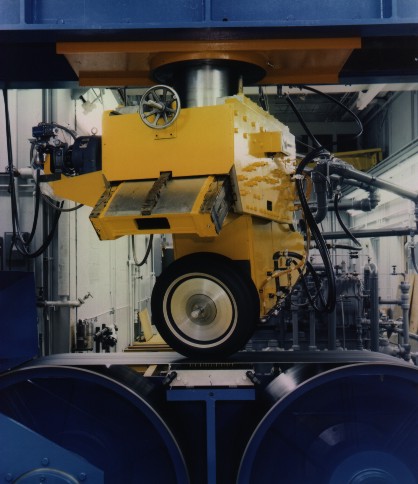
Little bit off topic, but may some of you find it interesting:
Some photos
SPMM test tig:


tire test machines:


Re: How can teams resolve tyre issues?
Posted: 18 Jul 2010, 10:42
by DaveW
Simple, perhaps, but effective. Frequency range - up to 40 Hz.:

Re: How can teams resolve tyre issues?
Posted: 18 Jul 2010, 10:57
by marcush.
747heavy wrote:Thanks Ben & DaveW
It´s a bit off-topic as well, but a very efficient method to heat tires is via micowaves.
It´s (AFAIK) banned now in allmost any categorie, but was used by AUDI in LeMans with great
success in one year. After that it was banned.
So, can we conclude, that frequency is another important component in how and why (or at times why not) a tire generates more or less grip, under what seems identic (a.g. track temp) conditions.
If right on the limit, a little bit higher corner speed, or more or less sliding(e.g. understeer) could be all what is needed to push the tire "over the edge".
As I would think that these frequnencies are rather high (in this context I mean > 20Hz, not in the range of body or wheel frequency, this would bring "parasitic" frequencies from the engine, drive train or due to wheel imbalance/deformation into the picture.
If "right" engine or drive train frequency get´s, via the suspension, transmitted into the tire, it will effect grip.
Here damper caracteristics which are not part of the "normal
" force vs. velocity
graph can play a role, in helping to "isolate" the tire from these frequencies.
to turn your idea the other ways round... could it be that a tyre at optimum grip shows a certain acoustic pattern-and monitoring this could help to find out where to go in terms of setup to get back to this sweet spot??
found this about checking Carbonfibre parts for integrity..
http://www.formtech-composites.co.uk/ac ... paper.html
Re: How can teams resolve tyre issues?
Posted: 18 Jul 2010, 11:21
by Tim.Wright
747heavy wrote:
If "right" engine or drive train frequency get´s, via the suspension, transmitted into the tire, it will effect grip.
The right frequency for maximum grip is 0Hz. Any oscillations will normally result in a net decrease of available grip. This is due to tyre load sensitivty, lag due to relaxation and a whole bung of other things.
This is the primary function of the suspension; i.e to isolate the bulk of the vehicle mass from the wheel mass to reduce contact patch force variations
Tim
Re: How can teams resolve tyre issues?
Posted: 18 Jul 2010, 11:43
by marcush.
Tim.Wright wrote:747heavy wrote:
If "right" engine or drive train frequency get´s, via the suspension, transmitted into the tire, it will effect grip.
The right frequency for maximum grip is 0Hz. Any oscillations will normally result in a net decrease of available grip. This is due to tyre load sensitivty, lag due to relaxation and a whole bung of other things.
This is the primary function of the suspension; i.e to isolate the bulk of the vehicle mass from the wheel mass to reduce contact patch force variations
Tim
in a static system I agree but nothing is static in a real world situation on track ?
what is the reasoning for big bang engines in MotoGP then ? I have to admit I have no idea if that concept is still in use there...