Page 12 of 19
Re: Ringo F1 design
Posted: 25 Oct 2011, 10:12
by Tozza Mazza
Apologies, got all my regs wrong, yeah it's legal.
Re: Ringo F1 design
Posted: 26 Oct 2011, 01:10
by ringo
Ready for the radiator?

Re: Ringo F1 design
Posted: 26 Oct 2011, 09:27
by Holm86
Where is it??

Re: Ringo F1 design
Posted: 28 Oct 2011, 04:45
by ringo
edit: let me modify the model.

I have come to a conclusion that a standard design is best.
Mine is more thermally efficient, but the absolute temperature drop is not a big for the same surface area.
The plane jane design is the optimum. Mine good for a frontal area compromise and could posibbly work in cool track conditions.
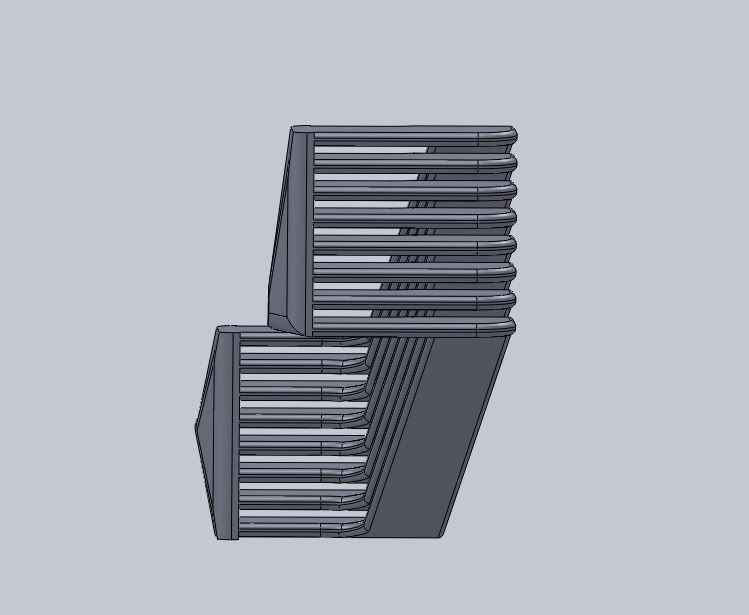
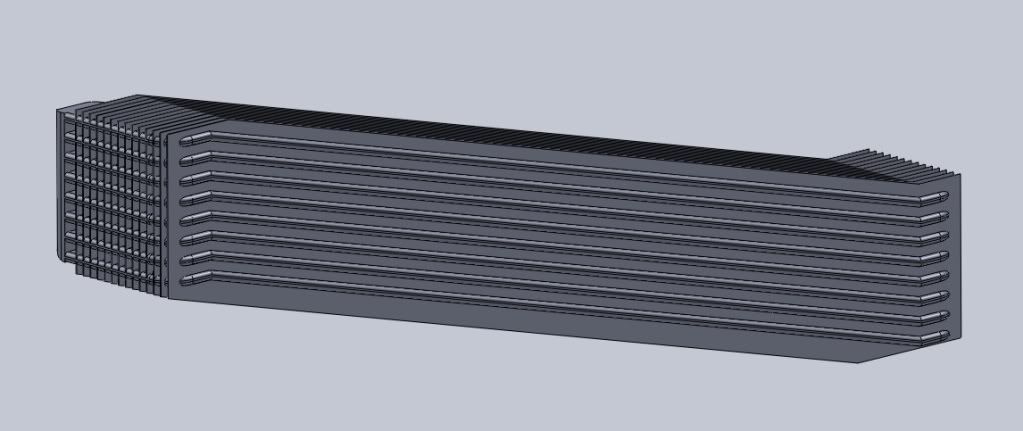
It has some flaws to it, but here it is anyway. It doesnt expose all the surfaces to the lowest temperature like the conventional radiator design. Also the lenght has to be carefully tuned to match the heat rate of the air coming in.
So i'll go back to the drawing board, and have a more conventional design with maybe a slight modification.
Oh yeah i forgot to mention, the cooling fluid in this system is Sodium flouride solution.
Re: Ringo F1 design
Posted: 28 Oct 2011, 06:50
by atanatizante
Ringo, could you design a 3D tear drop shape radiator?
Re: Ringo F1 design
Posted: 29 Oct 2011, 13:40
by hollus
Ringo.
Why sodium fluoride and not other salt? Honestly curious and interested here.
Also, is it allowed to use electrolytes for cooling fluid?
I thought that teams pressurized their cooling water circuits to allow them to operate at higher temperatures (120C or so) without boiling because they were not allowed to use any fluid other than water.
Re: Ringo F1 design
Posted: 29 Oct 2011, 15:54
by ringo
atanatizante wrote:Ringo, could you design a 3D tear drop shape radiator?
It's possible, but i don't think it would be efficient in terms of space and heat exchange.
Re: Ringo F1 design
Posted: 29 Oct 2011, 16:06
by ringo
hollus wrote:Ringo.
Why sodium fluoride and not other salt? Honestly curious and interested here.
Also, is it allowed to use electrolytes for cooling fluid?
I thought that teams pressurized their cooling water circuits to allow them to operate at higher temperatures (120C or so) without boiling because they were not allowed to use any fluid other than water.
Pure water has the best thermal conductivity. Salts tend to reduce that. The salt only make the boiling point and freezing point change, and the electical conductivity.
Sodium flouride is one of the few chemicals that has increasing conductivity over pure water, as its concentration increases.
It's particular very conductive at the temperatures that an engine cooling system operates at.
I think it is allowed to use electrolytes as cooling fluids, as i haven't seen anything in the rules specifying which fluids must be used.
The thing is salts dont agree with conductivity, as water is simply better. So i guess that's why the teams simply use pure water.
The salts may have an effect on engine scale build up, i don't know, but seeing as though the auxilaries around an F1 engine are dismantled and cleaned up. It should not be an issue as if it were like a road car engine cooling system that is hardly ever dismantled.
I have done a little mini research on the sodium flouride and it's pretty much a better solution than pure water.
One other issue with the salt, is the concentration and the density, engine power can suffer if pumping requirements will increase. But then if the pump can get superior cooling at lower pressures, then a balance can be found.
Re: Ringo F1 design
Posted: 29 Oct 2011, 16:47
by ringo
7.5 Coolant header tank :
The coolant header tank on the car must be fitted with an FIA approved pressure relief valve which is set to a maximum of 3.75 bar gauge pressure, details of the relief valve may be found in the Appendix to these regulations. If the car is not fitted with a header tank, an alternative position must be approved by the FIA.
7.6 Cooling systems :
The cooling systems of the engine must not intentionally make use of the latent heat of vaporisation of any fluid
nothing about coolant type here.
Re: Ringo F1 design
Posted: 29 Oct 2011, 19:45
by atanatizante
ringo wrote:atanatizante wrote:Ringo, could you design a 3D tear drop shape radiator?
It's possible, but i don't think it would be efficient in terms of space and heat exchange.
In terms of space you could gain some if you have: a) a longer wheel base or b) 3,4 (or whatever it thakes) layers radiator system, one above the other.
In terms of heat exchange, the longer circuit you could built the better, isn`t it? Therefore, if you have a system composed of parallel multi-horizontal radiators, everything disposed in a 3D tear drop manner you could increase the length of the circuit ...
Re: Ringo F1 design
Posted: 30 Oct 2011, 00:10
by MIKEY_!
MGP tried something similar this year didn't they? But with 2 layers?
Re: Ringo F1 design
Posted: 30 Oct 2011, 02:19
by ringo
atanatizante wrote:ringo wrote:atanatizante wrote:Ringo, could you design a 3D tear drop shape radiator?
It's possible, but i don't think it would be efficient in terms of space and heat exchange.
In terms of space you could gain some if you have: a) a longer wheel base or b) 3,4 (or whatever it thakes) layers radiator system, one above the other.
In terms of heat exchange, the longer circuit you could built the better, isn`t it? Therefore, if you have a system composed of parallel multi-horizontal radiators, everything disposed in a 3D tear drop manner you could increase the length of the circuit ...
Yes you can, but if there is a limited amount of air coming into the side pod at one time. The air can saturate with heat, and it will reach a point where downstream sections of the radiator will have to exhchange heat with hot air. This reduces overall temperature drop, though it increase efficiency.
The contrast to this is the current radiator design, where the every part of the radiator is exposed to the same temperature air. No part of the radiator is seeing hot air to exchange heat with. If you notice F1 radiators are relatively thin for this purpose.
Having a 3d designs is use full when it comes to thermal efficiency, but it can be overdone.
This is what i realized with my current design. It's a potential weakness, but this and tear drop design would have to be tested to see how much worse or better they are, and if the advantage in reduced frontal area outweighs that.
They may not have a benefit if they don't attain a smaller frontal area.
Re: Ringo F1 design
Posted: 01 Nov 2011, 05:16
by PlatinumZealot
Sodium flouride is toxic. 5 to 10g can kill a human. (Wikipedia).
Re: Ringo F1 design
Posted: 01 Nov 2011, 08:00
by MIKEY_!
So be careful. Would you drink the radiator fluid from your car? I would be careful not to get it even on my skin. Poisonous will not be a problem unless the rads are ruptured in a crash.
Re: Ringo F1 design
Posted: 02 Nov 2011, 01:19
by ringo
I think it may still be used, but toxity is definitely a concern if a team would want to try this.
However i think they will know what tests to go through and procedures to see if it's safe enough to use.
The differences between pure water is noticeable, which can be weighed against the safety.