Re: 2017-2020 Aerodynamic Technical Regulations
Posted: 27 Dec 2020, 02:03
Same reason they were banned,I guess. If they break their seal, the downforce disappears too suddenly. So safety.
Understandable, but isn't that also the case for the front wings? I wonder if they were considered, a rubber skirt like on a hovercraft would get the job done.

They make a slight return at the rear wheels, to seal off the rear diffuser and tidy up the rear wheel turbulence.ENGINE TUNER wrote: ↑26 Dec 2020, 16:40Back on topic, does anyone know why side skits weren't adopted for the new aero regs? Wouldn't they provide more downforce and cut down on turbulence, especially in traffic?
Their car was smoking like crazy...
They suck in a dangerous way.ENGINE TUNER wrote: ↑26 Dec 2020, 16:40Back on topic, does anyone know why side skits weren't adopted for the new aero regs? Wouldn't they provide more downforce and cut down on turbulence, especially in traffic?
Breaking a front wing is harder than going over a hump or a kerb awkwardly so the seal to the ground would fail, which would take away a good chunk of downforce immediately.ENGINE TUNER wrote: ↑27 Dec 2020, 06:25Understandable, but isn't that also the case for the front wings? I wonder if they were considered, a rubber skirt like on a hovercraft would get the job done.
I can point you to my PhD thesis if you wanna know why they have/need a big rear wingmzso wrote: ↑27 Dec 2020, 21:17Though I don't get why they didn't make the formula more underbody downforce focused. With minimal to no back wing. And (since they claim that it's necessary) only leaving the parts of the front wing that guides the air so that it would create the least turbulence behind.

There's no reason a trailing edge of a wingless car's body/diffuser couldn't do the same.jjn9128 wrote: ↑27 Dec 2020, 21:49I can point you to my PhD thesis if you wanna know why they have/need a big rear wingmzso wrote: ↑27 Dec 2020, 21:17Though I don't get why they didn't make the formula more underbody downforce focused. With minimal to no back wing. And (since they claim that it's necessary) only leaving the parts of the front wing that guides the air so that it would create the least turbulence behind.
[url=https://www.formula1.com/en/latest/arti ... LN8Ox.html]Alternatively there's this article on the official F1 website with quotes from Pat Symonds about why it's necessary./url]
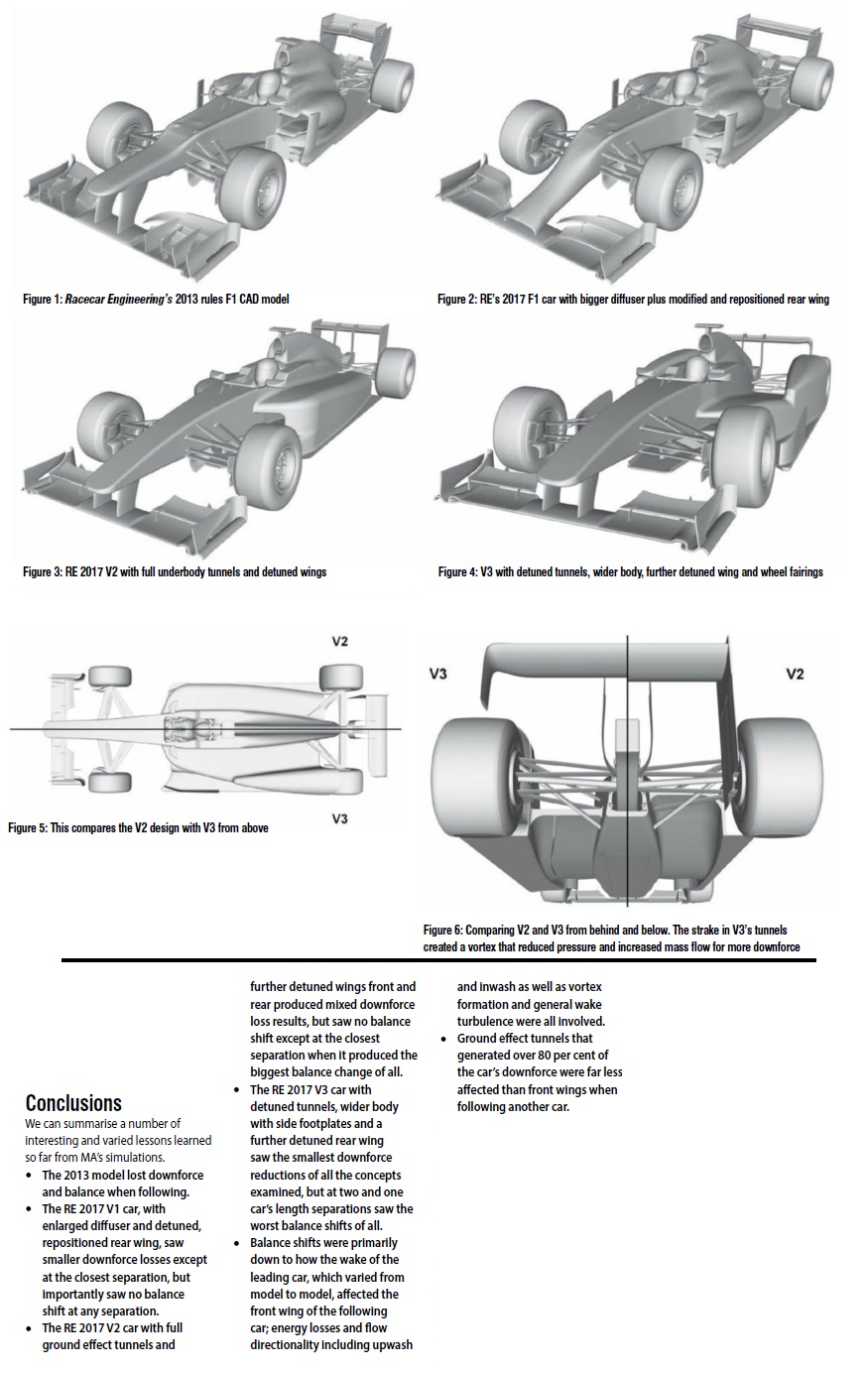
I disagree. The closer into ground effect a wing/downforce producing body is the more it's circulation is cancelled - which means wake upwash is reduced. The result is that the wake just hangs around - DynamicFlow/Miqdad Ali did an article in Racecar Engineering back in 2017 (?) with a "ground effect" car with tiny wings and showed this in action. The rear wing tip vortex pair is also really important in "cleaning" up the wake.
They do have side skirts, they just don’t extend below the “boat keel” and are fixed.ENGINE TUNER wrote: ↑26 Dec 2020, 16:40Back on topic, does anyone know why side skits weren't adopted for the new aero regs? Wouldn't they provide more downforce and cut down on turbulence, especially in traffic?
What do you mean by circulation in this use?
Not sure what to think about the vortices. They do anything they can to decrease them otherwise they wouldn't have endplates.
Is this available somewhere?
Circulation in this case refers to the bound vortex - part of lifting line theory, the air doesn't physically circulate around a lifting body, but without it there's no flow direction change in the mathematical model. In this case think of it in terms of Newtons 3rd law (a bit of a simplification) - the ground is exerting force on the car so the car is exerting force on the ground - there's a mirror image under the ground and the direction change of the flow, upwash in the wake, is cancelled.mzso wrote: ↑02 Jan 2021, 12:44What do you mean by circulation in this use?
I just fail to see a difference. If you want air to go up you just shape the trailing edge to do that without making a separate windcatcher (rear wing). You could add horizontal elements to the diffuser if it's really necessary. (Though I wouldn't expect it would be if a plain wing is enough)
The rear wing tip vortices are really powerful, the wings aspect ratio is pretty square so any treatment around the tips is only reducing the vortex strength by a few percent max. Endplates increase downforce too - the constraint of flow at the tip increases the effective span of the wing - making the spanwise lift distribution more rectangular than elliptical.
Other than direct from RCE not sure. This was posted from it here on p102 of this thread