Page 18 of 43
Re: Lotus E20 Renault
Posted: 27 Jul 2012, 22:21
by Huntresa
superdread wrote:bhallg2k wrote:It's believe that the system is completely independent of DRS, that it's activated at a certain pressure.
A passive F-Duct would brush the limits of legality, as the teams agreed not to pursue that further in exchange for the DRS.
The explanation that it permanently channels air from the ears down above the beam wing and with a pressure switch (activated by the opening of the DRS) detaches the flow, at least in the middle of the main wing.
Dude tell me what is an F-Duct ? Cause the FIA doesnt know and the teams doesnt know either, and there is no rule that says you cant have an F-Duct cause what is an F-duct ? For all we know an F-duct can be my mom

Both Merc and Lotus air channeling stuff is perfectly legal within that it operates as a passive 2nd ability to the movemnt of DRS.
Also no they didnt agree to not pursue it in exchange for DRS, DRS was made up by the FIA to get more overtaking, the "f-duct" on the mclaren and other cars during 2010 was made to make the car go faster.
Re: Lotus E20 Renault
Posted: 27 Jul 2012, 22:24
by bhall
superdread wrote:bhallg2k wrote:It's believe that the system is completely independent of DRS, that it's activated at a certain pressure.
A passive F-Duct would brush the limits of legality, as the teams agreed not to pursue that further in exchange for the DRS.
The explanation that it permanently channels air from the ears down above the beam wing and with a pressure switch (activated by the opening of the DRS) detaches the flow, at least in the middle of the main wing.
bhallg2k wrote:Where is this idea coming from that any hole is illegal?
Formula 1 Blog wrote:Opinion on DRS‐activated F‐Duct systems
CW: We think they’re going to be legal from what we’ve seen so far.
Why some teams are querying this
CW: Some teams are questioning it on the basis that they thought F‐Ducts were banned. F‐Ducts are
not banned. At the end of 2010 everyone was using driver operated F‐Ducts. The regulations that
were changed specifically banned the use of driver movement to influence the aerodynamic
performance of the car. This got rid of that generation of F‐Ducts.
Engineers, being unable to unlearn things, wanted to get the things back via different means. They
talked about allowing the opening and closing of a duct by having interaction with suspension. We
said no, you can’t do that, because it goes to the primary purpose of the suspension system.
There was a discussion in the TWG (Technical Working Group) at the beginning of the last year to
make sure this was clear. It seems that a couple of teams went away from that meeting with the
impression that F‐Ducts were therefore banned in general.
What some teams are doing now is allowing air to pass into a duct when the DRS is operated. It’s
completely passive, there are no moving parts and it doesn’t interact with any suspension or steering
systems.
Therefore, I can’t see any rule that prohibits it.
EDIT: That interview with Charlie Whiting was in February and dealt with Mercedes' Daffy Duct. Despite the inherent differences in the Mercedes and Lotus solutions, I think it's still relevant.
Re: Lotus E20 Renault
Posted: 27 Jul 2012, 22:33
by Huntresa
Yeah its relevant cause the holes themself doesnt break any rules, but teams thought using the DRS did, but it doesnt so you can essentially hook uip anything to the DRS action.
Re: Lotus E20 Renault
Posted: 27 Jul 2012, 22:42
by superdread
I know, switched ducts (if by driver (F-Duct) or by air pressure from somewhere else (passive "F-Duct") are not strictly forbidden, as it's impossible to effectively forbid it (there is a perfectly legitimate duct that even has an engine in the middle).
A passively switched duct purely for aerodynamic purposes would not go unrecognized by the FIA. If someone were actually able to effectively utilize such a system it would most probably trigger some change in the rules.
Mercedes tried passive ducts but abandoned them for the DDRS-system. And Lotus will also more likely go for that.
I think, the main problem is that you would have the system to switch at a precise speed (which depends on the circuit, fuel load, tire weather...) and that can't be resolved for a complete race distance.
Re: Lotus E20 Renault
Posted: 27 Jul 2012, 22:46
by bhall
superdread wrote:[...]
A passively switched duct purely for aerodynamic purposes would not go unrecognized by the FIA. If someone were actually able to effectively utilize such a system it would most probably trigger some change in the rules.
[...]
How come? If a DRS-activated F-duct is officially considered passive, why would a literally passive F-duct be any different?
Am I missing something?
Re: Lotus E20 Renault
Posted: 27 Jul 2012, 22:51
by madly
Re: Lotus E20 Renault
Posted: 27 Jul 2012, 22:54
by PlatinumZealot
PhillipM wrote:To be honest, I think it's as simple as DRS off > High pressure on wing plates = air from scoops goes through hole to vent in middle of monkey seat to draw out hot air from cooling.
DRS on, pressure drops on wing, flow diverts upwards to slit in main plain to blow the wing = better DRS.
Now, I think the side vents (I think they are holes, not reflections, maybe proved wrong, doesn't really matter, switching can be done via the wing/beam wing combo)) are part of the switching mechanism for that, which isn't dialled in yet, which would be why Raikonen would be complaining of a loss of low-speed downforce - the wing is being blown when the pressure on the front main plane drops in the slower corners, obviously they don't quite have the balance right, even with the monkey seat designed to create low pressure behind the lower exit?
You can't have a slit in the main plane. that is illegal.
Please no more slits in the main plane... I beg you.. pleaaa
Re: Lotus E20 Renault
Posted: 27 Jul 2012, 23:02
by superdread
bhallg2k wrote:
How come? If a DRS-activated F-duct is officially considered passive, why would a literally passive F-duct be any different?
Am I missing something?
I'm not aware of a official naming scheme, and meant by active anything that is caused by the driver (in current rules only by DRS) and passive anything that is switched by some sort of environmental effect (pressure...). A hole opened by the DRS flap would therefore qualify as active.
Re: Lotus E20 Renault
Posted: 27 Jul 2012, 23:03
by Huntresa
superdread wrote:I know, switched ducts (if by driver (F-Duct) or by air pressure from somewhere else (passive "F-Duct") are not strictly forbidden, as it's impossible to effectively forbid it (there is a perfectly legitimate duct that even has an engine in the middle).
A passively switched duct purely for aerodynamic purposes would not go unrecognized by the FIA. If someone were actually able to effectively utilize such a system it would most probably trigger some change in the rules.
Mercedes tried passive ducts but abandoned them for the DDRS-system. And Lotus will also more likely go for that.
I think, the main problem is that you would have the system to switch at a precise speed (which depends on the circuit, fuel load, tire weather...) and that can't be resolved for a complete race distance.
Lotus is somehow using the DRS, otherwise there wouldnt be a pillar going to the RW, thats quite clear.
Also they said it worked today.
Re: Lotus E20 Renault
Posted: 27 Jul 2012, 23:07
by madly
Compare those two photos. It looks like in new 'aero device' exhaust gases are directed higher (bottom of RW?) and in standard solution gases are directed lower (beam wing?). Or it is illusion - different shot angles?

(HiRes click to open)

Re: Lotus E20 Renault
Posted: 27 Jul 2012, 23:11
by madly
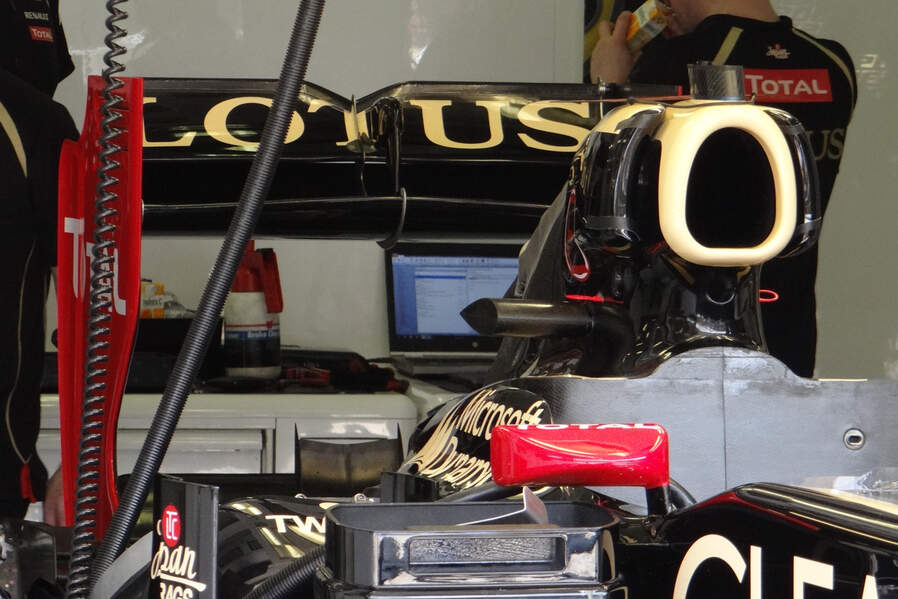
Opened and closed (for race) "ear slots". Not the most effective and spectacular way to disable it

.

Re: Lotus E20 Renault
Posted: 27 Jul 2012, 23:16
by madly
Good shot of diffuser. It seems, that Kimi was using new "aero device" after rain in FP2, even if he started FP2 without this system.

Re: Lotus E20 Renault
Posted: 27 Jul 2012, 23:18
by bhall
superdread wrote:bhallg2k wrote:
How come? If a DRS-activated F-duct is officially considered passive, why would a literally passive F-duct be any different?
Am I missing something?
I'm not aware of a official naming scheme, and meant by active anything that is caused by the driver (in current rules only by DRS) and passive anything that is switched by some sort of environmental effect (pressure...). A hole opened by the DRS flap would therefore qualify as active.
Formula 1 Blog wrote:[...]
What some teams are doing now is allowing air to pass into a duct when the DRS is operated. It’s
completely passive, there are no moving parts and it doesn’t interact with any suspension or steering
systems.
Therefore, I can’t see any rule that prohibits it.
Technically, you're absolutely right. But, Charlie Whiting sees it differently.
Re: Lotus E20 Renault
Posted: 27 Jul 2012, 23:20
by FrukostScones
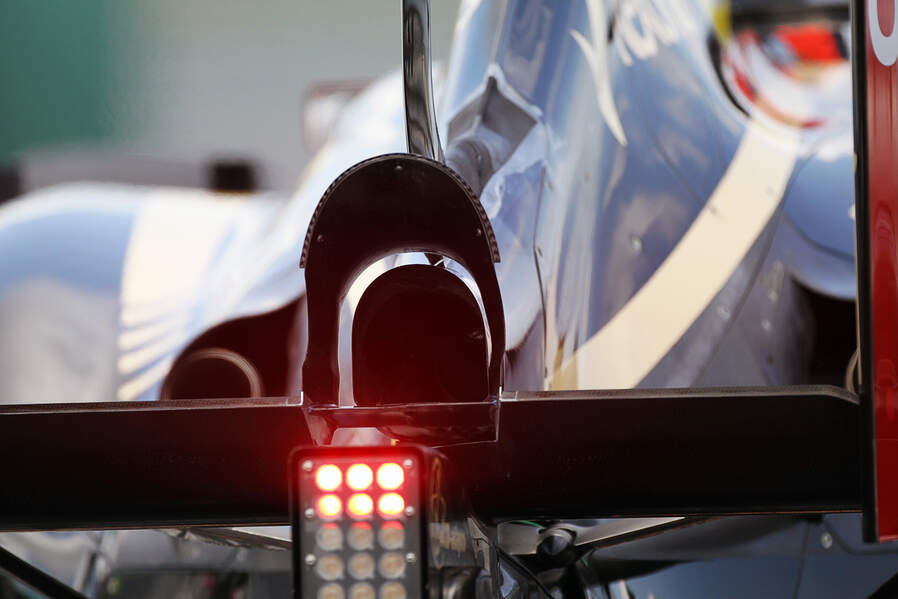
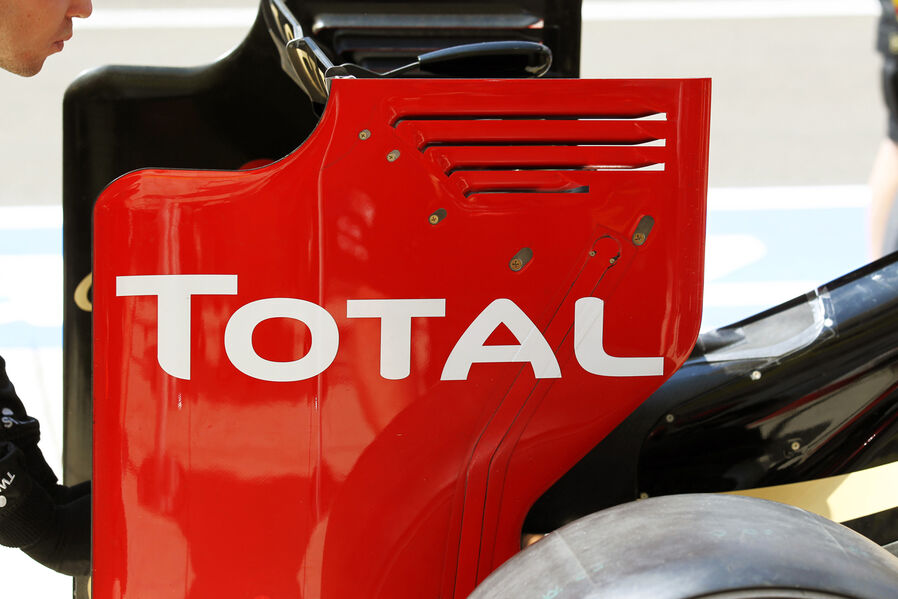
from automotorundsport.de
edit: I checked, but some didn't pop up.
Re: Lotus E20 Renault
Posted: 27 Jul 2012, 23:39
by madly
There are some changes in new 'aero device' since Hockenhaim. Vertical part of middle pilar has different shape (less bulge) and there is different join with car body. There is no hole in join too.
Hungary:

Germany:


Hungary:
Germany - hole in the join with bodywork and different shape of this join:


