Page 18 of 40
Re: The relative benefits of a pull rod suspension in 2011
Posted: 03 Feb 2011, 01:50
by DaveW
Ringo: There is no doubt that RBR created a very competitive car last year, complete with its pull rod rear suspension. I was under the impression, however, that Ferrari's offering, with its inferior push rod suspension, was also reasonably competitive once its version of the blown diffuser was working properly. In fact, I had thought that the Ferrari "won" the second half of the season in Alonso's hands. I must have been mistaken.
Re: The relative benefits of a pull rod suspension in 2011
Posted: 03 Feb 2011, 02:28
by lesz42
i guess in hindsight, everything is clear cut, so tell us, Ringo, what is the next big thing in F1, cant be that hard? what new tech in 2014, will be a game changer?
Re: The relative benefits of a pull rod suspension in 2011
Posted: 03 Feb 2011, 03:51
by PlatinumZealot
This thread is great.

Sam Michael
did in fact say it was a "no-brainer".. they changed it to "easy decision" so people from other cultures can understand. Sam Michael has used the words "no-brainer" many times before.. just google it.
Re: The relative benefits of a pull rod suspension in 2011
Posted: 03 Feb 2011, 05:22
by Jersey Tom
For Christ's sake... talk about not seeing the forest because the trees are in the way...
I'm quoting directly from here -
http://www.f1technical.net/news/15912
SM wrote:"The main changes revolve around the gearbox casing and location of the differential. Like most other teams, the target is to have as much clear flow to the rear wing assembly as possible. It is clear that we have lifted the top wishbone and track rod, and opted for a Z-bone layout, which was commonly used in the early 1990s. Using a pull-rod was an easy decision for our particular design, as it means there’s less blockage to the rear. This is the smallest and lowest gearbox we have ever made, with the most extreme driveshaft design. We made all these major decisions in March 2010 and have subsequently worked hard to ensure reliability through plenty of mileage on the dyno."
This has been the point
the entire time this thread has been going! Been said over a dozen times. Key is the word OUR. Williams' solution. Not the solution for all of F1.
This "discussion" we've been having would be comical if it wasn't so sad. The practicing engineers that I know here, with working experience in open ended problems, are all saying the same thing. In real engineering work, there are few clear-cut answers. There are no big solutions that work for everyone, nor all the time. As an aside, this is what drives me nuts about posts on FSAE.com. There are a lot of inquiries -
and as much as I want to I'm not going to generalize about them or where they typically come from - to the effect of "How do I design the brakes?" ... "What's the optimum material for my uprights?" ... "What's the best value for caster and KPI?"
There is no single set answer. Given a problem and a set of rules, you don't just click the "Optimize Button" and spit out the best answer every time. These problems are not like this-
Classroom Engineering
"Find the minimum of this function."
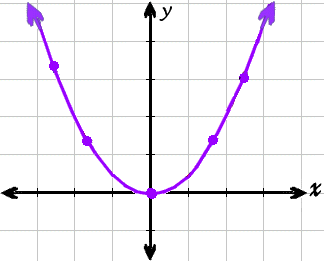
This is a bit closer, but still a simplification-
FSAE-level Engineering
"Find the global minimum of this multivariate function." (Which computationally is not trivial, and is really easy to get stuck in a local minimum rather than global - especially if you're only looking along ONE tiny slice of it, e.g. the CG of the damn suspension linkage by itself)
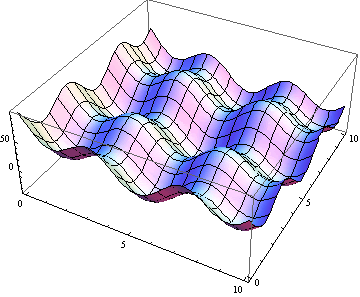
Here's more like what we're looking at-
Pro Motorsport Engineering
"Here's a rough idea of what you're looking at. Try and figure out what the problem even is, because it's not really even defined. The number of variables you have to worry about is somewhere between 1 and infinity - depending on who you talk to, and the people who claim they have all the answers are usually full of ---. You have 5 minutes to find the global minimum, and at some point between 2 and 4 minutes in, the problem is going to change. Also, you will lose partial credit for every minute you take to solve the problem, even if you get it entirely correct at the end of your allotted time."
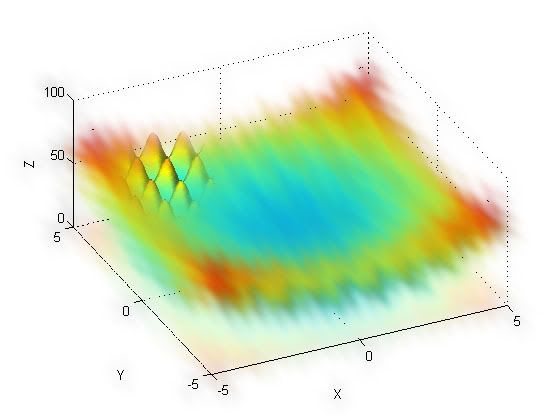 To sum this thread up - Gross, unrealistic oversimplification leading to silly questions and even sillier answers.
 Are Ferrari going to win some races with a pushrod setup? Absolutely. Are Red Bull going to win some races with a pullrod setup? Absolutely. Is there one answer that works the best for everyone? NO.
Re: The relative benefits of a pull rod suspension in 2011
Posted: 03 Feb 2011, 07:14
by Formula None
Jersey Tom wrote:This has been the point the entire time this thread has been going! Been said over a dozen times. Key is the word OUR. Williams' solution. Not the solution for all of F1.
This "discussion" we've been having would be comical if it wasn't so sad. The practicing engineers that I know here, with working experience in open ended problems, are all saying the same thing. In real engineering work, there are few clear-cut answers.
Thank you Jersey Tom, and to the other engineers here who've had a hand in motorsport, who are capable of creating lucid posts regarding more nuanced views of car design without needing to use emoticons and cartoons. I usually learn something new with your posts. Thank you for explaining things in a rational way and providing contrast to the more blind-faith tone of some of the other posts in this thread. Makes me miss 747 and riffraff, haven't seen 'em post much lately.
Anyway here's a collection of the rear suspensions we'll see in the field this year, scaled to approximately the same size and aligned vertically:

Red Bull seem to have developed the most cohesive design again. However, you can see the Ferrari forward-swept pushrod design leaves a clear path through the area near the intersection of the sidepods and floor which leads to the top of the diffuser, a possible aerodynamic advantage over the forward-swept pullrods, in my eyes. The thinness of the pullrods is a striking contrast here though.
Re: The relative benefits of a pull rod suspension in 2011
Posted: 03 Feb 2011, 15:32
by ubrben
Jersey Tom wrote:For Christ's sake... talk about not seeing the forest because the trees are in the way...
I'm quoting directly from here -
http://www.f1technical.net/news/15912
SM wrote:"The main changes revolve around the gearbox casing and location of the differential. Like most other teams, the target is to have as much clear flow to the rear wing assembly as possible. It is clear that we have lifted the top wishbone and track rod, and opted for a Z-bone layout, which was commonly used in the early 1990s. Using a pull-rod was an easy decision for our particular design, as it means there’s less blockage to the rear. This is the smallest and lowest gearbox we have ever made, with the most extreme driveshaft design. We made all these major decisions in March 2010 and have subsequently worked hard to ensure reliability through plenty of mileage on the dyno."
This has been the point
the entire time this thread has been going! Been said over a dozen times. Key is the word OUR. Williams' solution. Not the solution for all of F1.
This "discussion" we've been having would be comical if it wasn't so sad. The practicing engineers that I know here, with working experience in open ended problems, are all saying the same thing. In real engineering work, there are few clear-cut answers. There are no big solutions that work for everyone, nor all the time. As an aside, this is what drives me nuts about posts on FSAE.com. There are a lot of inquiries -
and as much as I want to I'm not going to generalize about them or where they typically come from - to the effect of "How do I design the brakes?" ... "What's the optimum material for my uprights?" ... "What's the best value for caster and KPI?"
There is no single set answer. Given a problem and a set of rules, you don't just click the "Optimize Button" and spit out the best answer every time. These problems are not like this-
Classroom Engineering
"Find the minimum of this function."
This is a bit closer, but still a simplification-
FSAE-level Engineering
"Find the global minimum of this multivariate function." (Which computationally is not trivial, and is really easy to get stuck in a local minimum rather than global - especially if you're only looking along ONE tiny slice of it, e.g. the CG of the damn suspension linkage by itself)
Here's more like what we're looking at-
Pro Motorsport Engineering
"Here's a rough idea of what you're looking at. Try and figure out what the problem even is, because it's not really even defined. The number of variables you have to worry about is somewhere between 1 and infinity - depending on who you talk to, and the people who claim they have all the answers are usually full of ---. You have 5 minutes to find the global minimum, and at some point between 2 and 4 minutes in, the problem is going to change. Also, you will lose partial credit for every minute you take to solve the problem, even if you get it entirely correct at the end of your allotted time."
To sum this thread up - Gross, unrealistic oversimplification leading to silly questions and even sillier answers. Are Ferrari going to win some races with a pushrod setup? Absolutely. Are Red Bull going to win some races with a pullrod setup? Absolutely. Is there one answer that works the best for everyone? NO.
You're very blunt, and I can see why some people have a go back - but that's a really good post.
You can spot people a mile away who've never actually done any real world engineering, but the "classroom" metaphor was very good

Ben
Re: The relative benefits of a pull rod suspension in 2011
Posted: 03 Feb 2011, 15:45
by Raptor22
so will the "oh my god its not a pullrod" stop now.
All this Pulling rods and pushing rods is maing me think Wake Activated Normalised KERS...
See what I did there...

Re: The relative benefits of a pull rod suspension in 2011
Posted: 03 Feb 2011, 16:50
by Jersey Tom
ubrben wrote:You're very blunt
Indeed, I'm from New Jersey
Re: The relative benefits of a pull rod suspension in 2011
Posted: 03 Feb 2011, 16:51
by PlatinumZealot
Jersey Tom wrote:For Christ's sake... talk about not seeing the forest because the trees are in the way...
I'm quoting directly from here -
http://www.f1technical.net/news/15912
SM wrote:"The main changes revolve around the gearbox casing and location of the differential. Like most other teams, the target is to have as much clear flow to the rear wing assembly as possible. It is clear that we have lifted the top wishbone and track rod, and opted for a Z-bone layout, which was commonly used in the early 1990s. Using a pull-rod was an easy decision for our particular design, as it means there’s less blockage to the rear. This is the smallest and lowest gearbox we have ever made, with the most extreme driveshaft design. We made all these major decisions in March 2010 and have subsequently worked hard to ensure reliability through plenty of mileage on the dyno."
This is the full interview Tom. Remember sometimes journalists will edit interviews to make the content easier to read. Then again i think it might be a different interview all together.
http://www.grandprix.com/ns/ns22899.html
Q: Can you speak about the gearbox casing and differential?
The main target was to clear all the area to the rear lower wing because it's a performance differentiator now. You've got to have the underside of the rear lower wing completely free, so we took the decision to lift the top wishbone and the track rod and went to a Z-bone layout which was commonly used in the early nineties to get that all above the underside so that all the weight is all inline with the trailing edge of the legality box, so you are nowhere near the underside of the rear lower wing and it's completely free airflow.
The pull rod was a no-brainer because it doesn't matter what you do with a pushrod, even if it's swept forwards or backwards you've got a load going into the rear lower wing, whereas a pull rod is completely out of the rear lower wing. That was an easy decision. Then the other thing was to clear the centre of it by lowering the gearbox. We dropped the top section as much as we could and so it's the smallest box we've ever made. We took that decision in March last year and we've done quite a few thousand kilometres on the dyno with that rear end. That was quite a big step on driveshaft angle, definitely the most extreme I've seen. The people we did the driveshaft design with had never done anything that extreme before. It was quite a big programme.
Q: Is there no performance loss with that degree of angularity in the joint?
It's pretty small with the tricks they've got nowadays, pretty impressive stuff.
Re: The relative benefits of a pull rod suspension in 2011
Posted: 03 Feb 2011, 17:01
by PlatinumZealot
On the post on pro-motorsport engineering. I don't do motorsport engineering but some of us in here are just regular mechanical engineers. The fundamentals don't change. Real life situations will always be harder to analyse but sometimes the best way to solve something is the most obvious.
However, it's not hard to analyse the cleanness of the airflow to the beam wing or the centre of gravity of the car. What I think you are talking about are damper response and a whole host of other things which are as you said are very difficult to interpret. Even still, in those areas ( wheel motion and damping response etc), I don't think there is a huge difference between pull-rod or pushrod.
The main bits of our argument were the obvious parts. Lowere CoG and clean airflow. But I think it's will make the topic better if we can get into the kinematics (or even kinetics) of using one or the other.
Re: The relative benefits of a pull rod suspension in 2011
Posted: 03 Feb 2011, 17:24
by RacingManiac
The thing is even with those 2 points you can't say that with 100% certainty. Sure pull rod is lower, you are mounting the suspension bits lower, but to make room down low do you need to change your gearbox casing? If you want to keep the width of the gearbox the same(or not, again we don't know what each team's design or compromises are), do you need to squeeze the internals higher up? Do taking the suspension load down in the base of the gearbox means you need to beef up the structure in place of the gearbox bits? If the components inside got moved up, since most of those are still solid chunks of steel, does that raise or lower your overall CofG? The pushrod is in the way of the rear beam wing flow, can you shed vortices's off the pushrod and made it do some odd things with the beam wing and makes it work better or worse?
Blah blah blah. I am no gearbox designer or certainly not aero expert by any stretch of the imagination, but nothing is ever that black and white...
Re: The relative benefits of a pull rod suspension in 2011
Posted: 03 Feb 2011, 17:36
by ringo
It's not black and white, i never said that. All teams have testing facilities to make that decision. Apparently they weren't torn between the 2 choices like some make it sound here.
That's the thing with this forum, it's easier to make a neutral post with a few words and charts that don't directly address the topic.
It's also easy to make underhanded attacks at another poster as well when you can't prove him wrong.
I am not a motorsport engineer, however a proper F1 engineer did say the choice was a no brainer. The other teams on the grid did so as well, indirectly. They must be school engineers as well or blind FSAE kids.
Jersery Tom's graphs say nothing really. I get his point about the variability and multiple ways to get the same result, but again no team is using a conventional push rod system for a few simple reasons; which we all know. I was right about that, so he can insult and throw in 500 more unlabeled graphs.
I would like to move on to actual kinematics as well. Every single team did change from conventional push rod, including Ferrari, for the very same reasons we have on the first pages of this thread.
It wasn't an uneducated guess, and i didn't have to be modest about it to win forum support and well wishes. So please let's not get back into the bickering.
The season hasn't even started yet.
Re: The relative benefits of a pull rod suspension in 2011
Posted: 03 Feb 2011, 22:00
by humble sabot
A little further weight to the suggestion that the CG effect isn't all that certain comes from the fact that the pick up for the pullrod has to be much higher on the upright. If your brake caliper is near the bottom, you end up with a noticeably larger upright, possibly heavier, if not overall, then at least higher up.
In the case of the Mercedes, even the control arms are mounted higher up on the upright.
Re: The relative benefits of a pull rod suspension in 2011
Posted: 04 Feb 2011, 02:29
by ringo
Mercedes did that last year as well with their old suspension.
this year:

last year:

Re: The relative benefits of a pull rod suspension in 2011
Posted: 04 Feb 2011, 04:24
by PlatinumZealot