Page 19 of 22
Re: Energy distribution (and electricity generation)
Posted: 14 Dec 2022, 01:21
by johnny comelately
The levels I told you were measured outside the glasshouse about a metre point five off the ground with accurate instruments that corroborate across different countries.
https://www.priva.com/horticulture/solu ... te-sensors
You can be a smart aleck if you like and let it degenerate into an argument, as is the almost standard practice here, of these figures versus those figures but that is what those instruments were measuring this morning. So if you are saying I'm wrong then all those thousands of operators are too.
I cannot account for the figures mentioned when this partic discussion started, I am saying there is a discrepancy. I have often looked at those high figures and wondered what , how?
Therefore if this point bothers you spend some energy on finding out why the difference instead of blindly citing.
BUT I do know the difference between what actually happens "on the ground" in say motor racing and what is journalistically reported.
In this somewhat emotional (and I know what you are going to say about that) area of climate change, is it possible that there is a case of "Lies, Damned Lies, and Statistics”
Re: Energy distribution (and electricity generation)
Posted: 14 Dec 2022, 02:07
by Tommy Cookers
hollus wrote: ↑14 Dec 2022, 00:22
Must be imperial ppm, then, because metric ppms are significantly higher.
well ....
ppm gravimetric (ie by weight) would be different to ppm volumetric
Re: Energy distribution (and electricity generation)
Posted: 14 Dec 2022, 02:21
by mrluke
Okay, fair.
However we know that the global climate has varied a lot over earth's history:
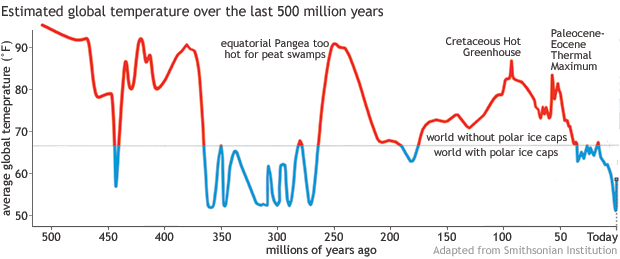
We know that for much of earth's history there weren't any polar ice caps, and we know that the climate has fluctuated by large amounts in very short periods of time.
There isn't any risk of "man made warming" causing any permanent damage to our planet. The impact would be on the life that lives here.
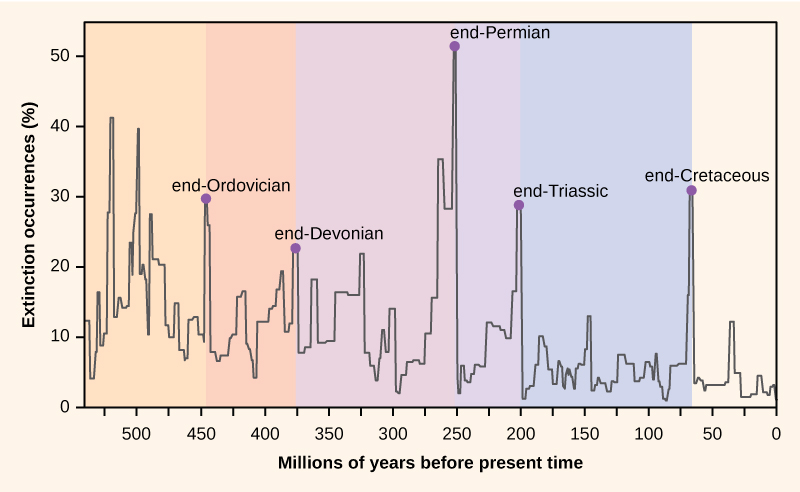
Just comparing the two charts, every major change in temperature correlates with a mass extinction event. Are they the only cause - I doubt it, but its difficult to say it isnt a factor.
Earth can definitely cope with all the warming we can throw at it. The problem is our society isn't really equipped to deal with the widespread flooding, famine, migration and war that will result from our new climate. I'm sure we'll survive as a species but I dont think we'll be sat around arguing about which driver should have left more space at the apex

FWIW I haven't got back through the thread and there is a lot of emotive / pseudo science thrown around on this issue (by both sides) however I think there is a consensus that some gasses can create a greenhouse effect that would result in warming and there is a consensus that we emit large volumes of these gasses.
Re: Energy distribution (and electricity generation)
Posted: 14 Dec 2022, 03:39
by Greg Locock
Your last para, yes, that's where I am. CO2 is not the only hand on the thermostat, it may not even be the most important one. My simplest model that agrees with the instrumental record suggests that all anthro (it's statistical, just assumes all anthro is proportional to co2) is about half of the warming seen since 1880, but that includes things like UHI and land use changes of course.
Re: Energy distribution (and electricity generation)
Posted: 14 Dec 2022, 08:34
by Greg Locock
Here's CO2 estimates for geological ages back to the wazoo
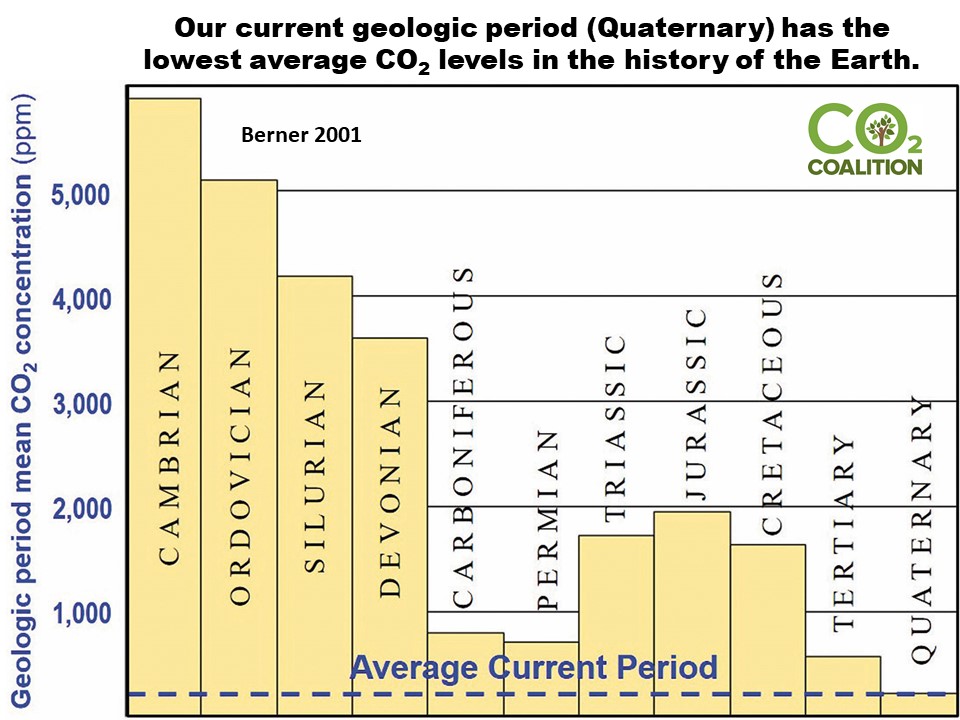
First mammalian ancestors split off from what were to become dinosaurs in the Permian, and mammals as such really got going in the Triassic. The first hominids appeared in the Tertiary. So the mammalian form is successful even with CO2 up towards 2000 ppm, or 0.2% to make an obvious point.
Re: Energy distribution (and electricity generation)
Posted: 14 Dec 2022, 09:13
by Andres125sx
Greg Locock wrote: ↑13 Dec 2022, 12:45
OK, now post the paleo CO2 record, back to when monkey type mammals first appeared.
This has been discussed before. CO2 levels are irrelevant, what matters is the rate of CO2 increase. In the paleo era, like any other except currently, any increase took hundreds thousands years, or millions years, allowing vegetals and animals to adapt, contrary to current increase wich is taking a few decades wich makes imposible to adapt to any form of life
It´s shocking to continue reading comments ignoring a crucial fact like this

Re: Energy distribution (and electricity generation)
Posted: 14 Dec 2022, 09:19
by hollus
Tommy Cookers wrote: ↑14 Dec 2022, 02:07
hollus wrote: ↑14 Dec 2022, 00:22
Must be imperial ppm, then, because metric ppms are significantly higher.
well ....
ppm gravimetric (ie by weight) would be different to ppm volumetric
Gravimetric (weight) vs volumetric (roughly speaking, molar ratios). Thanks for the new angle! I had never thought of gravimetric PPM, there is something primitive and unsatisfying about a ppm value that is, at the concentrations we use it, and by linear extrapolation, able to go to more than 1 million ppm. Which of course it never does in reality.
*Edit: And I just realized that the analytical department at my work does report in mass/mass PPM… I guess sometimes there are good reasons for it.
Anyways, the ratio between the two should be 44/29, so it doesn’t fit the ~400 vs ~330 discrepancy.
Johnny, you are the one citing a scale or unit that seems to be at odds with the scale everyone else is using, so don’t throw burden of proof around. If your hour is my 50 minutes, it means that there is an error somewhere, but I don’t need to explain what I mean with 1 hour.
Re: Energy distribution (and electricity generation)
Posted: 14 Dec 2022, 09:23
by Andres125sx
johnny comelately wrote: ↑13 Dec 2022, 23:00
hollus wrote: ↑13 Dec 2022, 16:34
Do you mean 320 ppm in 1997? In 2022? Before that?
I have made a mistake.
As of today in NZ it is 380ppm.
I hope to get some Canadian figures soon.
It varies on a daily and geographical basis by about + or - 10ppm.
From 1997 until 2010/12 it was always around 320 to 330ppm just about everywhere, with an occasional 350.
So there has been a relatively recent increase, just not as much as some sources are saying.
NASA disagrees
The atmospheric concentration of carbon dioxide now averages more than 400 parts per million, year-round, which is more than one third higher than CO2 levels before modern industrialization and fossil fuel use began
Satellite Detects Human Contribution to Atmospheric CO2
But some will say NASA, who is subsidized by a government who denies CC and do not accept any measure to reduce emissions, is not a reliable source

Re: Energy distribution (and electricity generation)
Posted: 14 Dec 2022, 15:44
by TimW
That is factually incorrect, the global temperature changes we see now are far beyond what happened in the little ice age.
The link is very misleading. The first paragraph of the link is factually incorrect. It reads:
The Little Ice Age was a period of wide-spread cooling from around 1300 to around 1850 CE when average global temperatures dropped by as much as 2°C (3.6°F), particularly in Europe and North America.
Misleading by suggesting global temperature dropped by 2 degrees,
which it did not
It should read:
The Little Ice Age was a period of wide-spread cooling from around 1300 to around 1850 CE when average global temperatures dropped, particularly in Europe and North America, where locally it dropped by as much as 2°C (3.6°F),
Current temperature anomalies are far beyond that. Global average change:

Re: Energy distribution (and electricity generation)
Posted: 14 Dec 2022, 16:59
by mrluke
Greg Locock wrote: ↑14 Dec 2022, 03:39
Your last para, yes, that's where I am. CO2 is not the only hand on the thermostat, it may not even be the most important one. My simplest model that agrees with the instrumental record suggests that all anthro (it's statistical, just assumes all anthro is proportional to co2) is about half of the warming seen since 1880, but that includes things like UHI and land use changes of course.
Even if that was the case, it would still be beneficial to limit our impact?
I mean what really is the downside for us? Sure we might leave 100 years worth of fossil fuel in the ground, but fossil fuel is never going to be the long term answer to our power needs anyway.
Re: Energy distribution (and electricity generation)
Posted: 14 Dec 2022, 17:01
by mrluke
Andres125sx wrote: ↑14 Dec 2022, 09:13
Greg Locock wrote: ↑13 Dec 2022, 12:45
OK, now post the paleo CO2 record, back to when monkey type mammals first appeared.
This has been discussed before. CO2 levels are irrelevant, what matters is the rate of CO2 increase. In the paleo era, like any other except currently, any increase took hundreds thousands years, or millions years, allowing vegetals and animals to adapt, contrary to current increase wich is taking a few decades wich makes imposible to adapt to any form of life
It´s shocking to continue reading comments ignoring a crucial fact like this
It isn't a fact. We aren't seeing the fastest change of co2 ever in the history of the world and pretty much all plants and animals will cope or even thrive with higher concentrations.
The downside is the impact on global weather and sea levels. Which impacts our current living and tech arrangements.
Re: Energy distribution (and electricity generation)
Posted: 15 Dec 2022, 08:48
by Andres125sx
mrluke wrote: ↑14 Dec 2022, 17:01
Andres125sx wrote: ↑14 Dec 2022, 09:13
Greg Locock wrote: ↑13 Dec 2022, 12:45
OK, now post the paleo CO2 record, back to when monkey type mammals first appeared.
This has been discussed before. CO2 levels are irrelevant, what matters is the rate of CO2 increase. In the paleo era, like any other except currently, any increase took hundreds thousands years, or millions years, allowing vegetals and animals to adapt, contrary to current increase wich is taking a few decades wich makes imposible to adapt to any form of life
It´s shocking to continue reading comments ignoring a crucial fact like this
It isn't a fact. We aren't seeing the fastest change of co2 ever in the history of the world
Before claiming something is false, you should provide some fact, data, source... anything wich contradicts the data I posted, because I didn´t post any opinion, I posted facts supported by links and graphs. Significant CO2 changes takes millions years, not few decades.
mrluke wrote: ↑14 Dec 2022, 17:01
and pretty much all plants and animals will cope or even thrive with higher concentrations.
Stating this, apart from false itself, is extremelly irresponsible TBH Loads of plants and animales are extinghising in this and past century, this is not a prediction, this is a fact
Nature is declining globally at rates unprecedented in human history – and the rate of species extinctions is accelerating
[...]
The overwhelming evidence of the IPBES Global Assessment, from a wide range of different fields of knowledge, presents an ominous picture,” said IPBES Chair, Sir Robert Watson. “The health of ecosystems on which we and all other species depend is deteriorating more rapidly than ever. We are eroding the very foundations of our economies, livelihoods, food security, health and quality of life worldwide
CC maybe is not main responsible...
To increase the policy-relevance of the Report, the assessment’s authors have ranked, for the first time at this scale and based on a thorough analysis of the available evidence, the five direct drivers of change in nature with the largest relative global impacts so far. These culprits are, in descending order: (1) changes in land and sea use; (2) direct exploitation of organisms; (3) climate change; (4) pollution and (5) invasive alien species.
...but it adds to the problem... but you claim the rest of species still alive will adapt?? That´s what is called wishful thinking, but unfortunately it is plain wrong
Quotes from this link:
https://www.un.org/sustainabledevelopme ... ed-report/
We should be a little bit responsible before posting this kind of nosense
Re: Energy distribution (and electricity generation)
Posted: 15 Dec 2022, 08:58
by Greg Locock
You posted data proving that the recent jump in CO2 from historic lows was the fastest ever? I missed it. That data doesn't exist because the instrumental record only goes back so far, and everything used as proxies before that has different time constants (as a purported engineer you should understand the implications of that). But please, do direct me to this 'data' of yours. Be prepared for sarcasm.
Re: Energy distribution (and electricity generation)
Posted: 15 Dec 2022, 09:21
by Andres125sx
Greg Locock wrote: ↑15 Dec 2022, 08:58
You posted data proving that the recent jump in CO2 from historic lows was the fastest ever? I missed it. That data doesn't exist
Sure you missed it, despite I posted it repeatedly, in this and other threads
CO2 has of course changed before, but it's happened in slow and predicable ways," said James Rae, a paleoclimatologist from the University of St Andrews who led the new research. "What's happening now is so much faster than anything in the geologic record. There's nothing in comparison to what’s happening now
https://mashable.com/article/co2-earth- ... ate-change
Greg Locock wrote: ↑15 Dec 2022, 08:58
Be prepared for sarcasm.
I´m ready Greg, I´m used to sarcasm and populism, they´re used too frequently in this kind of debate, but sarcasm can´t contradict reality
Re: Energy distribution (and electricity generation)
Posted: 15 Dec 2022, 12:34
by Greg Locock
Oh, some comedy corner populist thing, I assumed you actually had a peer reviewed paper.
So Mauna Loa detects CO2 with a time constant of the order of 1 hour. A little shell growing in the sea responds at the rate of perhaps a year at best.
Do you understand the issue?
You cannot easily compare the two. But of course you'd have learned that in lectures.