Re: 2 stroke thread (with occasional F1 relevance!)
Posted: 03 Jan 2020, 05:00
Pretty sure the propellers don't exceed 2,900/7,000 x 9,000 = 3,728 rpm.
Hi Manolis, it appears the 4T RCV did not offer the performance/durability factor required,
With both engines running at 9,000rpm, the upwards acceleration....
The props are geared from the cranks at a ratio of 2.74:1. So 9000rpm at the crank is as @gruntguru says at the props.
Just a question.manolis wrote: ↑04 Jan 2020, 08:21Hello Rodak.
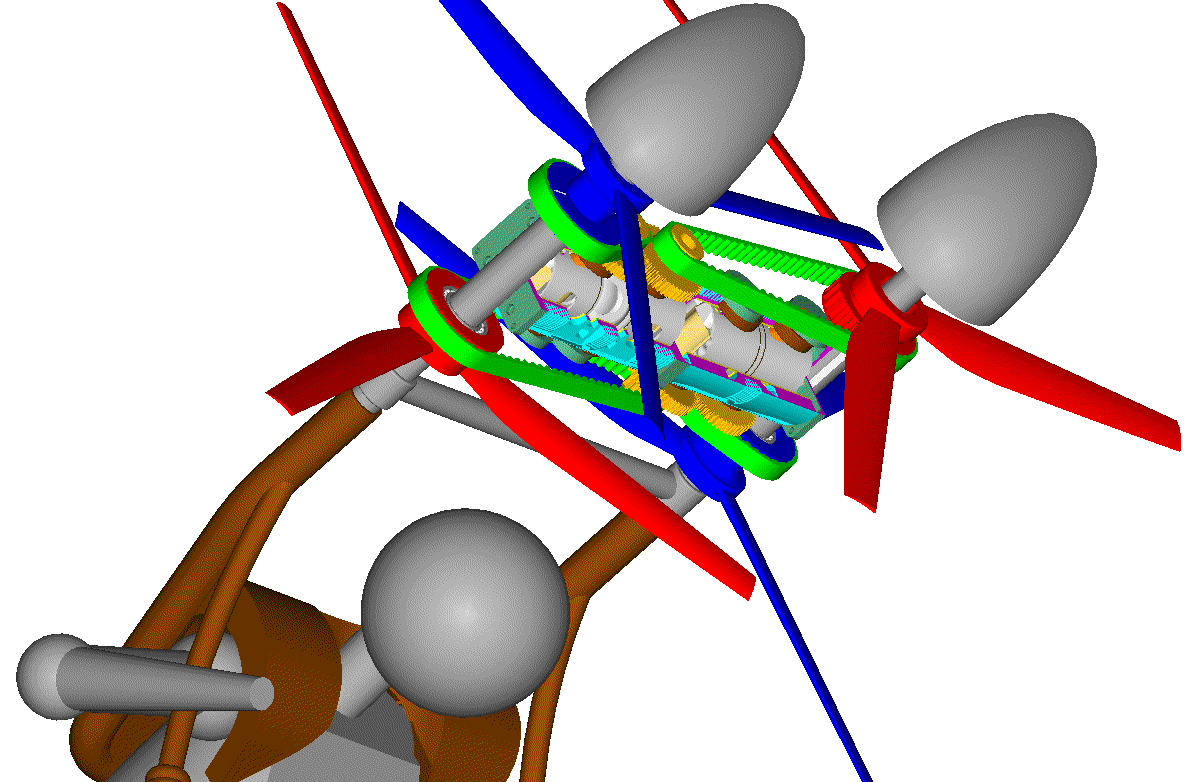
Here is the transmission of the Portable Flyer:
https://www.pattakon.com/Fly_files/Port ... ission.png
With the green toothed belts (there are four, two long and two short ones) each crankshaft drives its "own" propeller at a transmission ratio of 2.4:1 (when the engine is revving at 9,000rpm, its propellers are revving at 9,000/2.4=3,750rpm which gives a propeller tip speed of 195m/sec, which is less than 60% of sound velocity).
yes I should like to see a drawing .... additionally ....manolis wrote: ↑19 Dec 2019, 06:47Hello Tommy Cookers.
You write:
“if the wingsuiter's glide angle is 30 deg (having a L/D ratio of 1.7) .....
how does your mannequin have the PF in level flight at an apparent AoA of only 11 deg ?”
The angle of attack is a different thing than the glide angle.
The 30 degrees glide angle (from horizontal) is the angle of a line L along which the wingsuiter moves / flies / falls.
Relative to this line L (and not relative to the horizon) is the angle of attack of the wingsuiter.
Thus, an 11 degrees angle of attack of the unpowered wingsuiter (who’s glide angle is 30 degrees) means that his long axis is at an angle of 30-11=19 degrees from horizontal.
If I am not clear, please let me know to make a drawing.
That works for sealed off bearings, but not in this scenario. The centrifugal forces would sling the oil all over the place, eventually letting the gearwheels dry up and as you probably know, scatter oil all over the environment is big nogo today.
Of course with intermeshing propellers, the failure of a belt takes out both propellers. Can you see any benefit in staggering the propellers enough to avoid such a clash? This would leave 3 propellers and 2 power units functional in the event of such a failure. It would also eliminate the cost and debris created by clashing propellers.
Dr. Acula wrote: ↑04 Jan 2020, 18:49That works for sealed off bearings, but not in this scenario. The centrifugal forces would sling the oil all over the place, eventually letting the gearwheels dry up and as you probably know, scatter oil all over the environment is big nogo today.
In my opinion, if he wan't a "dry" transmission, he needs to go with timing belts for everything.