Page 203 of 431
Re: Ferrari Power Unit Hardware & Software
Posted: 23 Oct 2018, 08:46
by Dr. Acula
wuzak wrote: ↑23 Oct 2018, 03:41
henry wrote: ↑17 Oct 2018, 23:49
dans79 wrote: ↑17 Oct 2018, 23:47
that is illegal per appendix 3
It can be charged prior to both race and qualifying. Hence the term “during”.
In qualifying the ES could be charged before the first lap in Q1. But it cannot be for any subsequent lap - if a driver does 2 runs in each session, that is 5 runs that they cannot pre-charge.
For the big 3 teams, it is more likely 4 or 5 runs, but that still means the more important 3 or 4 runs have to be done without charging in the pits.
Shouldn't be to much of a problem actually. For the first flying lap you only have 1 lap to precharge the batteries. For every subsequent flying lap you basically have 2 laps to charge up the battery which should be more than enough. You can use the inlap from the flying lap before and the outlap.
Re: Ferrari Power Unit Hardware & Software
Posted: 23 Oct 2018, 09:54
by henry
wuzak wrote: ↑23 Oct 2018, 03:41
henry wrote: ↑17 Oct 2018, 23:49
dans79 wrote: ↑17 Oct 2018, 23:47
that is illegal per appendix 3
It can be charged prior to both race and qualifying. Hence the term “during”.
In qualifying the ES could be charged before the first lap in Q1. But it cannot be for any subsequent lap - if a driver does 2 runs in each session, that is 5 runs that they cannot pre-charge.
For the big 3 teams, it is more likely 4 or 5 runs, but that still means the more important 3 or 4 runs have to be done without charging in the pits.
The point I am tring to make and support is that because of efficiency losses the physical battery SOC (perhaps max 16 MJ) can be depleted during qualifying and the race to maintain the virtual SOC limits (4MJ max difference) specified in the regulations.
In qualifying the battery losses are low in relation to the max PSOC. So recharging between runs is completely unnecessary.
Of course my point depends on the VSOC being determined by the measuring the sum of differences between energy in an energy out using the single sensor attached to the ES for this purpose. If VSOC is determined in a different way the argument doesn’t hold.
Edit: fixed a typo in last sentence
Re: Ferrari Power Unit Hardware & Software
Posted: 24 Oct 2018, 04:08
by gruntguru
Good point Henry.
If the charge/discharge efficiency is as low as we think, the ES would need to have considerable reserve capacity to last the race without hitting its lower charge limit.
Re: Ferrari Power Unit Hardware & Software
Posted: 25 Oct 2018, 06:52
by MtthsMlw
Re: Ferrari Power Unit Hardware & Software
Posted: 26 Nov 2018, 01:15
by PlatinumZealot
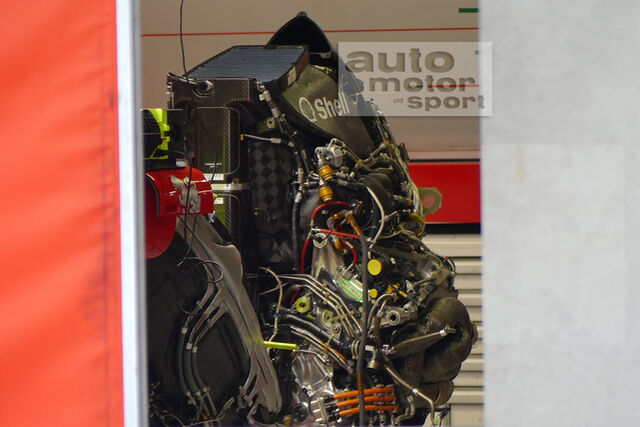
The ugliest engine but the strongest one.
Re: Ferrari Power Unit Hardware & Software
Posted: 27 Nov 2018, 13:51
by dren
PlatinumZealot wrote: ↑26 Nov 2018, 01:15
The ugliest engine but the strongest one.
I always liked the cooler packaging on their unit. It's nice to see the differences between the Ferrari and Mercedes and yet they are very close in performance.
Re: Ferrari Power Unit Hardware & Software
Posted: 28 Nov 2018, 14:34
by dfegan358
Now the challenge for Ferrari is to make more engine gains over the winter break and keep at the front of the pack or at least match Mercedes again. They seemed very close in performance this year.
Don’t think anyone on outside knows if either engine is better but more different characteristics.
I can’t wait already until pre season testing and all the speculation and anticipation begins again.
Re: Ferrari Power Unit Hardware & Software
Posted: 01 Dec 2018, 10:31
by aleks_ader
Honestly. Ferrari just needs to made interational steps. As they do from 2015 onwards. Heck, even 2014 had pretty same layout. Most of resorces will be directected into realibility and chassis. This years reallibity was bulletproof across all customer teams also. Impressive if you asks me.
Re: Ferrari Power Unit Hardware & Software
Posted: 12 Dec 2018, 12:46
by Blackout
Re: Ferrari Power Unit Hardware & Software
Posted: 12 Dec 2018, 14:48
by godlameroso
henry wrote: ↑23 Oct 2018, 09:54
wuzak wrote: ↑23 Oct 2018, 03:41
henry wrote: ↑17 Oct 2018, 23:49
It can be charged prior to both race and qualifying. Hence the term “during”.
In qualifying the ES could be charged before the first lap in Q1. But it cannot be for any subsequent lap - if a driver does 2 runs in each session, that is 5 runs that they cannot pre-charge.
For the big 3 teams, it is more likely 4 or 5 runs, but that still means the more important 3 or 4 runs have to be done without charging in the pits.
The point I am tring to make and support is that because of efficiency losses the physical battery SOC (perhaps max 16 MJ) can be depleted during qualifying and the race to maintain the virtual SOC limits (4MJ max difference) specified in the regulations.
In qualifying the battery losses are low in relation to the max PSOC. So recharging between runs is completely unnecessary.
Of course my point depends on the VSOC being determined by the measuring the sum of differences between energy in an energy out using the single sensor attached to the ES for this purpose. If VSOC is determined in a different way the argument doesn’t hold.
Edit: fixed a typo in last sentence
Didn't you dismiss the notion of multiple VSOC when debating me about when one can use 4MJ? Why the sudden change in opinion?
Re: Ferrari Power Unit Hardware & Software
Posted: 12 Dec 2018, 17:18
by subcritical71
Finally, a publication who gets the rules (translation by google);
According to the technical regulation, the battery can send to the MGU-K a maximum of 4 MJ per turn (
at a power of 120 kW, the 4 MJ will be "consumed" in about 33 seconds). But she can only receive 2 MJ. Therefore, to deliver the 4 MJ, it benefits from the contribution of the MGU-H.
It plays a dual role: recharge the battery (but only for 2 MJ) and support the MGU-K by sending him directly, without the battery, energy (no flow restriction in this case).
Re: Ferrari Power Unit Hardware & Software
Posted: 12 Dec 2018, 17:36
by hurril
subcritical71 wrote: ↑12 Dec 2018, 17:18
Finally, a publication who gets the rules (translation by google);
According to the technical regulation, the battery can send to the MGU-K a maximum of 4 MJ per turn (
at a power of 120 kW, the 4 MJ will be "consumed" in about 33 seconds). But she can only receive 2 MJ. Therefore, to deliver the 4 MJ, it benefits from the contribution of the MGU-H.
It plays a dual role: recharge the battery (but only for 2 MJ) and support the MGU-K by sending him directly, without the battery, energy (no flow restriction in this case).
Except that the MGU-h can send more than 2MJ to the battery.
Re: Ferrari Power Unit Hardware & Software
Posted: 12 Dec 2018, 18:12
by subcritical71
hurril wrote: ↑12 Dec 2018, 17:36
subcritical71 wrote: ↑12 Dec 2018, 17:18
Finally, a publication who gets the rules (translation by google);
According to the technical regulation, the battery can send to the MGU-K a maximum of 4 MJ per turn (
at a power of 120 kW, the 4 MJ will be "consumed" in about 33 seconds). But she can only receive 2 MJ. Therefore, to deliver the 4 MJ, it benefits from the contribution of the MGU-H.
It plays a dual role: recharge the battery (but only for 2 MJ) and support the MGU-K by sending him directly, without the battery, energy (no flow restriction in this case).
Except that the MGU-h can send more than 2MJ to the battery.
Ooops, your right. Didn't catch that one.. I was just happy they clarified the 33 second deal with 'at 120kw'. Looks like none of them get it 100% correct.
Re: Ferrari Power Unit Hardware & Software
Posted: 12 Dec 2018, 23:22
by henry
godlameroso wrote: ↑12 Dec 2018, 14:48
henry wrote: ↑23 Oct 2018, 09:54
wuzak wrote: ↑23 Oct 2018, 03:41
In qualifying the ES could be charged before the first lap in Q1. But it cannot be for any subsequent lap - if a driver does 2 runs in each session, that is 5 runs that they cannot pre-charge.
For the big 3 teams, it is more likely 4 or 5 runs, but that still means the more important 3 or 4 runs have to be done without charging in the pits.
The point I am tring to make and support is that because of efficiency losses the physical battery SOC (perhaps max 16 MJ) can be depleted during qualifying and the race to maintain the virtual SOC limits (4MJ max difference) specified in the regulations.
In qualifying the battery losses are low in relation to the max PSOC. So recharging between runs is completely unnecessary.
Of course my point depends on the VSOC being determined by the measuring the sum of differences between energy in an energy out using the single sensor attached to the ES for this purpose. If VSOC is determined in a different way the argument doesn’t hold.
Edit: fixed a typo in last sentence
Didn't you dismiss the notion of multiple VSOC when debating me about when one can use 4MJ? Why the sudden change in opinion?
Can you remind me of the discussion? It’s quite likely that I might have disagreed with something you said because at the time I didn’t understand. My understanding of these power units is continually evolving, my knowledge of batteries and their management systems is limited. To be honest, given the limited amount of discussion on this forum, I don’t think I’m alone. So if you can point me at your “multiple VSOC” comments I’d be grateful, I’m sure it will advance my understanding.
Re: Ferrari Power Unit Hardware & Software
Posted: 13 Dec 2018, 18:02
by godlameroso
henry wrote: ↑12 Dec 2018, 23:22
godlameroso wrote: ↑12 Dec 2018, 14:48
henry wrote: ↑23 Oct 2018, 09:54
The point I am tring to make and support is that because of efficiency losses the physical battery SOC (perhaps max 16 MJ) can be depleted during qualifying and the race to maintain the virtual SOC limits (4MJ max difference) specified in the regulations.
In qualifying the battery losses are low in relation to the max PSOC. So recharging between runs is completely unnecessary.
Of course my point depends on the VSOC being determined by the measuring the sum of differences between energy in an energy out using the single sensor attached to the ES for this purpose. If VSOC is determined in a different way the argument doesn’t hold.
Edit: fixed a typo in last sentence
Didn't you dismiss the notion of multiple VSOC when debating me about when one can use 4MJ? Why the sudden change in opinion?
Can you remind me of the discussion? It’s quite likely that I might have disagreed with something you said because at the time I didn’t understand. My understanding of these power units is continually evolving, my knowledge of batteries and their management systems is limited. To be honest, given the limited amount of discussion on this forum, I don’t think I’m alone. So if you can point me at your “multiple VSOC” comments I’d be grateful, I’m sure it will advance my understanding.
You said the only SOC level was a 4MJ pool and that pool did not reset every lap. It was in the Ferrari power unit thread. I said there is a 4MJ limit from the ES to the MGU-K per lap, which resets on crossing the timing beam, and consists of one SOC. In addition to that, there is also the actual battery SOC which is independent of the SOC per lap.