Re: Formula One 1.6l turbo engine formula as of 2013
Posted: 19 Dec 2010, 21:25
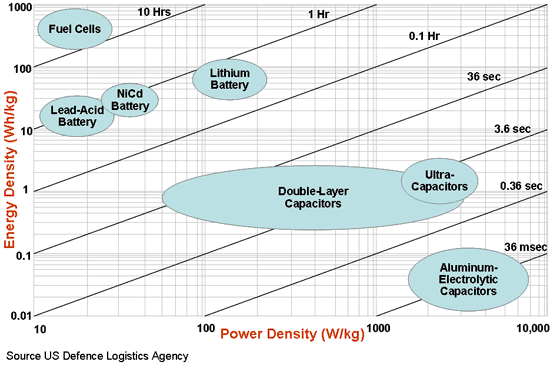
Keeping in mind that these cars brake much more quickly than they can accelerate, the braking energy could be stored in capacitors, which would then slowly discharge into the batteries (Say the braking zone is 1-2 seconds for charging, it could then slowly drain into the batteries for 5-10 seconds until the next corner). The batteries could directly power the MGU during acceleration since the rate required for discharge would be less than that needed for charging. Bear with me, no coffee yet this morning...
The car would essentially be set up for AWD, with front, rear and center driveshafts to transmit power and front, center and rear differentials to split up the breaking forces appropriately. This would all go back through the transmission, clutch and into the engine/compressor. Unfortunately the braking would be geared, so it would be like having brakes that need to downshift. I imagine this would cause traction issues at the limit of adhesion.
I like this idea. It would be great if the ICE could act as a compressor, but for a petrol engine it only gets up to around 10 bar, or 20 bar for diesel (speaking of, is diesel specifically outlawed for 2013?) and we need up to like ~300 bar as WB mentioned. Variable compression ratio engine designs might be a solution. For sure the whole engine, clutch and transmission would become heavier to cope with the braking forces and high air compression requirements. But if could all be done in same engine, then I imagine overall weight would not suffer much.WhiteBlue wrote:Ok, now I start to understand what could be done with a compressor. The point is we would not be talking 3 bar like a turbo compressor but 200-400 bar like a heavy duty industrial or diving compressor.ringo wrote:I wouldn't use a centrifugal compressor for gyro's idea. I would use 2 small pistons to compress the air. Pitson compressors can gain much higher pressure ratios.
Perhaps one cold actually use the ICE in the breaking phase to compress air and store it in a bottle for later use for boosting. The exhaust gas can then be totally used 100% for some time to drive a turbo compounder while the intake pressure would be fed from the air bottle.
The car would essentially be set up for AWD, with front, rear and center driveshafts to transmit power and front, center and rear differentials to split up the breaking forces appropriately. This would all go back through the transmission, clutch and into the engine/compressor. Unfortunately the braking would be geared, so it would be like having brakes that need to downshift. I imagine this would cause traction issues at the limit of adhesion.

 the best way to reduce pollution and greenhouse gases would be to feed all F1 team members a vegetarian diet, eliminating copious methane (the F1 of greenhouse gases) and other livestock effluence. Secondly, all air travel to the venues would need to be banned. Only ships, carpools, (full) buses, airships and trains would be permitted for moving around the support equipment. These are both things that could be done NOW without the need for any battery electric development involved. Only logistics and grocery list inspections would need to be implemented. I'm only half joking here, this would be the quickest way to get F1 carbon neutral. We could still have a nice NA V10 wail while you munch on a veggie burger. The only trade-off would be that Ross Brawn and Mr T would, how you say, improve their power-to-weight ratio.