variante wrote: it would be illogical to assume that the compound hypothetically chosen for this championship suits best the less performing cars...
In reality Virtual Stopwatch is "supplying" the tyre, so there is no "assumption"; currently we're running a tyre model that was decided (Or "designed") by me without any input... but I could "design" any tyre characteristics we want... drop off at high loads due to overuse, drop off at low loads due to low temperature, etc. etc.....
I'd make sure that the drop off in tyre performance meant that higher downforce meant cars are still at an advantage, just less of an advantage than currently... if the majority agree that's the way to go....
Finally, i've always got the impression that our races are more similar to qualifying session rather that proper races: would tire wear be a discriminating factor over just one lap?
At the moment the tyre model I'm using is one I developed for predicting the performance of cars competing in the UK sprint championship; which is for short distance events and shows no drop off; I think its OK for our purposes. However, I remember times not so long ago when drivers in F1 would report that the tyres were "going-off" at the end of one qualifying lap. For me adding this characteristic is just a few taps of the keyboard away (Ok, a little more than that, but not too bad...) if we want to go that way....
Yes, i'm against the introduction of this change: too many variables we can't manage properly, as well as unnecessary added complexity.
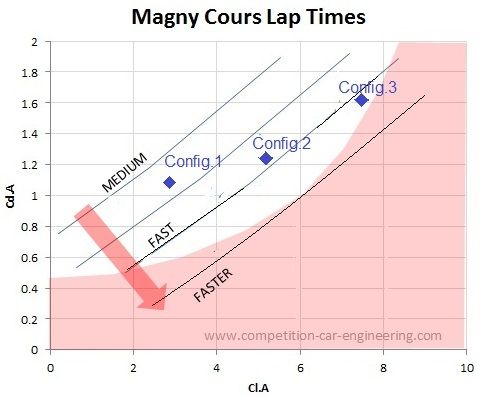
As with all of these things being suggested (e.g. the ability of more efficient cars to run with less fuel, or to have a slightly increased power output to use up any remaining fuel), the only outcome for you guys as competitors is that it changes the shape/gradient of the lines of equal lap time (that I've labelled "Medium" "Fast" and "Faster" in the diagram below): you'll still put your aero coefficients into Virtual Stopwatch and get a lap time out: all these tyre degradation formulas/fuel saving formulas will be automatically considered... So the additional work is only for me on the programming side really....
This contrasts quite a bit with the desire to introduce engine power output modifications based on airflow/pressure on the inlet and cooling intake surfaces: that request certainly adds complexity and more variables for both the competitor and the organisers to handle....
On the flip side you could argue that the fact that since the tyre degradation has no real impact on the method competitors should use to design their cars (and therefore no increase in the "enjoyment" a competitor gets from adding this feature), there is also no real advantage in adding this tyre degradation feature either, since we can also change the shape/gradient of these lines of equal lap time by increasing/decreasing engine power, changing gearing ratios, changing engine inertia, or simply choosing other tracks to visit....
e.g: current curve:
e.g. curve with tyre degradation at high loads:-
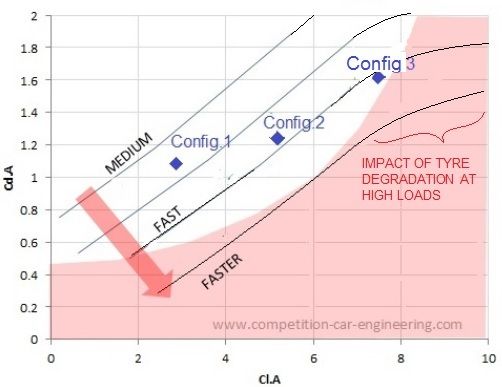
...You can see that Config 3 is still fastest, but now a little closer to the "Fast" lap time curve than it was before, i.e. a little slower than before.... LVDH put it quite nicely:-
I thought adding some more complexity and realism would make the whole thing even more interesting. But in the end you are just changing the gradient of the optimal design (I guess, utility function to be more accurate) we are trying to reach. So nothing would really change.
If you have more downforce you are just pushing further the limit but when you drive, you drive at the limit
That is exactly how Virtual Stopwatch works: it drives at the limit of the tyre with the least amount of relative grip at all times unless some other variable is the limiting factor (e.g. during acceleration engine power, drag, gearing etc. are the limiting factors most of the time, with tyres, the forces on them and the transmission configuration (FWD, RWD or 4WD) only the limiting factor to acceleration at low speeds), so in essence there is no extra "margin" or "less sliding" with more downforce in the Virtual Stopwatch simulation, only more speed due to the higher limit.


