Page 4 of 10
Re: F1 engine RPM
Posted: 11 Oct 2009, 01:09
by PlatinumZealot
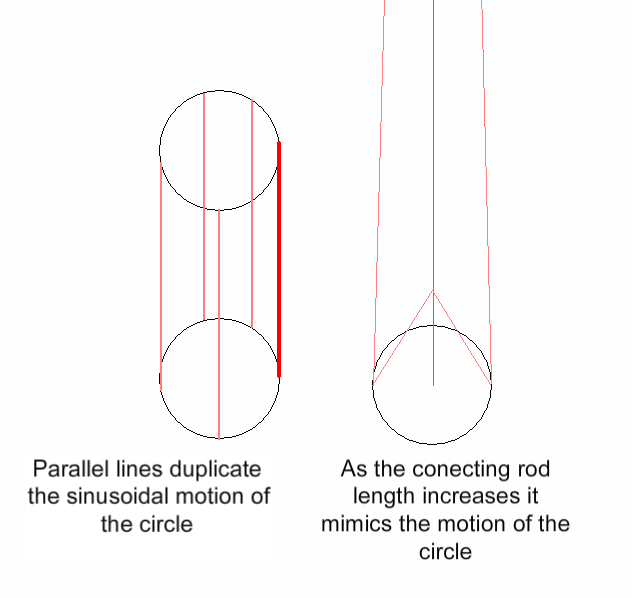
True.. because you can imagine a disk with a rod connected to it..the disk rotation in the Z axis. Now imagine that the rod is always oriented vertically, always parallel to the vertical as the disk rotates..this means that the motion at the tip of the rod will look like a circle too. sinusoidal.
So that's like a connecting rod with infinite length. since it forms a "triangle" of infinite height, it's almost as if the sides were parallel like the example above. Hence he motion would be sinusoidal.
This is another way to see it without equations:
Re: F1 engine RPM
Posted: 05 Jun 2011, 14:38
by Richard
Shameless bump for a great technical thread....
Re: F1 engine RPM
Posted: 07 Jun 2011, 19:10
by Caito
Took around half an hour to find it. But here it is, I strongly recommend you to read this:(though it may be basic to most of you)
Rod Ratio - Kinematics
Rod Ratio - Dynamics
Re: F1 engine RPM
Posted: 07 Jun 2011, 19:59
by donskar
From the piece linked to by Caito:
The sketch on the left shows a piston moving down a cylinder bore as a consequence of combustion pressure. This pressure is converted to a force on the piston. (It is interesting to note that for a given combustion pressure, a bigger bore will give rise to a larger force on the piston)
And . . .
The piston in turns pushes on the rod, and this force is subsequently used to create a torque on the crank, causing it to rotate. Thus the burning of fuel and air is converted to mechanical energy that can be used to propel an automobile down the road (or track).
I'm not afraid to expose my ignorance (my wife gives me endless practice in humility): I take it that the paragraphs above encapsulate about half of what I know about ICE performance:
1) more bore means more HP
2) more stroke means more torque
Re: F1 engine RPM
Posted: 07 Jun 2011, 20:16
by xpensive
More like this Don;
1) More Bore-area means more Force on the piston and thus more Torque.
2) More Stroke also means more torque.
3) Torque times Rpm equals Power.
1) and 2) is why engines are limited by Displacement, as total Bore-area times Stroke.
3) xplains that you need to multiply Torque with Rpm to get Power, why also Rpm is limited in F1 nowadays.
Conclusivey; Power comes from speed, Torque without Rpm is nothing, with a good pipe-wrench I could easily
produce a Torque unseen in Formula One, but it would be useless as it would have no Power.
Re: F1 engine RPM
Posted: 09 Jun 2011, 06:11
by xpensive
What is interesting in this context, is that if the BMW P85 delivered 950 Hp at 19800 Rpm, it's not much different from the 70s Ferrari Flat-12, which delivered 520+ Hp at 12000 Rpm. Xtrapolating the latter to the BMW's speed, lands at 860 Hp.
But they must have been pretty much evenly matched when it comes to torque, the difference was basically in the Rpm.
The answer for the difference in Rpm and thus power from these 3 litre units, can perhaps be found in the bore and stroke ratio, the Ferrari was at 1.61 (80.0 x 49.6), while the P85 was a staggering 2.61 (98.0 x 39.75)!
Re: F1 engine RPM
Posted: 09 Jun 2011, 13:45
by WhiteBlue
xpensive wrote:More like this Don;
1) More Bore-area means more Force on the piston and thus more Torque.
2) More Stroke also means more torque.
3) Torque times Rpm equals Power.
1) and 2) is why engines are limited by Displacement, as total Bore-area times Stroke.
3) xplains that you need to multiply Torque with Rpm to get Power, why also Rpm is limited in F1 nowadays.
Conclusivey; Power comes from speed, Torque without Rpm is nothing, with a good pipe-wrench I could easily
produce a Torque unseen in Formula One, but it would be useless as it would have no Power.
All of this is true within the limitation of naturally aspired engines. Nobody will stop you to blow an engine and find that all the sudden you get different optimum bore/stroke ratios.
Same is true if you start introducing fuel budgets. The maximum power starts being defined by maximising efficiency and thermal efficiency will play a role in the optimization of the bore/stroke ratio.
The super revving N/A engines of the past 20 years have unnaturally short strokes to avoid inertial force and enable insane piston accelerations. The moment you force efficiency you automatically drop revs and gain power from torque by higher gas pressures.
All the Le Mans and F1 engines will shortly be blown to be competitive in efficiency and the very high revving engines will be a thing of the past.
Re: F1 engine RPM
Posted: 09 Jun 2011, 16:45
by Ciro Pabón
X, I hardly recognize you.
The formula given in the previous page uses theta, not phi.
The derivative of the sine is the cosine.
The scale for Chris's graphic is on the left. It's in mm/s2 (curious units) and the numbers go from -1250 mm/s2 to +750 mm/s2.
(very low, roughly a tenth of a G: why? What kind of engine is that, Chris? A Wartsila at 75 rpm? What am I missing here?).
Re: F1 engine RPM
Posted: 09 Jun 2011, 19:41
by alelanza
WhiteBlue wrote:
...The super revving N/A engines of the past 20 years have unnaturally short strokes to avoid inertial force and enable insane piston accelerations...
Hmmm... i would have thought a shorter stroke actually
decreases your piston accelerations, am i wrong here?
Re: F1 engine RPM
Posted: 09 Jun 2011, 21:38
by Caito
alelanza wrote:WhiteBlue wrote:
...The super revving N/A engines of the past 20 years have unnaturally short strokes to avoid inertial force and enable insane piston accelerations...
Hmmm... i would have thought a shorter stroke actually
decreases your piston accelerations, am i wrong here?
WhiteBlue said:
to avoid all that. Meaning, to aovid inertial forces and insane piston accelerations. That's what I understand, at least.
Re: F1 engine RPM
Posted: 10 Jun 2011, 05:40
by xpensive
WhiteBlue wrote:xpensive wrote:More like this Don;
1) More Bore-area means more Force on the piston and thus more Torque.
2) More Stroke also means more torque.
3) Torque times Rpm equals Power.
1) and 2) is why engines are limited by Displacement, as total Bore-area times Stroke.
3) xplains that you need to multiply Torque with Rpm to get Power, why also Rpm is limited in F1 nowadays.
Conclusivey; Power comes from speed, Torque without Rpm is nothing, with a good pipe-wrench I could easily
produce a Torque unseen in Formula One, but it would be useless as it would have no Power.
All of this is true within the limitation of naturally aspired engines. Nobody will stop you to blow an engine and find that all the sudden you get different optimum bore/stroke ratios.
...
Not so, all of the above is true for all piston-engines, we are not talking fuel-efficiency here, just basic mechanics.
Re: F1 engine RPM
Posted: 10 Jun 2011, 15:58
by alelanza
Caito wrote:alelanza wrote:WhiteBlue wrote:
...The super revving N/A engines of the past 20 years have unnaturally short strokes to avoid inertial force and enable insane piston accelerations...
Hmmm... i would have thought a shorter stroke actually
decreases your piston accelerations, am i wrong here?
WhiteBlue said:
to avoid all that. Meaning, to aovid inertial forces and insane piston accelerations. That's what I understand, at least.
no, he said to
enable
Re: F1 engine RPM
Posted: 10 Aug 2011, 01:22
by GrndLkNatv
I remember Toyota experimenting with gasoline, RPM and F1 engines and maxed out near 22k rpm. After that the fuel used had a problem with the combustion rate... I can't remember where I heard this or where I read it...
Re: F1 engine RPM
Posted: 10 Aug 2011, 10:31
by xxChrisxx
The formula given in the previous page uses theta, not phi.
The derivative of the sine is the cosine.
The scale for Chris's graphic is on the left. It's in mm/s2 (curious units) and the numbers go from -1250 mm/s2 to +750 mm/s2.
(very low, roughly a tenth of a G: why? What kind of engine is that, Chris? A Wartsila at 75 rpm? What am I missing here?).
I'm afraid it's so long ago I can't really remember. Looking back on it, it's a bit of a crap graph really. But it does show that as rod length to stroke ratio affects peak forces, and affects the shape of the acceleration curve.
That particular graph isn't of any real engine, it used arbritrary values to test if a model worked. I did so many similar things back than, that this could either be an engine that is rotating slowly or I labelled the graph wrong. If the scale were m/s^2 it would give peak figures of 125g and 75g which are more sensible.
With the figures quoted, i'd guess I messed up the axis units.
I did make and and post it whilst I was drunk!
Re: F1 engine RPM
Posted: 10 Aug 2011, 15:23
by Just_a_fan
GrndLkNatv wrote:I remember Toyota experimenting with gasoline, RPM and F1 engines and maxed out near 22k rpm. After that the fuel used had a problem with the combustion rate... I can't remember where I heard this or where I read it...
The problem will be the flame front speed. In order to burn all of the fuel in the short time available you need high flame front speeds. High engine speeds require higher flame front speeds. But if you go too far you end up with detonation (which is effectively a supersonic flame front) rather than conflagration (i.e. burning, which has <supersonic flame front). Detonation is extremely unhealthy for the engine, obviously, and thus the engine speed is limited to how close you can get the flame front speed to detonation. If the rules limit your bore/stroke then your max revs are limited by flame front speed (assuming you can't improve the combustion conditions in the cylinder any more).
I now await being shot down in flames myself...
