Re: F1 Pistons
Posted: 26 Feb 2010, 15:48
i never knew Ferrari drilled holes on the big end of the connecting rod

Mercedes High Performance Engines, former Mercedes-Ilmor, make their own F1 pistons. So do Cosworth and I think also Honda did. But aside of those, most other manufacturer use Mahle Motorsport pistons. But Mercedes racing engines not built in England, like their DTM engines use Mahle Motorsport pistons. So do Mercedes AMG models, BMW M models and Audi RS models.JohnsonsEvilTwin wrote:Very interesting stuff!
I didnt know Mahle supplied Ferrari! Do they supply Mercedes-Benz?
Slight conflict of interest if so.
Also can anyone tell me if the forthcoming Mclaren road car, the MP4 12C, has a Mahle engine?
Im a massive Mercedes fan, and was dissapointed to hear mclaren wouldnt be using Merc power for their road cars anymore.
 ).
).My professor teached us that the maximum average piston speed for engines currently lies at 25 m/s so there is a limit to this. I checked it with some Ferrari engine data’s and it perfectly fits.Can I ask why the racing engines have such small stroke? Why it is more eficient an engine when a piston moves little but very rapidly? Would the ideal engine have pistons with almost zero stroke and almost infinite speed?
It is not when you think about fuel efficiency.Why it is more eficient an engine when a piston moves little but very rapidly?

I guess you rather had power in mind than fuel usage when you wrote about efficiency. For Formula 1 the answer might be simple because the volumetrical capacity of your engine is fixed. So you can't make your engine bigger when you want more power. The only way to get more power is to let your engine run faster. So when you have a specific displacement, a maximum average piston speed and you want highest revs per minute (power) you simply make your piston bigger in diameter and therefore stroke smaller. Of course there are limits to this. With a smaller stroke you have much less time to burn your fuel and for gas exchange. This wastes your fuel. Furthermore friction and mass inertia are rapidly increasing on a high revving engine. On the other side is such an engine more lightweight.Fuel consumption at maximum economy is 0.260 lbs/hp/hour. At maximum economy the engine exceeds 50% thermal efficiency. That is, more than 50% of the energy in the fuel in converted to motion.
For comparison, most automotive and small aircraft engines have BSFC figures in the 0.40-0.60 lbs/hp/hr range and 25-30% thermal efficiency range.
Most interesting, can anyone comment on that flywheel assembly type of thing?manchild wrote:
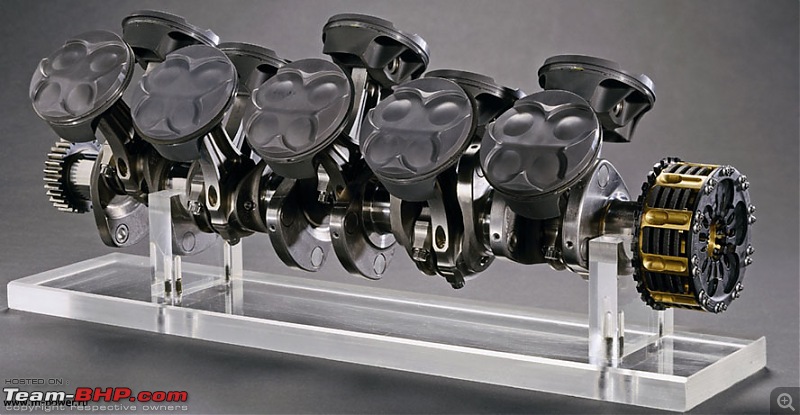
Its that 12cm long clutch pack assembly that I throw away in my system.alelanza wrote:Beautiful thread, not sure how I missed it before
Most interesting, can anyone comment on that flywheel assembly type of thing?manchild wrote:
The reason camshafts are sourced from only a few manufacturers is because the use of compound valve angles; that is the valves are angled in two directions. This means the camshaft have to be made with lobes that also have a small angle. Only a few companies have the equipment for that.Ciro Pabón wrote:Thanks, Edis, very nice post. The ones by Belatti, riff_raff and safeaschuck in pages 2 and 3 of this thread are, too, jewels. Thanks also to Professor for the opportunity to bump this thread and to MC for the nice pictures.
I cannot avoid to think, after reading your post, Edis, that for many of us this is another "layer" to discover in F1. I've never heard of (almost!) sole providers for some high performance parts like the ones you mention (Del West, Schrick). Those are sites I have to visit.
This "monopoly" is achieved by means of quality, you have to assume (and price, you have to fear!
EDIT: Del West is an all-american company aerospace company that, somehow, switched to racing, and it has a manufacturing plant in Switzerland. That's a strange story.
I also loved the phrase at Schrick: "We produce prototypes in series".
Can I ask why the racing engines have such small stroke? Why it is more eficient an engine when a piston moves little but very rapidly? Would the ideal engine have pistons with almost zero stroke and almost infinite speed?
A piston must offer a good fatigue strength at high temperatures, typically in the range of 150-400 degC, a high stiffness and good wear resistance. A production gasoline engine is subject to around 80 bar peak pressures, a F1 engine probably around 110 bar or so, but obviously it is subject to much higher intertial loads. A diesel is subject to much higher peak pressures, when the common rail passenger car engine was introduced in the late nineties the typical peak pressure was around 140 bar, today it's around 180 bar. Commercial diesels see pressures as high as 200-250 bar, and should the oil spray cooling of the pistons fail under full load they wouldn't survive long. Large diesels, such as those found in ships for instance, usually use oil or watercooled pistons. Larger high output diesels use a steel piston, or a steel/aluminium hybrid.autogyro wrote:So the high tech pistons are made to stretch the engine to high revs or in the case of diesels to deal with extreem forces.
Surely much better to harvest the wasted energy from the emgine after all they are only around 20% efficient anyway.
It's a circa 4" multiplate carbon/carbon clutch. For a while they were even below 90 mm in diameter. The 'cage' is titanium, the plates carbon/carbon and the spring 'fingers' steel. The clutch has pull type operation. Today I think it's more common to place the clutch on the gearbox input shaft rather than the engine output shaft. The axial shaft play there is smaller, which is beneficial for the precision of clutch operation.manchild wrote:
Most interesting, can anyone comment on that flywheel assembly type of thing?
Some engines run as much as 30 m/s, I know some speedway racing engines are around here. But it is rare.mep wrote:My professor teached us that the maximum average piston speed for engines currently lies at 25 m/s so there is a limit to this. I checked it with some Ferrari engine data’s and it perfectly fits.
For peak efficiency you want the engine to run at a certain speed that can be related to the cylinder size. For a passenger car engine with 0.5 liter cylinders that's around 3000 rpm, for a commercial diesel with 2.5 liter cylinders it's around 1200 rpm and for a big diesel like the one above, it's probably around 100 rpm or so. Why? Well, heat losses decrease with increased engine speed and increased cylinder size, frictional losses increase with piston mean velocity. So you want to balance heat losses against frictional losses; high speed is benefitial to minimize the heat losses while lower speed is benefitial to minimize the frictional losses. With larger cylinders, this balance will occur at lower engine speeds.mep wrote:In fact very big, slow moving, long stroked Diesel engine are the most fuel efficient ones.
Check this out:
http://people.bath.ac.uk/ccsshb/12cyl/
Fuel consumption at maximum economy is 0.260 lbs/hp/hour. At maximum economy the engine exceeds 50% thermal efficiency. That is, more than 50% of the energy in the fuel in converted to motion.
For comparison, most automotive and small aircraft engines have BSFC figures in the 0.40-0.60 lbs/hp/hr range and 25-30% thermal efficiency range.
Great stuff, many thanks for the wealth of info. So the first small and noticeably thin gear like bit is the actual flywheel? or is there no flywheel at all?Edis wrote:
It's a circa 4" multiplate carbon/carbon clutch. For a while they were even below 90 mm in diameter. The 'cage' is titanium, the plates carbon/carbon and the spring 'fingers' steel. The clutch has pull type operation. Today I think it's more common to place the clutch on the gearbox input shaft rather than the engine output shaft. The axial shaft play there is smaller, which is beneficial for the precision of clutch operation.
There are two big suppliers of these clutches for F1, Sachs Race Engineering and AP Racing.
http://www.zf.com/media/media/document/ ... 132_zf.pdf
http://www.apracing.com/info/index.asp? ... tches_2789
Yes, there is no separate flywheel. In a c/c clutch the flywheel isn't used as a friction surface as with a normal clutch. The toothed wheel is for the crankshaft position sensor.alelanza wrote:Great stuff, many thanks for the wealth of info. So the first small and noticeably thin gear like bit is the actual flywheel? or is there no flywheel at all?Edis wrote:
It's a circa 4" multiplate carbon/carbon clutch. For a while they were even below 90 mm in diameter. The 'cage' is titanium, the plates carbon/carbon and the spring 'fingers' steel. The clutch has pull type operation. Today I think it's more common to place the clutch on the gearbox input shaft rather than the engine output shaft. The axial shaft play there is smaller, which is beneficial for the precision of clutch operation.
There are two big suppliers of these clutches for F1, Sachs Race Engineering and AP Racing.
http://www.zf.com/media/media/document/ ... 132_zf.pdf
http://www.apracing.com/info/index.asp? ... tches_2789
EDIT: nevermind, i just read the document you linked, flywheel is integrated, cool!
Different question though, how about ilmor/MB, do they make most of their engine parts? or do they outsource as well?
Excellent info, thanks a lot Edis!Edis wrote:Yes, there is no separate flywheel. In a c/c clutch the flywheel isn't used as a friction surface as with a normal clutch. The toothed wheel is for the crankshaft position sensor.alelanza wrote:Great stuff, many thanks for the wealth of info. So the first small and noticeably thin gear like bit is the actual flywheel? or is there no flywheel at all?Edis wrote:
It's a circa 4" multiplate carbon/carbon clutch. For a while they were even below 90 mm in diameter. The 'cage' is titanium, the plates carbon/carbon and the spring 'fingers' steel. The clutch has pull type operation. Today I think it's more common to place the clutch on the gearbox input shaft rather than the engine output shaft. The axial shaft play there is smaller, which is beneficial for the precision of clutch operation.
There are two big suppliers of these clutches for F1, Sachs Race Engineering and AP Racing.
http://www.zf.com/media/media/document/ ... 132_zf.pdf
http://www.apracing.com/info/index.asp? ... tches_2789
EDIT: nevermind, i just read the document you linked, flywheel is integrated, cool!
Different question though, how about ilmor/MB, do they make most of their engine parts? or do they outsource as well?
Usually there haven't been that much information about Ilmor/MB availible. They do make their own pistons, I know that much, and they have for obvious reasons used TAG/McLaren Electronic Systems for engine control, fuel injection and electrical.