Re: Exhaust Blown Floor - Forward Exhaust Exit
Posted: 08 Apr 2011, 21:33
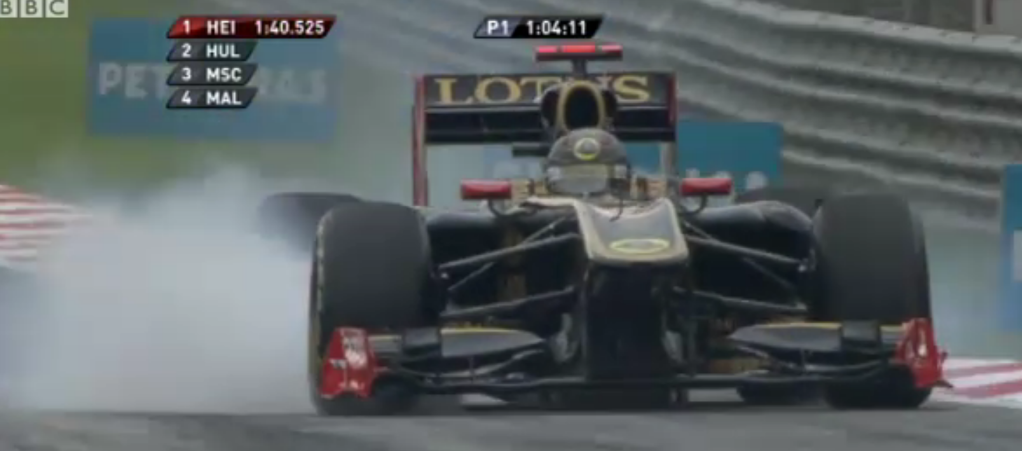
Because if you watched the coverage you could see that the front right wheel was locked by a failed upright.strad wrote:why do you assume that is tire smoke?
Because if you watched the coverage you could see that the front right wheel was locked by a failed upright.strad wrote:why do you assume that is tire smoke?
marekk wrote:@ ringo:
any comments on this one:
Please note: right tyre's smoke going out of diffuser center.


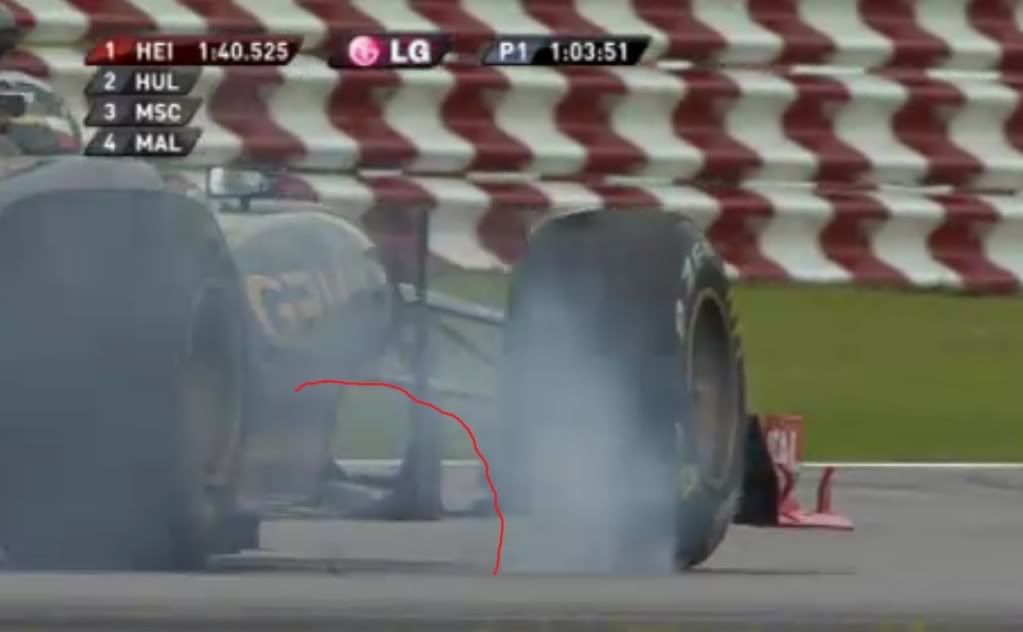
Smoke.ringo wrote:That is tyre smoke or general dust on the track. I was waiting for this to come up.marekk wrote:@ ringo:
any comments on this one:
Please note: right tyre's smoke going out of diffuser center.
The engine is not smoking,so it cannot be engine exhaust.
Not true. I've made this snapshot myself. It's in the middle of the long straight.The car is turning and constantly moving across track. It's likely that the car can move over the path of the front wheel while turning or following the racing line.

Bargeboards + turning vanes in action. Or do you suggest, exhaust is blowing THAT high and wide ? And starts to blow just behind front wheel: ?I think you will see the tyre smoke deflected by the exhaust.
edit: i can post a snap shot to justify an opinion as well.
why does it go so wide?

This force has a name. Imagination.and why is there a clean area to the left of the red line, as if there is some force pushing away the smoke?

Am i talking about rear wheel ?n smikle wrote:In a left turn the back wheel goes towards the smoke.
Also that other picture is clearly sparks and smoke from the floor/plank. Two separate sources of smoke.
n smikle wrote:So what are you saying then?
It's just 1 frame, if you look at the whole video, there is some smoke going from the diff almost all the time.TURU wrote:It may very well be smoke coming from the floor as its clearly sliding on the ground. The smoke coming from front right wheel is going outside of right rear or at least majority of it.

barge board and turning vane effect is not that huge.marekk wrote:
Bargeboards + turning vanes in action. Or do you suggest, exhaust is blowing THAT high and wide ? And starts to blow just behind front wheel: ?
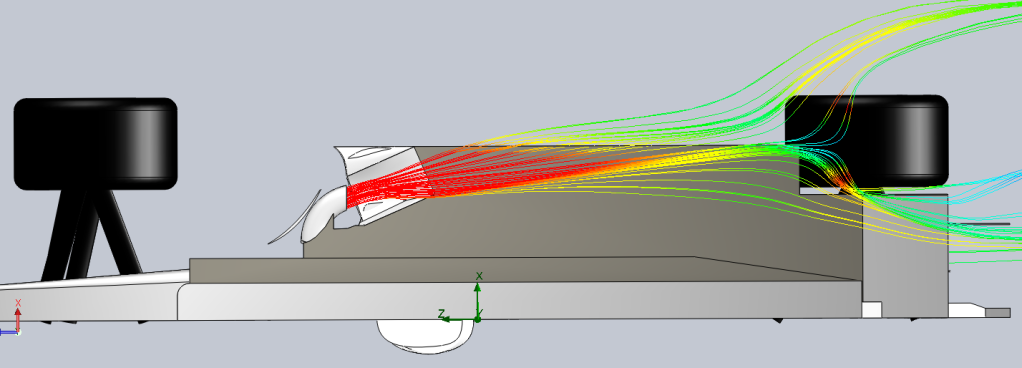
We have to wait for the finel evidence, where is this exhaust realy going - our speculations are just this... speculations.ringo wrote: Tell me though, why do you want the flow to go under the diffuser?
It's effect will be minimal compared to the other solutions that have the pipes right by the diffuser where it can get maximum energy.
I am willing to accept any logical explanation, but there isn't much facts to support the diffuser being blown.
It could well be, but there is no evidence for it.
I find that blowing wide has multiple benefits that positvely improve the diffuser as opposed to desperately blow the diffuser, and not even do it effectively.
How do you think the f duct works?marekk wrote:
I don't think one can significantly decrease drag by blowing all exhaust gases into low pressure wake behind front tyres - volume/mass flow of exhaust is simply to small compared to amount of air displaced by the tire, and at high speeds of the car, when drag reduction will give biggest gains, even more so.
Hopefully one day they fill to much oil in the tank and we will see.
Of which at least #4 would work better at lower speeds. That might go someway to explain the start of both Renaults and they pace right out of the hairpin in Malaysia.marekk wrote:
...
If exhaust goes under the floor and to the diffuser, one can have following gains:
1. Kinetic energy (exhaust has momentum more or less perpendicular to longitudal axis) is used to "widen" flow lines from leading edge to diffuser. This means more area covered, longer paths/more time to accelerate flow and more downforce.
2. Heat exchange/mixing with external flow means higher gas temp under te floor. Hot gases have less density and inertia, so they accelerate better then cold ones, achiving higher speeds - this is less static pressure and more downforce.
3. Hot gases under the floor and in diffuser decrease boudary layers thickness and prevent flow separation (especially in highly loaded diffuser).
4. Mixed flow cools down partially due to heat transfer and radiation - gases contract as they cool down. Created void is low pressure, so more downforce. As the gases around rush to fill this void, they accelerate - more downforce.
...
