Page 342 of 668
Re: Formula One 1.6l V6 turbo engine formula
Posted: 25 Jan 2014, 12:29
by zrche
Say pls what could it be?

Re: Formula One 1.6l V6 turbo engine formula
Posted: 25 Jan 2014, 13:57
by WhiteBlue
I would say an airbox.
Re: Formula One 1.6l V6 turbo engine formula
Posted: 25 Jan 2014, 14:39
by Juzh
WilliamsF1 wrote:djos wrote:
If they did want back in to promote their ecoboost range of cars then Cosworth would be their logical partners IMO.
Has there been a rumor elsewhere?
We may have just started it

[/quote]
Way offtopic - but did you see the 2015 mustang? looks like a modded Aston
http://www.autoguide.com/auto-news/wp-c ... tang1.jpeg[/quote]
It really does lol.
Re: Formula One 1.6l V6 turbo engine formula
Posted: 25 Jan 2014, 15:57
by FW17
WhiteBlue wrote:I would say an airbox.
Question is why is it so big? What is inside it? Do they need that tall intake trumpets?
Re: Formula One 1.6l V6 turbo engine formula
Posted: 25 Jan 2014, 15:59
by tuj
My understanding was that the dual inlet turbine housings were twin-scroll designs, thus the interference from exhaust pulses is mitigated. In theory the twin-scroll is better for response but with the MGU-H keeping the huge turbos spooled all the time, I'm not so sure it matters that much.
As for the airbox, my understanding is that it acts as a resonator, thus it is sized accordingly to the engine's breathing demands to maximize torque.
Re: Formula One 1.6l V6 turbo engine formula
Posted: 25 Jan 2014, 16:03
by Holm86
tuj wrote:
As for the airbox, my understanding is that it acts as a resonator, thus it is sized accordingly to the engine's breathing demands to maximize torque.
Yes it has acoustic tuning abilities but also works to diffuse the air to get an equal filling of all cylinders.
Re: Formula One 1.6l V6 turbo engine formula
Posted: 25 Jan 2014, 17:08
by wuzak
tuj wrote:My understanding was that the dual inlet turbine housings were twin-scroll designs, thus the interference from exhaust pulses is mitigated. In theory the twin-scroll is better for response but with the MGU-H keeping the huge turbos spooled all the time, I'm not so sure it matters that much.
My understanding is that the problem with a single scroll design for a V6 is that when at a speed for which the headers are not optimised the exhaust pulses can interfere with each other and lower the power that the turbine cane generate (which means lower response but also lower recoverable power for the MGU-H) and can be problematic for exhaust scavenging.
Re: Formula One 1.6l V6 turbo engine formula
Posted: 25 Jan 2014, 17:41
by Tommy Cookers
WilliamsF1 wrote:WhiteBlue wrote:I would say an airbox.
Question is why is it so big? What is inside it? Do they need that tall intake trumpets?
the intake trumpet length (from the port) should need to be 71% longer than for 2013
because it will be inversely proportional to the ratio of 2014 rpm to 2013 rpm
(if the induction air temperature is unchanged from 2013)
allowing for 2014 induction temperature being about 50 C higher (increasing the velocity of the induction pulse effects)
the 2014 inlet trumpet length (from the port) should be about 58% greater than the 2013 length
this (retaining 'tuned length' induction system) gives about 0.2 bar of free supercharging, worth about 10 hp directly, and more indirectly
Re: Formula One 1.6l V6 turbo engine formula
Posted: 25 Jan 2014, 17:50
by FW17
Holm86 wrote:tuj wrote:
As for the airbox, my understanding is that it acts as a resonator, thus it is sized accordingly to the engine's breathing demands to maximize torque.
Yes it has acoustic tuning abilities but also works to diffuse the air to get an equal filling of all cylinders.
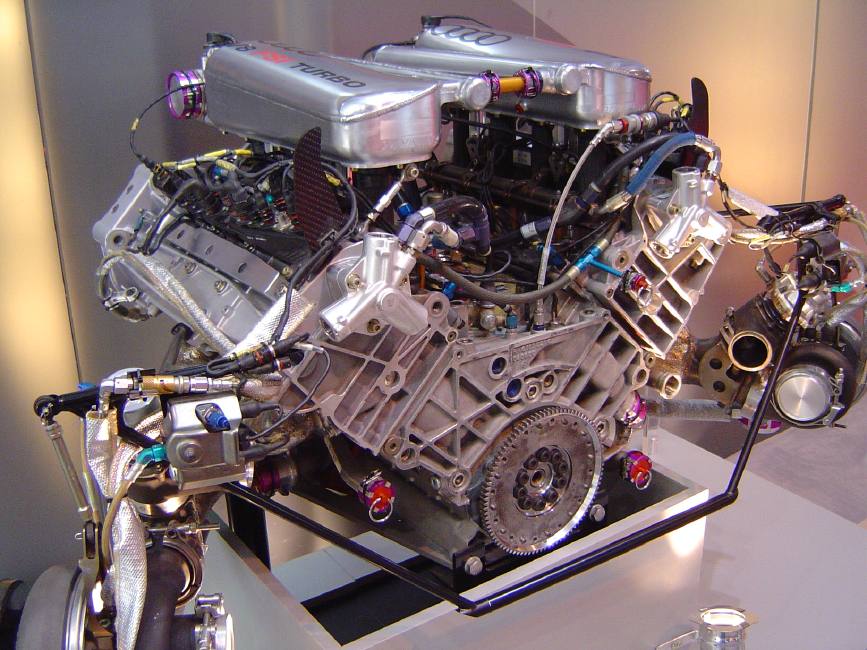
That is the purpose of the airbox when it is a ram air design working at atmospheric pressure not for a compressed air system.
The R8 FSI engines ran with small plenums.
Re: Formula One 1.6l V6 turbo engine formula
Posted: 25 Jan 2014, 17:54
by FW17
Tommy Cookers wrote:WilliamsF1 wrote:WhiteBlue wrote:I would say an airbox.
Question is why is it so big? What is inside it? Do they need that tall intake trumpets?
the intake trumpet length (from the port) should need to be 71% longer than for 2013
because it will be inversely proportional to the ratio of 2014 rpm to 2013 rpm
(if the induction air temperature is unchanged from 2013)
allowing for 2014 induction temperature being about 50 C higher (affecting the velocity of the induction pulse effects)
the 2014 inlet trumpet length (from the port) should be about 63% greater than the 2013 length
If trumpet lengths are to be increased a Peugeot LMP idea could be incorporated (not say that this is the best way)

Re: Formula One 1.6l V6 turbo engine formula
Posted: 25 Jan 2014, 18:04
by tuj
That is the purpose of the airbox when it is a ram air design working at atmospheric pressure not for a compressed air system.
The Helmholtz effect works no matter FI or NA. The acoustic effect is dependent primarily upon plenum volume. Perhaps the Audi plenums were optimized for the lower RPM's of their engines, thus their smaller volume. The plenum size also affects throttle response, so perhaps without a MGU-H on the Audi, they wanted as small of plenums as possible. With the MGU-H spinning, throttle response on these engines should not be an issue.
Re: Formula One 1.6l V6 turbo engine formula
Posted: 25 Jan 2014, 20:20
by Tommy Cookers
tuj wrote:
The Helmholtz effect works no matter FI or NA. The acoustic effect is dependent primarily upon plenum volume. Perhaps the Audi plenums were optimized for the lower RPM's of their engines, thus their smaller volume. The plenum size also affects throttle response, so perhaps without a MGU-H on the Audi, they wanted as small of plenums as possible. With the MGU-H spinning, throttle response on these engines should not be an issue.
the Helmholtz frequency is proportional to the square root of A/VL .... that (proportionality) simplifies to 1/L
so it is (for a given fluid at a given temperature) length dependent only
ie numerically the same as those old unexciting formulae that don't mention Helmholtz
the true Helmholtz chamber has a small neck relative to the body volume
and is highly frequency-specific
more engine-useful devices on inlet or exhaust side have larger 'necks' and are less strongly frequency-specific/ 'peaky'
call it Helmholtz or not, the design length will be the same for the same case
the pressure pulses we wish to capture to boost filling are proportionate to the dynamic pressure ie to the square of the gas velocity
so volumes ie cross-sectional areas should be small enough to keep gas velocities high, certainly on the induction side
I don't understand what the plenum does for cylinder filling beyond what the inlet trumpet (length) does
is it to do with air intake from the atmosphere ??
maybe Professor Blair's (free) work can show this ? ..... or does someone here have his book ?
Re: Formula One 1.6l V6 turbo engine formula
Posted: 25 Jan 2014, 20:40
by lio007
here the new Renault V6 sound:
[youtube]
http://www.youtube.com/watch?v=bQEBjMydOhk[/youtube]
Re: Ferrari F14T
Posted: 25 Jan 2014, 20:51
by mclaren_mircea
http://grandprix247.com/2014/01/25/disp ... d-ferrari/
Reports have emerged that even before the new V6 turbo engines are fired up in anger, a dispute is brewing between Mercedes, Renault and Ferrari.
Auto Motor und Sport reports that the dispute is over whether a protective cover for the turbocharger, weighing a crucial 3 or 4 kilograms, is necessary.
Mercedes and Renault argue that the cover is needed for safety reasons in the event of a turbo failure, but Ferrari wants to leave the cover off.
“Next week there will be a clarifying conversation with the FIA,” wrote correspondent Tobias Gruner. ”Renault will apparently show a film of what happens when a turbocharger explodes.”
You can read in this that Ferrari has a lighter engine (and probably a little less power) than Mercedes and Renault, but they exploited to the last level of possibility the and in a much clever way the distribution of the weight of F14T. It's also very likely that the overal package (chassis+engine) is much more on limit with the regulations with the whole weight of the car than Mercedes and Renault power cars, and that their's design can't sustain another add of weight without damaging some joker they think they have in their hands, regarding their package. I may be wrong, but that's my interpretation of this problem. I'm eagerly waiting for other opinions.
Re: Formula One 1.6l V6 turbo engine formula
Posted: 26 Jan 2014, 02:13
by mrluke
How can anybody not like the sound of that!?
This looks pretty similar to the renault plenum really, if you start the box at the bottom of the trumpets there wouldnt be much in it.
As per previous posters plenum works to equalise pressure to all chambers, also it can be a store of compressed air for quicker throttle response, especially as turbo will be continuously spooled by mguh