Page 36 of 668

Re: Formula One 1.6l turbo engine formula as of 2013

Posted: 23 Dec 2010, 18:37
by strad
Image

Re: Formula One 1.6l turbo engine formula as of 2013

Posted: 23 Dec 2010, 18:53
by xpensive
What's wrong with you anyway strad, can't you give a second of your precious time to appreciate a man's ambitions?

I'm almost done with my own invention, which will turn fossil fuels obsolete in a heartbeat, where I have managed to split
H2O into Hydrogene gas for propulsion use and pure oxygene for divers as well as astronauts. Wasn't that difficult really.

Re: Formula One 1.6l turbo engine formula as of 2013

Posted: 23 Dec 2010, 18:59
by Richard
Yes, I'd be interested in any news on developing ESERU ...

but not here please!

There is a special thread for that

:arrow: :arrow: :arrow: viewtopic.php?f=3&t=7572

Re: Formula One 1.6l turbo engine formula as of 2013

Posted: 23 Dec 2010, 19:02
by Richard
xpensive wrote: Hydrogene gas ... oxygene ....
So that's where your missing "e" has gone - you scavenged "expensive" to add an extra electron to "hydrogen" and "oxygen".

Anyway, a vast solar array in the desert would generate the hydrogen and oxygen for you without the need for fossil fuels. Not sure you could patent that?

Re: Formula One 1.6l turbo engine formula as of 2013

Posted: 23 Dec 2010, 19:52
by xpensive
Not unless it's o-xygene richard, not in this lifeime, gotta do something xplicit about this here xtrordinary keyboard.

Just look at the composition itself, You got o-xygene and hydrogene, simply separate them, how difficult could it be?

Re: Formula One 1.6l turbo engine formula as of 2013

Posted: 23 Dec 2010, 20:34
by ringo
autogyro wrote:Using a flywheel for storage would be simple using my ESERU
(electric shift energy recovery unit)/gearbox.
You would simply place the flywheel between the engine and the gearbox/ESERU in place of the clutch which would no longer be needed, in the bell housing, exactly the right place for a flywheel.
It would be spun up or applied to the gearbox/ESERU mechanicaly, without the need for a conventional mechanical clutch and disengaged when not needed. It would not be connected to the engine.
I would still expect to use MGUs on the front axle which would electricaly spin up the flywheel through the ESERU electro mechanical gearsets, (as well as the mechanical spin up from the rear axle via the ESERU geartrain). The front MGUs would be driven from the flywheel using the ESERU to supply current from the flywheel through its (electro mechanical) gearsets (as well giving direct mechanical drive to the rear axle).

How many batteries if any would depend on the regulations.
remember you don't want your flywheel in a vertical plane. It would have to be supported by bearings, meaning it will leak it's energy into friction. It needs to be magnetically levitated.
It's easier to design a system to levitate in a horizontal plane.
If you put your flywheel on the crank, the mag lev system has to be integrated into that as well.
I don't understand your gearbox, but if it is a twin input shaft, the flywheel can be on the outer shaft levitating until ready for use.
What williams never specified is the weight of a maglev system and it's size, neither if it's elctromagnetic or permanent magnet.

Re: Formula One 1.6l turbo engine formula as of 2013

Posted: 23 Dec 2010, 20:39
by ringo
747heavy wrote:
If we take our 3.6MJ energy budget and spend it on a 75s lap, which means 63s where we not brake, and let´s say we have only 40s where we are not traction limited, we can average the energy over 40s into 90kW more power, then a non KERS car.
Assuming a 640kg KERS car and a 450kW I4turbo engine that´s 450kW+90kW/640kg=~0,85kW/kg

a non KERS car, if we did not have the min. weight limit would have 450kW/640kg-185kg = ~0,99kW/kg

both would have the same fuel (weight goes on top) and the same tires. Chances are that the ligther car would be able to use the softer tire for longer etc.
Great post.
I'll have the few drops of fuel instead thank you! :lol:
It's more economical, and smaller carbon footprint as well.
Think of the factories and energy requirements to manufacture that 185kg behemoth of a battery. You probably burn more oil making the KERS system, than to produce the same power in a lighter car for the whole year.

Re: Formula One 1.6l turbo engine formula as of 2013

Posted: 23 Dec 2010, 21:32
by 747heavy

This

So how do we make a better battery if we cannot depend on packing them tighter? We change the positive and negative electrodes to something that has more energy. This is already happening; many devices are now sold with a different positive electrode, with theoretical energy of ~450 Wh/kg for these cells. And there are some amazing things going on at Berkeley via the Batteries for Advanced Transportation Technologies (BATT) program that will surely make things better in the very near future.

or this?

A lot of pundits — Thomas Friedman being the latest — and Silicon Valley investors talk about the hope for a Moore’s Law for batteries. In the same way that the number of transistors on a chip has doubled roughly every two years, leading to the personal computing and Internet revolutions, the dream is that batteries will drop in size and price and rise in performance in the same fashion. But at The Battery Show in San Jose, Calif. on Tuesday, Paul Beach, president of battery company Quallion, brought that idea back to reality and explained the actual difference in progress between batteries and IT: “Moore’s Law has delivered a 10,000 times improvement over the years for chips, while historically batteries have shown a 3 to 4 times improvement.”

Beach, who has decades of experience in the battery biz, put it simply: If you want to find a Moore’s Law-type improvement for batteries, “you’ve got to go to an asteroid and come back with some new materials.” Battery improvements these days are about optimization and incremental improvements, and we need to stop drinking the Kool-Aid and be realistic about pricing, said Beach.
Why there where and will be certainly improvements in this area, we may should not hope for half the size and double the power in 2 years time.

Re: Formula One 1.6l turbo engine formula as of 2013

Posted: 23 Dec 2010, 21:56
by autogyro
It would be interesting to see how one makes a comparison with the speed of computer chip development and battery development.
Surely it would be better to compare battery development with internal combustion development, which has basicaly stood still.

Re: Formula One 1.6l turbo engine formula as of 2013

Posted: 24 Dec 2010, 04:16
by Formula None
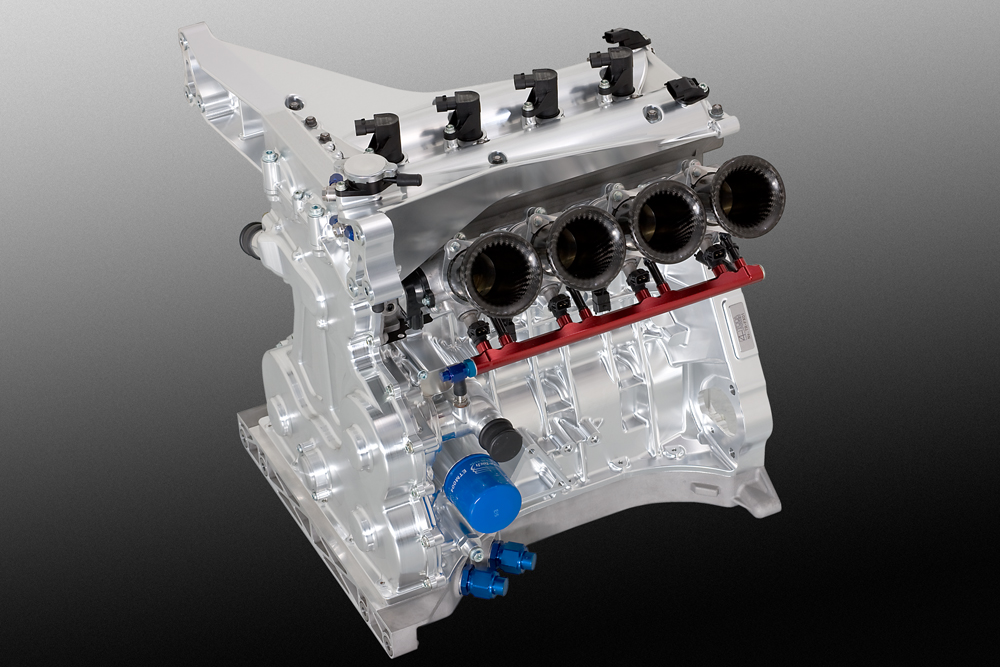
Some images of the TODA TRFX-01 engine. Seems like a good example of a stressed member, upright I-4.

Image

Image

Re: Formula One 1.6l turbo engine formula as of 2013

Posted: 24 Dec 2010, 07:37
by ringo
Yeah it has some telltale signs.
Especially the ribs and thick flanges and bottom.

This unit is pretty neat though.

Re: Formula One 1.6l turbo engine formula as of 2013

Posted: 24 Dec 2010, 07:43
by xpensive
Good lord, look as those torque arms, bet they are set for holding looong pin-bolts with spherical-seat nuts in order to be compliant with that unspeakable phenomenon, which mechanical enginneers rather not face in a dark alley.

The layout looks engineerishly logic however, the shape of things to come WB?
Re: Formula One 1.6l turbo engine formula as of 2013

Posted: 24 Dec 2010, 09:38
by WhiteBlue
xpensive wrote:Good lord, look as those torque arms, bet they are set for holding looong pin-bolts with spherical-seat nuts in order to be compliant with that unspeakable phenomenon, which mechanical enginneers rather not face in a dark alley.

The layout looks engineerishly logic however, the shape of things to come WB?
Image

Yes, except that this is a NA multi port injected F3 engine. The turbo would be injected from the top and the ignition would come slightly sideways. I'm very curious now where they will position the turbo. I agree with Ringo's proposal as it would make space for the tunnels.

Re: Formula One 1.6l turbo engine formula as of 2013

Posted: 24 Dec 2010, 10:20
by xpensive
I would have gone with the Ferrari I4 layout from the 80s, lower CG and stiffness for free, where's Gordon Murray?

Re: Formula One 1.6l turbo engine formula as of 2013

Posted: 24 Dec 2010, 10:58
by Blackout
Something like this ?

Image

:mrgreen: