Page 382 of 1333
Re: Honda Power Unit
Posted: 16 Feb 2017, 11:16
by Lucky
RolledaNsx:
Honda went very advanced again with their new PU.
It looks like they moved the compressor out of the V.(most likely like the MB PU with split turbo with MGU-H in the V between the front compressor and rear turbine)
Also it looks like they went with a trick crank shaft to make the block shorter to make up for the compressor now out of the V.Ford Flathead V8 like with two rods sharing the same crank pin?
It sounds weird!
So what it looks like they did is no off-set to pistons(shortens block 40-50mm) to make up for putting the Compressor out of the V so 2016 and 2017 PU could be the came overall size.
It looks like they are using this year for testing for winning it all in 2018.
(it will take time to get the ICE combustion right and then maxing out ER ,their first year with pre-chamber/trick injection...MB been running 4 years and Ferrari 2 years.....Honda is behind everybody.This is like a rookie year for them with the tech!
Can do that with no tokens!
http://vtec.net/forums/one-message?message_id=1307115

Re: Honda Power Unit
Posted: 16 Feb 2017, 11:30
by Farfar
If I'm not wrong, each bore's block has a displacement of 20/40 mm with the other. (Conecting rod). So with coplanar rods engine could be shorter in that length
Re: Honda Power Unit
Posted: 16 Feb 2017, 11:56
by Tommy Cookers
glenntws wrote:Tommy Cookers wrote:coplanar rods save only a little length (what roon said), as modern bores are large and modern bearings are small (reason coplanars are in museums)
articulated (one coplanar type) rods will give motion differences between banks
coplanar rods will be less suited to very high rpm, but seem plausible at current F1 mandated stroke and rpm used
the mandated 90 deg V could have a flat crank but still good balance, eg whole left bank firing simultaneously, then whole right
convention says rather poor for the turbo and for the crankshaft
You're right with the low stability of coplanar rods. They also cause different vibrations which are hard to control at 12k rpm.
However in my opinion your idea of big bang wouldn't really work. There would simply be way to much vibrations which are simply put not really attractive in a 12k rpm engine

I think a possible firing order is 1-4-3-6-2-5, which allows for 90° - 150° - ... seperation in firing. This would also mean that the exhaust manifold length of each cylinder simply has to have the same length to the main connection to achieve a very static pressure flow to the turbine which in turn means a more efficient turbo.
I was trying to say that in a 90 deg (3 throw) V whatever the crankshaft layout there's only secondary (ie rather small) force imbalance
eg three 90deg 1 throw (100% counterweighted) V twins would combine in different ways into a 90deg V6 with broadly similar results
eg a 0, 0, 0 deg crank, a 0, 240, 480 deg, a 0, 90, 180 deg ??, or something weird helping pulse feed to the turbo w or w/o cylinder cutting
eg Honda made conventional 0, 180 deg 2 throw V4 road motorcycles and then used a 0, 0 deg crank in race versions based on them
(only to get a stronger, higher rpm crankshaft within the dimensions dictated by the road machine design race rules - BB otherwise a myth)
the exhaust system imo has one runner longer than the other to (at typical rpm) equispace the pulses arrival at turbo (as single turbo Renault c.1978)
many/very many have said otherwise ie that the turbos are 'double-entry' (eg allowing equal or some other runner lengths)
Re: Honda Power Unit
Posted: 16 Feb 2017, 12:18
by Brian Coat
Re: Exhaust sound, I'm going to wait to hear it fully warm at full load ...
Re: Honda Power Unit
Posted: 16 Feb 2017, 12:22
by GoranF1
Lucky wrote:RolledaNsx:
Honda went very advanced again with their new PU.
It looks like they moved the compressor out of the V.(most likely like the MB PU with split turbo with MGU-H in the V between the front compressor and rear turbine)
Also it looks like they went with a trick crank shaft to make the block shorter to make up for the compressor now out of the V.Ford Flathead V8 like with two rods sharing the same crank pin?
It sounds weird!
So what it looks like they did is no off-set to pistons(shortens block 40-50mm) to make up for putting the Compressor out of the V so 2016 and 2017 PU could be the came overall size.
It looks like they are using this year for testing for winning it all in 2018.
(it will take time to get the ICE combustion right and then maxing out ER ,their first year with pre-chamber/trick injection...MB been running 4 years and Ferrari 2 years.....Honda is behind everybody.This is like a rookie year for them with the tech!
Can do that with no tokens!
http://vtec.net/forums/one-message?message_id=1307115
Sasha is Rolenda NSX.....not that that is a bad thing, just saying.
Re: Honda Power Unit
Posted: 16 Feb 2017, 13:14
by restless
GoranF1 wrote:
Sasha is Rolenda NSX.....not that that is a bad thing, just saying.
Are you sure?!
Re: Honda Power Unit
Posted: 16 Feb 2017, 13:22
by PlatinumZealot
wuzak wrote:PlatinumZealot wrote:The renault number from exhaust is extremely high.
Reynolds Number?
Yes.

Too much f1 on my brain. Lol didnt even realize what i typed.
Re: Honda Power Unit
Posted: 16 Feb 2017, 13:24
by GoranF1
restless wrote:GoranF1 wrote:
Sasha is Rolenda NSX.....not that that is a bad thing, just saying.
Are you sure?!
99% compare the posts...
Re: Honda Power Unit
Posted: 16 Feb 2017, 14:03
by wuzak
Lucky wrote:Also it looks like they went with a trick crank shaft to make the block shorter to make up for the compressor now out of the V.Ford Flathead V8 like with two rods sharing the same crank pin?
Most vee engines have two rods sharing the same crank pin.
They could shorten the whole engine by using fork and blade type rods or a master and slave rod arrangement, thereby aligning left and right cylinder banks and shortening the crank by the offset (thickness of rod).
Or it could be that the previous engines had a more conservative bore spacing, and by closing the spacing up they have shortened the engine.
Re: Honda Power Unit
Posted: 16 Feb 2017, 15:57
by godlameroso
If you're brave you can also remove the center main bearing journal and try to figure out another way to control thrust forces and crank harmonics, but that's the least likely solution.
Re: Honda Power Unit
Posted: 16 Feb 2017, 17:09
by PhillipM
I suppose being bore constrained you could use offset rods on either end and loose a little length from the crank/block beneath the liners, which might let you move the engine a little further forwards as your oil tank can take some of that space up -so long as your compressor is in the V not on the front...and possibly the gearbox a little too, if your flywheel/clutch is under the liners...seems a dicey tradeoff though.
edit, actually you'd be better staggering them all one way towards the 'box and keep the flywheel side the same, to pull as much as you could from the front for oil tank space.
Re: Honda Power Unit
Posted: 16 Feb 2017, 17:28
by glenntws
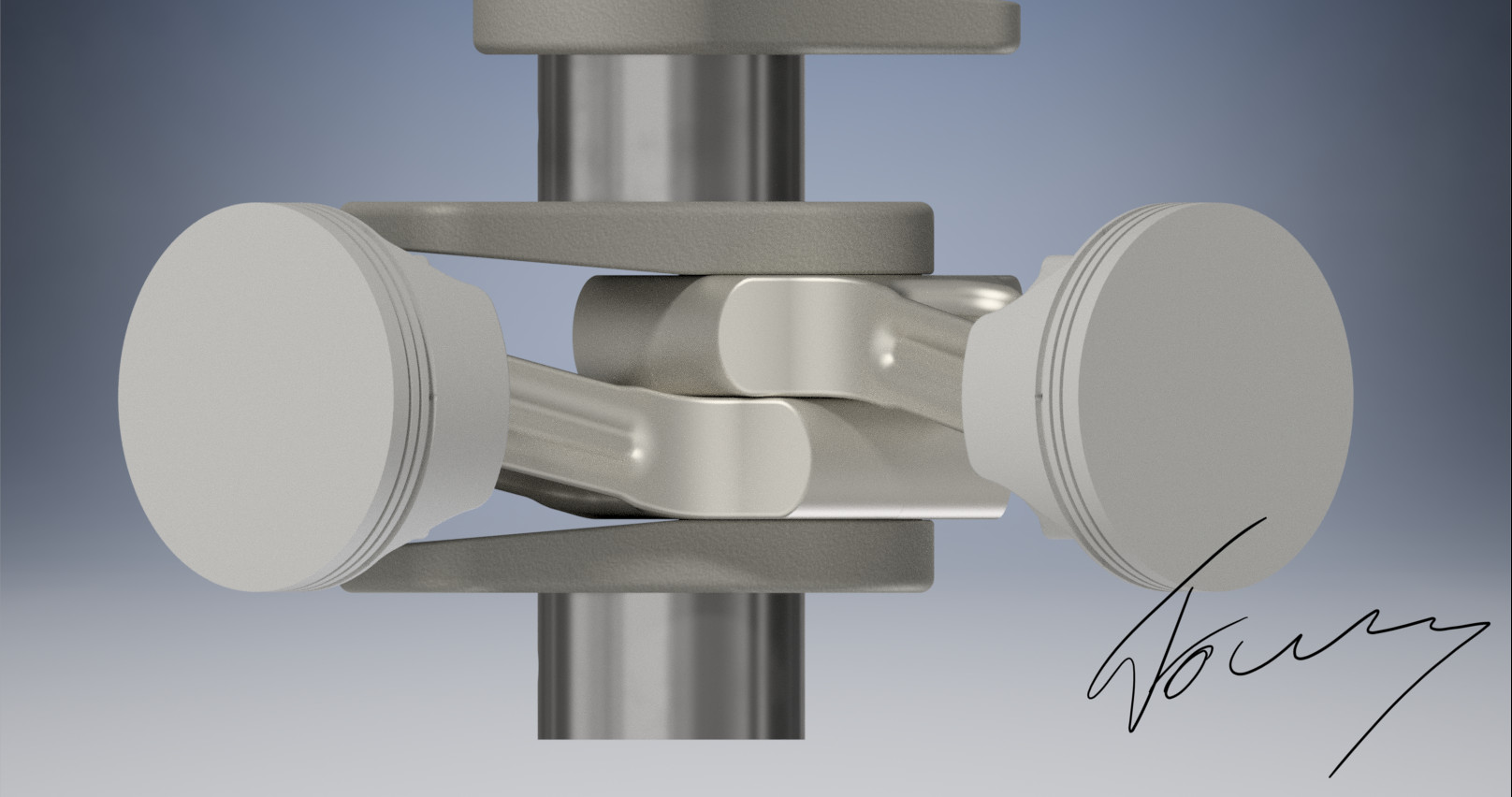
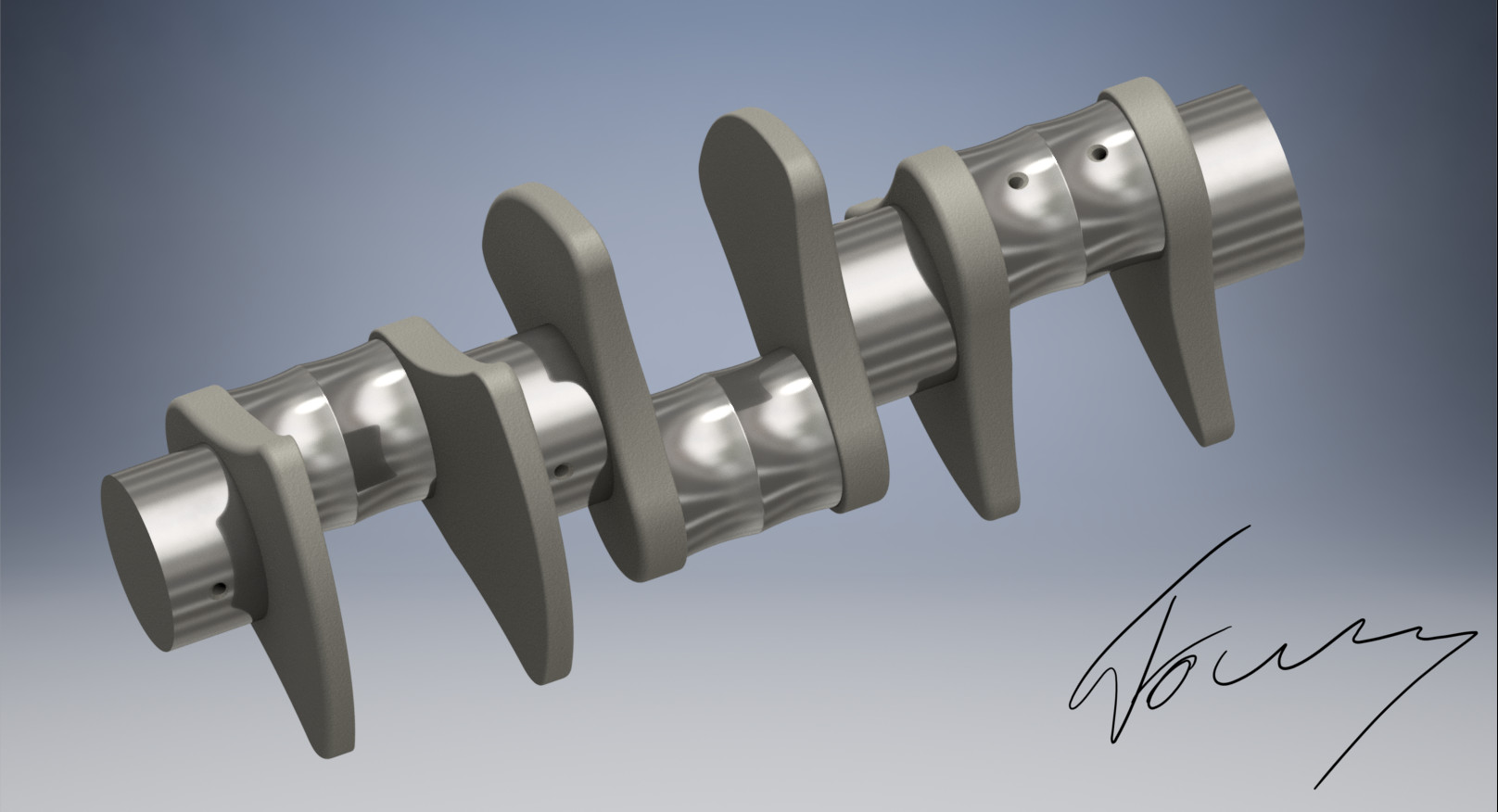
Like I said before, I think there is no way that they use forked rods. However, since this rumor goes around again and again, I think I found a solution which (I think atleast) is comparable to the one from Honda.
Was about two hours of work in Inventor. Nothing perfect, just made up fast and simple models. Two little simulations give a safety factor of 1.4 at 350bar peak cylinder pressure. I'm sure that, if this model would get perfectionated, they could really have two banks without cylinder offset without using these forked rods no one wants
The view from top:
The crankshaft with U-shaped crankpins:
Also, I'm right now working on a little model of the cylinder head which implements the idea I gave yesterday with the combustion priciple. Maybe I can also realize some little CFD-Simulations, which could give a further hint how things look like in reality.
Re: Honda Power Unit
Posted: 16 Feb 2017, 17:36
by PhillipM
I think they'd be worse for stiffness than the forked rods would be.
Re: Honda Power Unit
Posted: 16 Feb 2017, 17:58
by glenntws
PhillipM wrote:I think they'd be worse for stiffness than the forked rods would be.
I don't really know, the offset is not that big and if the used Piston is able to withstand the higher longtitudual Forces, there should be a Problem. Obviously this still means bigger and bolder rods, which in turn means more weight
Re: Honda Power Unit
Posted: 16 Feb 2017, 20:24
by henry
I believe the whirl frequency of a shaft is inversely proportional to the 4th power of its length. So shortening the connection between the turbine at one end of the block and the compressor at the other may make a considerable difference to the complexity or sizing of the resulting shafting.