Page 43 of 45
Re: Vodafone McLaren MP4-27 Mercedes
Posted: 27 Apr 2012, 05:44
by omar2726
Crucial_Xtreme wrote:
Nobody ever said otherwise. The point is Coanda is being used to start the downward motion of the plume. The downwash then helps to direct the plume further downward. End of story.
If we would want to think that Coanda is indeed playing a bigger role here, I would reckon that the downwash first directs the plume downward, then Coanda takes effect to attach to the bodywork, as raymondu, shamikaze and I have said earlier.
Nando, I think the the exhaust gases don't travel at 360kph all the way, as said earlier, it quickly decelerates as it expands. Added to the fast downwash, IMHO it's not that hard to believe that the exhaust plume is indeed being pushed downwards by Coanda and downwash.
Omar
Re: Vodafone McLaren MP4-27 Mercedes
Posted: 27 Apr 2012, 06:00
by Nando
n smikle wrote:Because the bending is not a function of the angle of the bend alone. Your theory is not accurate you see. There is also gas speed, and the speed of the surrounding gasses.
The higher angle of the bend is more like to cause separation of the gas than a lower angle.
In the same CFD I did,you can see the 10 degree angle of the exhaust. It follows the curve very well.
[img]
http://img.photobucket.com/albums/v626/ ... 5g.png[img]
That´s a nice picture, the question is if it´s the Coanda effect pulling the gas downwards to the floor or if it´s only in effect at the red area.
Again, nobody is doubting that the effect is there. Question is how much of an effect it is.
Re: Vodafone McLaren MP4-27 Mercedes
Posted: 27 Apr 2012, 09:24
by beelsebob
Nando wrote:Again, nobody is doubting that the effect is there. Question is how much of an effect it is.
We already know the answer to that – exactly enough to direct the exhaust gasses to the heat stained areas just around the sides of the diffuser...
Re: Vodafone McLaren MP4-27 Mercedes
Posted: 27 Apr 2012, 09:44
by Nando
beelsebob wrote:Nando wrote:Again, nobody is doubting that the effect is there. Question is how much of an effect it is.
We already know the answer to that – exactly enough to direct the exhaust gasses to the heat stained areas just around the sides of the diffuser...
Show me the numbers that support this. i'd also like to see numbers that say it's not the downwash pushing the gases downwards.
the mclaren exhaust ends abruptly with a sharp edge. i can't see how it would stay attached and find it's say down to the floor of the car.
Re: Vodafone McLaren MP4-27 Mercedes
Posted: 27 Apr 2012, 10:31
by Richard
Pup wrote:imo, this is a bit of a pointless conversation. The antis weren't convinced earlier this year, and there is no new evidence to consider.
Why are you guys rehashing February's arguments?
Probably the most sensible comment in the last few pages....
Re: 2012 Exhaust Blowing & Coanda
Posted: 27 Apr 2012, 11:21
by shelly
In order to introduce some good references, I think the abstract of this article (freely downloadable) is very useful.
http://www.epj-conferences.org/index.ph ... 01015.html
Re: 2012 Exhaust Blowing & Coanda
Posted: 27 Apr 2012, 20:13
by hardingfv32
shelly wrote:In order to introduce some good references, I think the abstract of this article (freely downloadable) is very useful.
Well that sure does not correlate to my torch demonstrations.
What is the significance of 'isothermal' flow used in the paper?
Our torches are obviously not 'isothermal' but what would you consider the real F1 exhaust flow?
Brian
Re: 2012 Exhaust Blowing & Coanda
Posted: 27 Apr 2012, 22:10
by ESPImperium
I personally would have the exhausts to the 2009 regs, however made the pipe exit and be level at the end of the pipe to +/- 5 degree angle and be in a box that is 50% smaller and closer to the centre line (Engine Cover) than is current.
My regs would see very little or no Coanda or Magnus effect ay all.
Im thinking something like the McLaren/Brawn solution in 2009, however both sides must be symmetrical.
Re: 2012 Exhaust Blowing & Coanda
Posted: 27 Apr 2012, 22:17
by hollus
Awesome paper, Shelly. Thanks.
Brian, I suspect that the width of the flow is a key parameter, and one that is different between your torch and Pup's.
No proof of this, but I think there is a minimum "broadness" needed in the flow before Coanda takes over. A very simplistic view of the coanda effect is that the jet of flow entrains air around it moving it away from its position, and other air must come in to fill this void. If the gap between the flow and the wall becomes small enough, and not enough air can be found to fill in this gap created by entrainment, then a vacuum would be produced. The alternative to that energetically impossible vacuum is for the flow to bend and follow the wall, negating any entrainment that created the problem in the firs place.
That effect would not manifest in a very narrow jet, where air from the sides can successfully fill in for the air between the jet and the wall.
This is in agreement with the all or nothing nature of the flows in Shelly's paper and in Pup's and Brian's torches.
Disclaimer: no evidence was used in producing the speculation in this post.
Re: 2012 Exhaust Blowing & Coanda
Posted: 27 Apr 2012, 23:49
by hardingfv32
hollus wrote:Brian, I suspect that the width of the flow is a key parameter, and one that is different between your torch and Pup's.
Well this has me attention and interest. I will have to do something on the dyno in the way of an experiment. Is oil smoke going to be good valid as a follow indicator? I will make a McLaren channel that is proportional to my dyno exhaust tail pipe. I am a couple weeks away from having an engine available. Having problems with a parts supplier of a key engine component.
Brian
Re: 2012 Exhaust Blowing & Coanda
Posted: 28 Apr 2012, 07:37
by Chuckjr
Holy smokes that would be superb to see.
Re: 2012 Exhaust Blowing & Coanda
Posted: 28 Apr 2012, 18:37
by hardingfv32
Aiming the actual exhaust system (outlet pipe) is not possible under the current restrictions.
Directing the exhaust flow towards the brake duct is probably possible.
Brian
Re: 2012 Exhaust Blowing & Coanda
Posted: 29 Apr 2012, 01:35
by MIKEY_!
Possible but risky and a bit difficult to control.
Re: Vodafone McLaren MP4-27 Mercedes
Posted: 01 May 2012, 19:06
by PlatinumZealot
Nando wrote:beelsebob wrote:Nando wrote:Again, nobody is doubting that the effect is there. Question is how much of an effect it is.
We already know the answer to that – exactly enough to direct the exhaust gasses to the heat stained areas just around the sides of the diffuser...
Show me the numbers that support this. i'd also like to see numbers that say it's not the downwash pushing the gases downwards.
the mclaren exhaust ends abruptly with a sharp edge. i can't see how it would stay attached and find it's say down to the floor of the car.
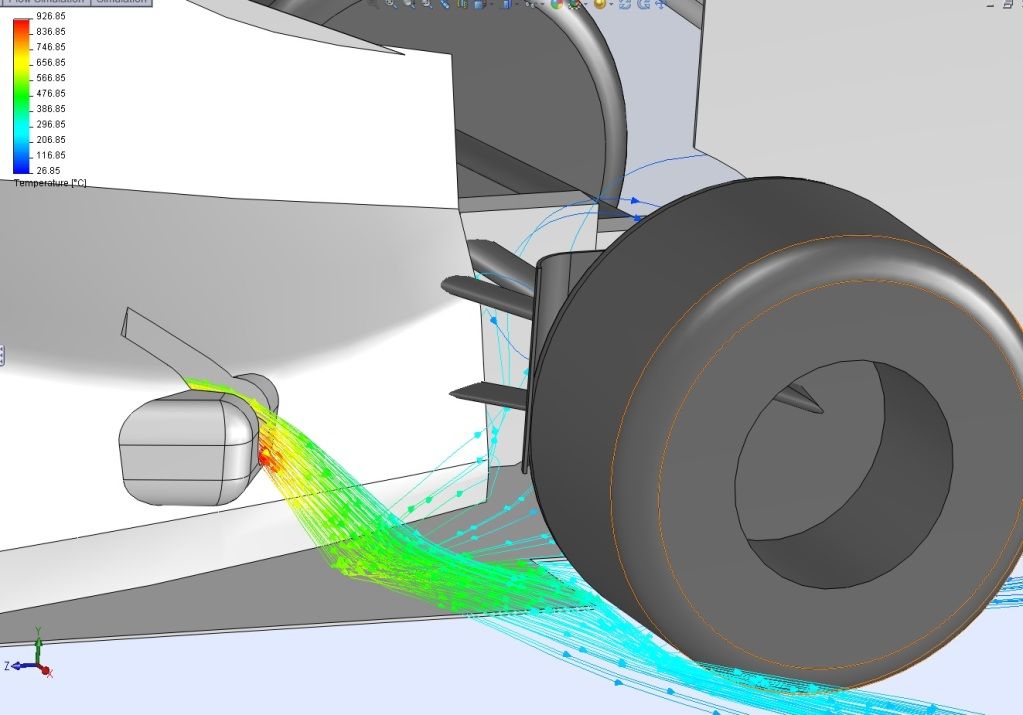
It is not the down-wash, because as the car goes faster the exhaust bends less and less. It bends more at slower speeds. I have not tested it at zero road speed but I will, and post the results.
Re: 2012 Exhaust Blowing & Coanda
Posted: 02 May 2012, 02:11
by PlatinumZealot
This is 2m/s road speed. The exhaust bends downwards even more. This can be explained by the slower speed of the surrounding air being too slow to rush in fill up the low pressure area at the convex surface of the curve. At higher air speeds the air can fill up the low pressure space quick enough so the exhaust gas will not bend downwards with the curve as much.