Page 43 of 47

Re: CFD - Computational Fluid Dynamics, Motorsport, Formula

Posted: 02 May 2014, 22:11
by sandipjadhav
Kiril Varbanov wrote:Nicely written article with examples: "Understanding CFD Simulation Process" - http://learncax.com/index.php/en/blog/b ... h-examples
Thanks Kiril.

Re: CFD - Computational Fluid Dynamics, Motorsport, Formula

Posted: 21 Jul 2014, 22:02
by firasf1dream
hello guys,
any suggestion please for a free and good CFD software ? i am using windows XP and need a CFD software to study a model made by solidworks or by CATIA

Re: CFD - Computational Fluid Dynamics, Motorsport, Formula

Posted: 07 Aug 2014, 14:54
by Kiril Varbanov
Dr. Gordon McCabe discusses Adrian Newey and unsteady CFD - http://mccabism.blogspot.co.uk/2014/08/ ... y-cfd.html

Adrian Newey and unsteady CFD

Posted: 08 Aug 2014, 22:09
by Crucial_Xtreme
The September 2014 issue of Motorsport Magazine contains an interesting article in which Adrian Newey discusses his favourite F1 cars. For disciples of modern F1 aero design, however, two statements catch the attention.

With respect to the 2009 Red Bull RB5, Adrian remarks that "we had a really great design group. We did some good research, understood the flow physics and the packaging." Then, recalling the research conducted for the exhaust-blown area around the spat on the 2011 RB7, Newey states that "it was very clear that the area around the rear tyres was critical...Then the whole research started developing...from steady-state CFD to tyre-dependent CFD and we worked with Renault to understand how the pulsing and acoustics of the exhaust worked."

This suggests that the recent aerodynamic success of the Red Bull has been based upon using unsteady CFD to understand the flow physics in that complex area around the spat. When the car pitches and rolls, not only does the rear ride-height change, but the rear tyre sidewall deforms, and given the sensitivity of the flow in the spat area, this sidewall deflection can crucially affect the performance of the diffuser.

The phrase 'tyre-dependent CFD' could, in isolation, merely imply that a set of steady CFD simulations were conducted, each representing a different degree of roll. However, by placing this phrase in opposition to 'steady-state CFD', it implies that Red Bull conducted unsteady CFD simulations which represented the roll of the car, including the time-evolution of the tyre sidewall profile.

Having said that, even if the solid geometry remains fixed, there is ample reason to believe that unsteady CFD simulations are indispensable for understanding the flow physics of a Formula 1 car.
Image

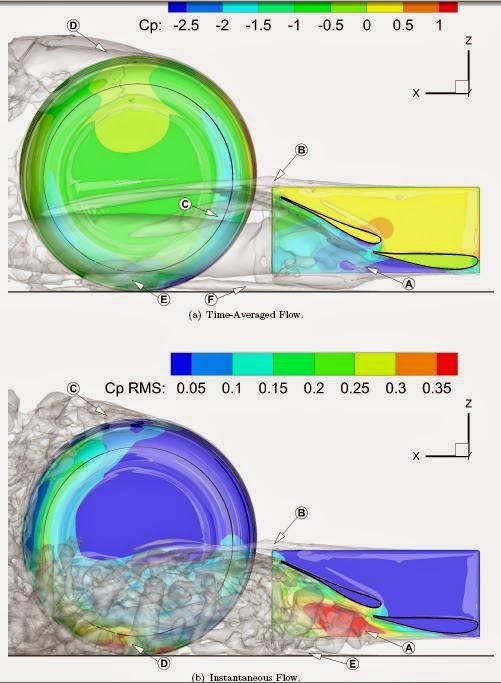
Steady-state CFD generates time-averaged images of the flow, and these can be misleading, both because they smear away time-dependent fluctuations in the flow, but also because the time-averaging procedure sometimes generates fictional flow structures which don't actually exist in the any of the instantaneous flow fields.

The image on the left, taken from Jacques Heyder-Bruckner's PhD research on wing-wheel interaction, vividly illustrates how the time-averaged image (top) smears away much of the structure associated with the breakdown of a front-wing endplate vortex (bottom).
Image

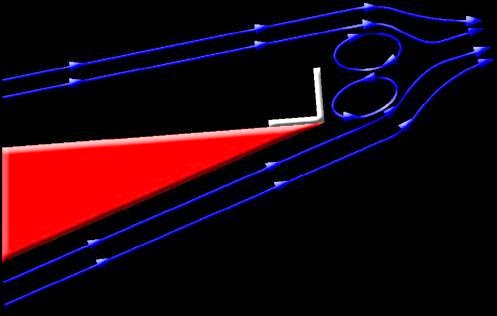
The fictional potential of steady-state CFD is exemplified by the common wisdom used to explain the function of a Gurney flap. This claims that there is a stable, counter-rotating vortex pair formed behind the Gurney. As a case in point, the All-American Racers website proffers the following explanation


"At the trailing edge, the airflow immediately beneath the wing rolls into a small anti-clockwise vortex behind the Gurney. Immediately above this, a second small vortex, rotating in the opposite direction, is formed by the airflow traveling above the wing as it passes over the gurney's lip. together these two vortices form a small separation bubble - a rotating mass of air removed from the main flow - which is somewhat taller overall than the gurney itself.

In clearing this separation bubble, the airflow's vertical deflection is increased and hence downforce increases. Additionally, separation of airflow from the wing's lower surface is postponed, allowing a higher angle of attack to be used before stall, which further enhances the wing's effectiveness."


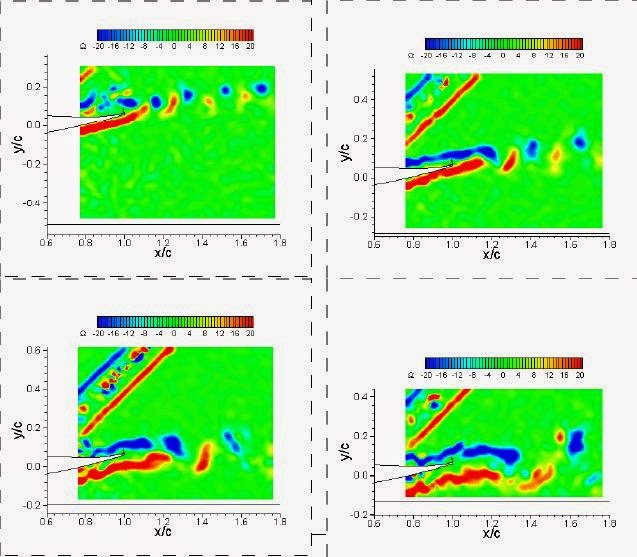
In reality, there is no such stable vortex pair. Research conducted by David Jeffrey and David Hurst at the turn of the century established that the flow behind a Gurney is intrinsically unsteady, consisting of the continual alternate shedding of discrete vortices, which convect downstream (see the PIV images below, obtained by Jonathan Zerihan, which depict the vorticity contours associated with a Gurney flap in ground-effect at four different ride-heights). The process is not dissimilar to that associated with the von Karman vortex street behind a bluff body:

"The first stage in this shedding cycle begins as the separating shear layer on one side of the body rolls up to form a vortex. As it does so, it draws the separating shear layer over from the other side of the body. This second shear layer contains vorticity of opposing sign, and as it crosses the wake centerline it cuts off the supply of vorticity to the shear layer that is rolling up. At this point, the vortex is shed and moves downstream, while the shear layer on the opposite side starts to roll up, repeating the process.

With the Gurney flap the offsurface edge provides a fixed separation point for the pressure-surface shear layer, and this interacts with that separating from the suction surface to form a vortex street, in a manner similar to other bluff bodies."

To understand the flow physics in such circumstances, it necessary to compile a sequence of instantaneous flow images, (a storyboard, if you will). Studying the frozen and often fictional images generated by steady-state CFD simply doesn't cut the mustard.
Image


Article via the awesome Dr. Gordon McCabe and the original can be found HERE

Re: Adrian Newey and unsteady CFD

Posted: 09 Aug 2014, 01:50
by flyboy2160
from the article "...With the Gurney flap the offsurface edge provides a fixed separation point for the pressure-surface shear layer, and this interacts with that separating from the suction surface to form a vortex street, in a manner similar to other bluff bodies."

This shedding "stability" is important to keep the vortices from wandering back and forth from the upper to lower surfaces and thus giving potentially significant changes in the surface forces. Modern control surface trailing edge design achieves this by using a small, flat, sharp cornered aft surface.

(Thanks for this excellent link.)

Re: CFD - Computational Fluid Dynamics, Motorsport, Formula

Posted: 09 Aug 2014, 16:07
by flyboy2160
We have a double mention of the excellent unsteady CFD blog post. At KV's suggestion, I've merged this into what, hopefully, becomes a single thread for this topic.

Re: CFD - Computational Fluid Dynamics, Motorsport, Formula

Posted: 13 Sep 2014, 04:45
by Lycoming
I'll just point out again here that CFD is not a substitute for a solid and comprehensive knowledge of aerodynamics.

Re: CFD - Computational Fluid Dynamics, Motorsport, Formula

Posted: 13 Sep 2014, 18:38
by flyboy2160
Lycoming wrote:I'll just point out again here that CFD is not a substitute for a solid and comprehensive knowledge of aerodynamics.
..nor for an Order of Magnitude hand calculation/empirical validation. You can't just push the button and accept the answer without knowing the engineering and scientific background principles.

Re: CFD - Computational Fluid Dynamics, Motorsport, Formula

Posted: 13 Sep 2014, 21:23
by firasf1dream
flyboy2160 wrote:
Lycoming wrote:I'll just point out again here that CFD is not a substitute for a solid and comprehensive knowledge of aerodynamics.
..nor for an Order of Magnitude hand calculation/empirical validation. You can't just push the button and accept the answer without knowing the engineering and scientific background principles.
of course, you're totally right, if we don't know the basics we can do nothing

so about the software i chose and found Autodesk Simulation CFD, i bought it and installed it, so anyone that have experience with that CFD software ?

Re: CFD - Computational Fluid Dynamics, Motorsport, Formula

Posted: 13 Sep 2014, 23:50
by flyboy2160
firasf1dream wrote:...so about the software i chose and found Autodesk Simulation CFD, i bought it and installed it, so anyone that have experience with that CFD software ?
Is this the Autodesk version of the old Nika software that also became the basis of Solidworks Flowsim? Or something else?

Re: CFD - Computational Fluid Dynamics, Motorsport, Formula

Posted: 14 Sep 2014, 01:16
by Pierce89
flyboy2160 wrote:
firasf1dream wrote:...so about the software i chose and found Autodesk Simulation CFD, i bought it and installed it, so anyone that have experience with that CFD software ?
Is this the Autodesk version of the old Nika software that also became the basis of Solidworks Flowsim? Or something else?
I think this version is based off the old Blue Ridge Numerics software.BRN called it cfdesign.

Re: CFD - Computational Fluid Dynamics, Motorsport, Formula

Posted: 14 Sep 2014, 02:54
by flyboy2160
Pierce89 wrote:
flyboy2160 wrote:
firasf1dream wrote:...so about the software i chose and found Autodesk Simulation CFD, i bought it and installed it, so anyone that have experience with that CFD software ?
Is this the Autodesk version of the old Nika software that also became the basis of Solidworks Flowsim? Or something else?
I think this version is based off the old Blue Ridge Numerics software.BRN called it cfdesign.

Right you are - I knew there had been some buyouts, but I'd forgotten who bought what. I think Mentor ended up with Nika.

So, I can't help with the Blue Ridge software. I have the Nika-based software called Flowsim.

Re: CFD - Computational Fluid Dynamics, Motorsport, Formula

Posted: 14 Sep 2014, 12:47
by firasf1dream
Pierce89 wrote:
flyboy2160 wrote:
firasf1dream wrote:...so about the software i chose and found Autodesk Simulation CFD, i bought it and installed it, so anyone that have experience with that CFD software ?
Is this the Autodesk version of the old Nika software that also became the basis of Solidworks Flowsim? Or something else?
I think this version is based off the old Blue Ridge Numerics software.BRN called it cfdesign.
that's right, i have the cfdesign but doesn't work so i had to get the new one

Re: CFD - Computational Fluid Dynamics, Motorsport, Formula

Posted: 19 Oct 2014, 10:45
by F1NAC
Does anyone works in Solidworks? I installed recently Solidworks and now I am asking for opinions is it good for fluid dynamics?

Re: CFD - Computational Fluid Dynamics, Motorsport, Formula

Posted: 19 Oct 2014, 13:24
by firasf1dream
F1NAC wrote:Does anyone works in Solidworks? I installed recently Solidworks and now I am asking for opinions is it good for fluid dynamics?
well i never tried the fluid dynamics in solidworks, but i will soon when i finish a model i am working on, but seems that it is getting better, basic study, there is extensions that u can get for solidworks but i would prefer to study my model with a software made for CFD only, it would be more accurate