Page 45 of 99
Re: Sensible ideas for what will happen after the 2.4 V8?
Posted: 21 Jul 2010, 23:01
by donskar
ISLAMATRON wrote:hopefully they ban pneumatic valves or better yet open up the valvetrane regs.
maybe they'll allow rotary valves
or variable valve timing
or variable runner lengths
alot of things banned over the years that can increase efficiency should be allowed back in... but in a cost effective manner
Wouldn't it be exciting to see F1 engines as technically advanced as those in, say a Chevy or Toyota or Ford? You know, far out stuff like variable valve timing, variable lift, variable runner length, direct injection . . .
Re: Sensible ideas for what will happen after the 2.4 V8?
Posted: 21 Jul 2010, 23:05
by Dukeage
I wouldn't be surprised if we see VVT in the new engine formula.
Re: Sensible ideas for what will happen after the 2.4 V8?
Posted: 21 Jul 2010, 23:43
by autogyro
Rotary and sleeve valves now that would be something.
At last proper ic development.
Re: Sensible ideas for what will happen after the 2.4 V8?
Posted: 22 Jul 2010, 01:23
by alelanza
Not so sure F1 engines would benefit from variable timing/lift
Re: Sensible ideas for what will happen after the 2.4 V8?
Posted: 22 Jul 2010, 02:18
by Holm86
VVT, VTEC and so on would be useless on a racing engine.
Its great technology for a roadcar that uses the whole rpm range.
Allthough a F1 engine revs to 18.000 rpm's only a small area of around 4000 rpm is used.
From 14.000-18.000 rpm.
If you take a VTEC Civic Type R for instance and drive it round for everyday purposes you are not likely to ever activate the VTEC system. But if you take it to the track and trashes it you are not likely to ever fall out of the VTEC working range.
So in a race engine thats made only to be trashed around a track VTEC or a VVT system would be useless i figure.
Re: Sensible ideas for what will happen after the 2.4 V8?
Posted: 22 Jul 2010, 03:59
by alelanza
Yeap, plus it would mean added complexity/rotating mass in the valvetrain, and yet something else that needs hydraulic pressure of some sort, so most likely a disadvantage in the end.
Re: Sensible ideas for what will happen after the 2.4 V8?
Posted: 22 Jul 2010, 09:06
by WhiteBlue
I reckon for something like a blown diffusor VVT would be very good.
Also watch out for Ferrari to use their own three dimensional cam system.
People might also want to use computer controlled single solenoid systems. The lower revs of blown engines could make that possible. If you generate 600 bhp with 2/3 of the actual displacement you have turbo pressure reserve to lower rpm. So engines could have 13.000 or 14.000 rpm instead of 18.000 they have now.
http://www.mechadyne-int.com/vva-refere ... -si-engine
This is an interesting page to read for technologies that allow throttle less running of engines. Most of the technologies require variation of valve timing. The next F1 engine will difinitely have direct injection and most likely HCCI. So you can almost certainly expect the manufacturers to go for systems that will run throttle less.
Re: Sensible ideas for what will happen after the 2.4 V8?
Posted: 22 Jul 2010, 11:40
by autogyro
+1
I have been working on exactly this and mainly the driveability with a KERS powertrain.
Such non throttle operation can give major improvement.
However it will depend on the regulations later this year.
Re: Sensible ideas for what will happen after the 2.4 V8?
Posted: 22 Jul 2010, 11:52
by Just_a_fan
I think F1 would benefit from VVT style technology if only because they could extend the useable rev range slightly with better torque at slightly lower revs which will give better driveability out of corners.
Re: Sensible ideas for what will happen after the 2.4 V8?
Posted: 23 Jul 2010, 02:46
by alelanza
WB, not sure i understood the blown diffusor VVT part. I didn't get the 'turbo pressure reserve to lower rpm' part either.
Regarding the whole throttle less part yes i agree it's something that may benefit F1, but neither vvt nor vtec accomplish that, though they share common concepts. I think valvetronic is a better analogy, though even with all of BMW's might and cash it's my understanding they have not gotten it to work past ~6k rpms, thus M models don't have it. So i'm not sure if the F1 teams with much less money and a very different focus would be able to. I guess given F1 engines don't have to last as long as a road car's i guess they could get away with it, sounds expensive though and kind of against the whole cost reduction trend.
As for driveability out of corners, F1 cars are for the most part traction limited in that situation, that's why you see them pulling out of corners at 12k, but in pure acceleration they're jumping from 16 to 18k most of the times. I don't see how more torque would help corner exit, quite the opposite no? If anything a heavier valvetrain would be slower to react to driver input, making it less drivable in my opinion.
Re: Sensible ideas for what will happen after the 2.4 V8?
Posted: 23 Jul 2010, 13:14
by WhiteBlue
alelanza wrote:WB, not sure i understood the blown diffusor VVT part. I didn't get the 'turbo pressure reserve to lower rpm' part either.
If you avoid the throttle all together (for efficiency reasons) you get the full gas flow going through the engine. This is what people want for the blown diffusors.
Regarding turbo and rpm have a look at the diesels. They make the power from torque which is an option for petrol engines as well. The engineers and the rule makers will have an option if they get the target power of 600 bhp from revs or turbo pressure.
Re: Sensible ideas for what will happen after the 2.4 V8?
Posted: 24 Jul 2010, 10:50
by xpensive
You know WB, I think the FIAs point, as it has been for recent years, is to KISS, all in order to make engines affordable for the garagistes, perhaps you agree as we sometimes do?
Once a millennium anyway.
But you have convined me of the sense in an I4 Turbo, can we have balance-shafts, did the 1986 BMW have that, or was the rpm too low?
Re: Sensible ideas for what will happen after the 2.4 V8?
Posted: 24 Jul 2010, 13:18
by WhiteBlue
Paul Rosche story
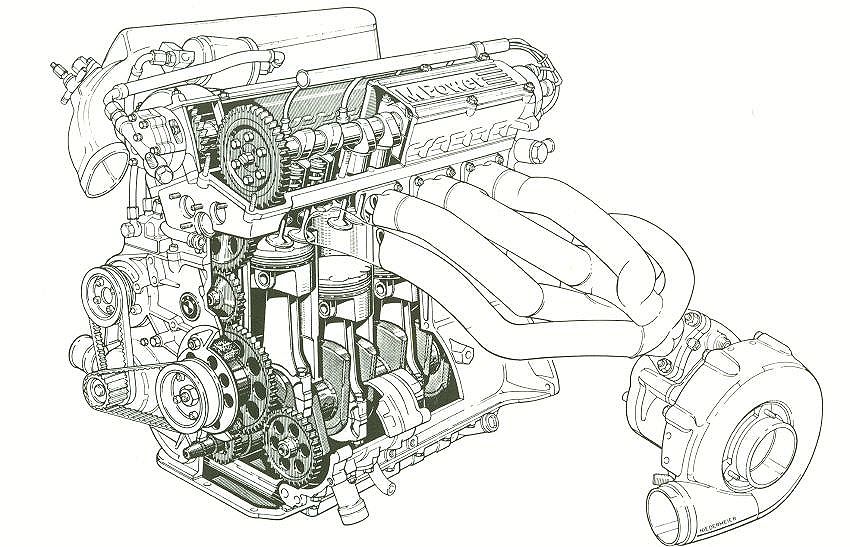
I don't think that they had balance shafts. At least I cannot see that in the above picture and nothing is mentioned in the story of the engine told by Paul Rosche himself. The engine did 11.000 rpm in race trim and made 1000 bhp available. In qualifying for one lap they could activate almost 1400 bhp, but the upper con rod eye would have been stretched to one additional millimeter.
Their biggest problems were cooling of the pistons which they did by injecting castor oil into a cooling channel in the piston. The other problem was knocking. They had no control over the proper ignition until they used an old trick of WWII aircraft engines. They used methylbenzene C7H8 for fuel which is poisonous like hell but has supreme knock resistance.
If you build a similar engine today much of the material selection will be different like the engine block which was made from cast iron. Today they would probably use cast aluminum alloys.
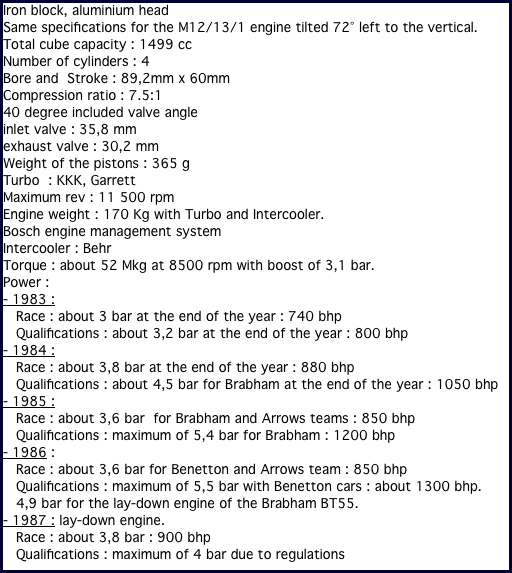
The specification detail from gurneyflap show that the engine made the power from the turbo pressure and not from the rpm. They went from a 3 bar standard pressure to almost twice that with 5.5 bar. But the engine would do this only for one hot lap. So quali engine life was probably less than 20 km.
I would not know what the FiA will be going for with the new engine other than a certain power level and best fuel efficiency. We know from Norbert Haug that target power will be 600 bhp. It means that the old BMW engine would be running well below 3 bar turbo pressure.
I believe that the emphasis could be on higher revs (higher revs make for better efficiency) like 13.000-16.000 depending of the harmonics of such an engine type. I know very little about the harmonics so someone who has experience in race engins should say something.
I would find it totally impossible to run with special fuel again as they did in the eighties. We would most likely see standard grade petrol with 5-10% bio fuel added.
My assumption is that the peak power will be limited and that the development race will be for the best fuel efficiency in partial load conditions. The team which runs the leanest engine under partial load will have to carry the least fuel and will have to detune the engine latest.
So variable valve timing for avoiding pumping losses, exhaust gas recycling, stratified direct fuel injection, ion current measuring and all the modern technologies for increasing the combustion efficiency should all be employed.
Re: Sensible ideas for what will happen after the 2.4 V8?
Posted: 24 Jul 2010, 13:49
by xpensive
Intersting data WB, but as I learned things way back when, they used fuel as a coolant.
Btw, is it true that Roche had his workers pissing on the blocks to be used?
Re: Sensible ideas for what will happen after the 2.4 V8?
Posted: 24 Jul 2010, 16:17
by WhiteBlue
xpensive wrote:Btw, is it true that Roche had his workers pissing on the blocks to be used?
Not really. According to the source I posted they initially used aged blocks that had run 200,000 kms. Later they found a way to relieve the cast in stresses by a heat treatment it said. I would doubt that the worker's piss was hot enough for that.
