Page 473 of 668
Re: Formula One 1.6l V6 turbo engine formula
Posted: 10 Nov 2014, 14:30
by bonjon1979
Can someone link me to the permitted engine development chart for next year. Thanks.
Re: Formula One 1.6l V6 turbo engine formula
Posted: 10 Nov 2014, 15:04
by Juzh
You mean This?
Or this:
f1 2014 technical regs
Last page is what you're looking for.
Re: Formula One 1.6l V6 turbo engine formula
Posted: 17 Nov 2014, 21:59
by Blackout
Have a dumb question: how the hell can you increase RPM from 10500 to 15000 if fuel and air flow are constant and the engine has no variable valve timing ? you use the KERS?
Re: Formula One 1.6l V6 turbo engine formula
Posted: 17 Nov 2014, 22:19
by langwadt
Blackout wrote:Have a dumb question: how the hell can you increase RPM from 10500 to 15000 if fuel and air flow are constant and the engine has no variable valve timing ? you use the KERS?
as long as the engine makes more power than is needed to push the car through the air the car with be accelerating, thus the rpm increasing, there is no trickery involved
Re: Formula One 1.6l V6 turbo engine formula
Posted: 17 Nov 2014, 22:30
by mrluke
Blackout wrote:Have a dumb question: how the hell can you increase RPM from 10500 to 15000 if fuel and air flow are constant and the engine has no variable valve timing ? you use the KERS?
Less fuel per revolution, same fuel per hr

Re: Formula One 1.6l V6 turbo engine formula
Posted: 17 Nov 2014, 23:21
by Blackout
langwadt wrote:Blackout wrote:Have a dumb question: how the hell can you increase RPM from 10500 to 15000 if fuel and air flow are constant and the engine has no variable valve timing ? you use the KERS?
as long as the engine makes more power than is needed to push the car through the air the car with be accelerating, thus the rpm increasing, there is no trickery involved
I dont fully understand
Re: Formula One 1.6l V6 turbo engine formula
Posted: 17 Nov 2014, 23:24
by Blanchimont
Don't forget that there are two electric mgu(motor generator unit)s!
At first i would optimise the valve timing and lift for a rpm of ~11500, this seems to be the most common rpm used. We know that the turbo is capable of delivering enough air into the engine and at the same time can provide power for the mguh to power the mguk to power the wheels. If the software detects that the turbo delivers less air than needed for best combustion energy from the battery is used to spool the turbo up via the mguh(=motor mode). If on the other side the software realises that the turbo provides too much air for an ideal combustion, the mguh switches to generator mode. As a generator the mguh slows the turbo down or makes it stay at the same rpm and this limits the amount of air that can enter the engine and the air to fuel ratio is ok.
Re: Formula One 1.6l V6 turbo engine formula
Posted: 17 Nov 2014, 23:26
by Tommy Cookers
Blackout wrote:Have a dumb question: how the hell can you increase RPM from 10500 to 15000 if fuel and air flow are constant and the engine has no variable valve timing ? you use the KERS?
I don't know why you would want to do this .....
and why the airflow would need to be constant, but ......
you have full control of boost and the mean exhaust pressure aka backpressure via the mutually independent mgu-h rpm and load
so you can charge with less air/rev and less fuel/rev ie same AFR less mep
or achieve this same AFR but cut the charge with exhaust
or let the AFR increase
or run not eg at 10000-11500 rpm mostly, but at eg 13000-14700 mostly
or some combination from the above
Re: Formula One 1.6l V6 turbo engine formula
Posted: 17 Nov 2014, 23:54
by wuzak
Blackout wrote:langwadt wrote:Blackout wrote:Have a dumb question: how the hell can you increase RPM from 10500 to 15000 if fuel and air flow are constant and the engine has no variable valve timing ? you use the KERS?
as long as the engine makes more power than is needed to push the car through the air the car with be accelerating, thus the rpm increasing, there is no trickery involved
I dont fully understand
As Langwadt says, so long as the engine has more power than is required to drive the car at a set speed it will accelerate.
Re: Formula One 1.6l V6 turbo engine formula
Posted: 18 Nov 2014, 01:40
by gruntguru
What you end up with approximates a "constant power" engine. This is common in electronic injected diesels where the fuel rate is mapped so that power is constant over a significant rpm range - say 1500 to 2100. The fuel flow to achieve this will be approximately constant (usually increasing somewhat to account for decreasing TE, as friction and other losses rise with rpm).
Of course diesels can operate with a wider range of AFR than SI engines, so the F1 engine will typically need reducing boost above 10,500 to obtain a near constant airflow - if constant AFR is required.
Re: Formula One 1.6l V6 turbo engine formula
Posted: 18 Nov 2014, 01:49
by olefud
Blackout wrote:Have a dumb question: how the hell can you increase RPM from 10500 to 15000 if fuel and air flow are constant and the engine has no variable valve timing ? you use the KERS?
I don’t see why you’d do it in a perfect world with a choice of gear ratios. But if you’re limited to a ratio optimum for the average course but too short for a specific course, overreving at a bit reduced power is better than not doing so.
Re: Formula One 1.6l V6 turbo engine formula
Posted: 18 Nov 2014, 02:44
by Wayne DR
ian_s wrote:Just put a recovery turbine and GU-H in the exhaust (no need for a motor part, no forced induction)
all the time you are at full throttle its recovering exhaust energy, maybe at a cost of crankshaft HP due to back pressure but there should be a good amount of 'free' hp available
No so sure about the no need for the motor part, an MGU-H on a V8 could be used to bring back blown diffusers/floors...

Re: Formula One 1.6l V6 turbo engine formula
Posted: 18 Nov 2014, 06:49
by Cold Fussion
Blackout wrote:langwadt wrote:Blackout wrote:Have a dumb question: how the hell can you increase RPM from 10500 to 15000 if fuel and air flow are constant and the engine has no variable valve timing ? you use the KERS?
as long as the engine makes more power than is needed to push the car through the air the car with be accelerating, thus the rpm increasing, there is no trickery involved
I dont fully understand

For a particular gear ratio, the power curve vs vehicle speed looks like above. Power to overcome the aerodynamic drag is cubic with vehicle speed. So long as the vehicle is transmitting more power to the road than the power required to overcome the aero drag, the vehicle will keep accelerating.
If the fuel flow into the engine is constant, and for simplicity, the airflow is constant for constant fuel flow (it may not be in the case for these engine), then it means the average power per engine cycle is lower, but because there are more cycle the output power is the same.
Re: Formula One 1.6l V6 turbo engine formula
Posted: 18 Nov 2014, 12:08
by Blackout
Thanks to everyone for the answers
Re: Formula One 1.6l V6 turbo engine formula
Posted: 18 Nov 2014, 13:08
by Richard
I came across this MGU-H image from Marelli. So the turbo is on the left, MGU-H is the tube with the Marelli sticker, the compressor is on the right?
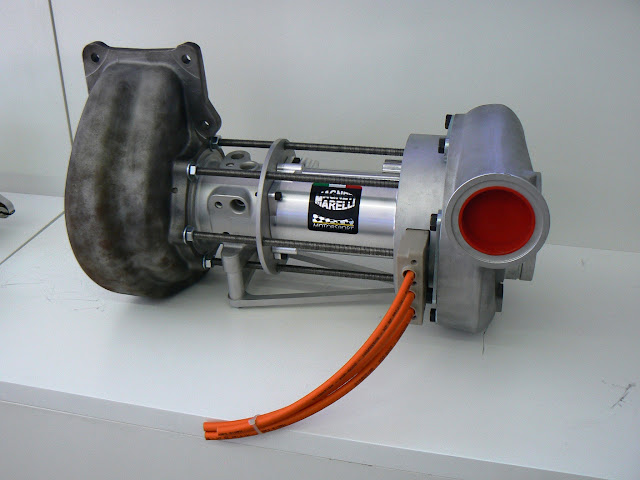
I also found this image of the Renault turbo (or it might be a decoy):

(
http://forum.b92.net/topic/72645-novi-v6-f1-motori/)
A google search for the first image lead me to a sketch for a split turbo/compressor with a shaft down the middle of the V from
Jan 2013 
by Matt Somers.
http://somersf1.blogspot.co.uk/2013/01/ ... h-ers.html

That's a coup on par with manchild's prediction of the 2008 Ferrari nose vent
http://www.f1technical.net/forum/viewtopic.php?t=4589