Page 6 of 7
Re: Carbon Fibre pushrod, a closer look
Posted: 01 Jun 2012, 22:58
by marcush.
as for the use of fabricated steel for suspension components its 15CDV6 1.7734. 4 or 5 one should use these days
funny that motorsports never reached the sophistication in terms of conification ,butting and other types of tube forming techniques like bike frame builders..
Re: Carbon Fibre pushrod, a closer look
Posted: 02 Jun 2012, 06:40
by xpensive
humble sabot wrote:That makes lots more sense for the pushrod, less of an option for the rest. Since you're extruding you won't have the right surface for your joints so ti inserts would seem to make sense.
to prove my point though
I love gurneyflap!
FW14B
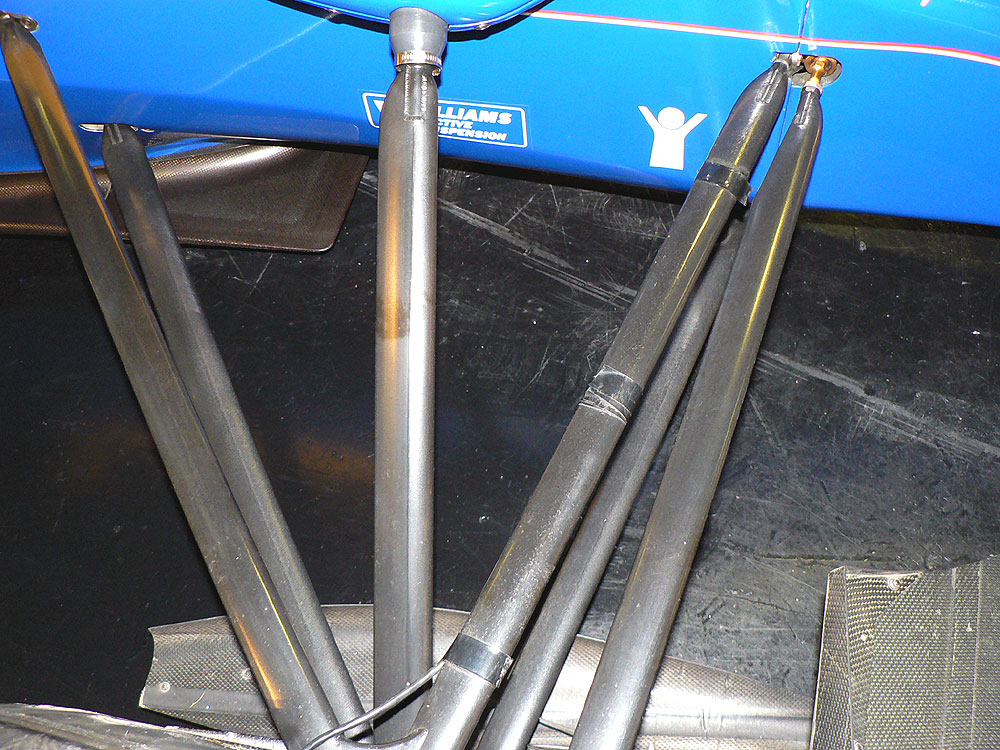
Such nice images and so many questions. I can't see why xtruded Alu wouldn't work for the wishbones as well and what you mean with "the right surface" and "ti inserts" is somewhat confusing?
Re: Carbon Fibre pushrod, a closer look
Posted: 05 Jun 2012, 05:36
by humble sabot
Fair question. If you extruded it for lightweight you would have a tubular structure. If you imagine how your spherical bearing is to be attached to that you would see that you would actually need to produce a piece to fit inside of or be welded to the tube.
Re: Carbon Fibre pushrod, a closer look
Posted: 05 Jun 2012, 05:51
by xpensive
That is correct, machined to fit with a reasonable tolerance and then preferably glued, welds are so ugly don't you think?
Should work fine for both pushrod as well as wishbones, where the latter are not as xposed to shockloads as the former.
Re: Carbon Fibre pushrod, a closer look.
Posted: 01 Jul 2012, 03:36
by Belatti
mep wrote:Well if you have in mind that carbon fibre has a modulus of 170-700GPa and a density of 1.85 g/cm³ + very good resistance to corrosion and fatigue then it should be clearly the better material.
However in the may issue of racecar engineering there is article saying that Mclaren has build a full aluminium front wing in 2009!
Also they say that the current wing has a 2-3kg aluminium spar milled from one 160kg solid aluminium block.
Milling away 158kg of aluminium seems to be the absolute waste of material and time for me.
Do you know what was the reason behind the building of that Al wing? Its a waste of time, yes, but I guess you can recycle 99% of the machined Alu
Re: Carbon Fibre pushrod, a closer look
Posted: 01 Jul 2012, 12:19
by marcush.
audi has done this before with the R18 front difusser.It´s an aluminium machined part and skinned with some flimsy cf foils.
I´d think a foam core has more weight and you need a LOT more resinfilm to bond the skins with the core .So a skinned spar and stringer wing has considerable potential in terms of weight.
To build the spars and stringers from CF is elaborate -you need so many moulds for each and every piece..so maybe this is the firsrt step towards oing the full cf route.
Re: Carbon Fibre pushrod, a closer look
Posted: 04 Jul 2012, 07:37
by riff_raff
Using aluminum up front in an open wheel car may have some justification in terms of impact energy absorption. I can imagine a situation where the McLaren chassis just missed the frontal impact test, and replacing some carbon with aluminum temporarily got them thru the test without big design changes.
Re: Carbon Fibre pushrod, a closer look
Posted: 04 Jul 2012, 12:39
by mep
The crash structure is the nose not the wing so I doubt that. Marcus might have a point that it is easier to generate small and complex structures with a metal than fiddling around with carbon layers. Especially when modern manufacturing methods for metals like rapid prototyping are used. I would really like to see one of these front wing spars. So if anybody has a picture bring it up here.
Re: Carbon Fibre pushrod, a closer look
Posted: 04 Jul 2012, 12:57
by ubrben
marcush. wrote:audi has done this before with the R18 front difusser.It´s an aluminium machined part and skinned with some flimsy cf foils.
I´d think a foam core has more weight and you need a LOT more resinfilm to bond the skins with the core .So a skinned spar and stringer wing has considerable potential in terms of weight.
To build the spars and stringers from CF is elaborate -you need so many moulds for each and every piece..so maybe this is the firsrt step towards oing the full cf route.
Do you not think Audi made the wing from Machined aluminium to
add weight.
The trend in LMP1 over the past few years has been to run the same front and rear tyre size. This means you need a weight distribution of essentially 50:50 or certainly between 48% and 50% front. Having watched people lifting LMP1 nosebox/front diffuser assemblies vs. the equivalent part on a 45% front weight LMP2 car I've concluded that the nosebox assemblies of LMP1 cars are being intentionally ballasted and/or built with heavier materials.
In the case of the audi the fringe benefit of using a solid aluminium machined part is better dimensional accuracy of the part, particularly if it's vibrating I would imagine.
Ben
Re: Carbon Fibre pushrod, a closer look
Posted: 04 Jul 2012, 15:51
by hardingfv32
ubrben wrote:The trend in LMP1 over the past few years has been to run the same front and rear tyre size.
What is the reason for this trend?
Brian
Re: Carbon Fibre pushrod, a closer look
Posted: 04 Jul 2012, 16:21
by wesley123
more contact patch area with the track, which means in theory, more grip
Re: Carbon Fibre pushrod, a closer look
Posted: 04 Jul 2012, 20:38
by marcush.
ubrben wrote:marcush. wrote:audi has done this before with the R18 front difusser.It´s an aluminium machined part and skinned with some flimsy cf foils.
I´d think a foam core has more weight and you need a LOT more resinfilm to bond the skins with the core .So a skinned spar and stringer wing has considerable potential in terms of weight.
To build the spars and stringers from CF is elaborate -you need so many moulds for each and every piece..so maybe this is the firsrt step towards oing the full cf route.
Do you not think Audi made the wing from Machined aluminium to
add weight.
The trend in LMP1 over the past few years has been to run the same front and rear tyre size. This means you need a weight distribution of essentially 50:50 or certainly between 48% and 50% front. Having watched people lifting LMP1 nosebox/front diffuser assemblies vs. the equivalent part on a 45% front weight LMP2 car I've concluded that the nosebox assemblies of LMP1 cars are being intentionally ballasted and/or built with heavier materials.
In the case of the audi the fringe benefit of using a solid aluminium machined part is better dimensional accuracy of the part, particularly if it's vibrating I would imagine.
Ben
why would you try to add weight forward of the wheels? I agree they want to have their weight distribution more forward biased with the big fronts.
Re: Carbon Fibre pushrod, a closer look
Posted: 04 Jul 2012, 20:51
by wesley123
By that they easier are able to get a more forward weight distribution. It will have more effect to have 1kg in the tip of the splitter than around the front wheel center line.
Re: Carbon Fibre pushrod, a closer look
Posted: 08 Jul 2012, 02:30
by riff_raff
mep wrote:The crash structure is the nose not the wing so I doubt that....... Especially when modern manufacturing methods for metals like rapid prototyping are used........
mep,
The impact structures include almost every part of the car. With a very high, narrow nose it's not very common to impact directly on this structure. Instead it's more common to impact the front wing first. And it's the wing spar that transfers load to the nose cone and chassis. If the wing spar is very stiff (ie. made from composite) it will produce more strain in the nose cone structure during an impact. If the wing impact is at an (yaw) angle, with the large vertical offset present in the front wing spar and nose cone attachment it could produce a significant torsional moment in the nose cone, thus reducing its designed buckling strength.
slider
Re: Carbon Fibre pushrod, a closer look
Posted: 08 Jul 2012, 06:51
by Pierce89
marcush. wrote:as for the use of fabricated steel for suspension components its 15CDV6 1.7734. 4 or 5 one should use these days
funny that motorsports never reached the sophistication in terms of conification ,butting and other types of tube forming techniques like bike frame builders..
Some of the aluminum bike frames I've seen, border on being artwork. Even modern motocross bikes have incredible extruded aluminum frames.