Page 6 of 7
Re: Heatsinks maybe?
Posted: 16 May 2009, 06:23
by PlatinumZealot
My heat transfer is rusty too..
I don't remember any equations right now..
I remember something called Nusselt number and some other numbers... we would get that from the conditions of the air then get the heat transfer coefficient of the air. Then we would plug that into to whatever equations..
hoo.. That was a course I did not like!! An equation for a radiator is supposed to be nasty! Fins and ducts all into one! (shudder)
Talk about brain drain.. lol..
Re: Heatsinks maybe?
Posted: 18 May 2009, 05:42
by The FOZ
ISLAMATRON wrote:The liquid in the cooling systems are pretty much moving heatsinks.
Someone correct me if I'm wrong, but the liquid is part of a heat exchanger, which is designed to move the heat away from the source for dissipation elsewhere.
A heat sink would be directly attached to the source, designed to increase surface area for heat dissipation through radiation or convection.
Re: Heatsinks maybe?
Posted: 20 May 2009, 15:35
by ISLAMATRON
The FOZ wrote:ISLAMATRON wrote:The liquid in the cooling systems are pretty much moving heatsinks.
Someone correct me if I'm wrong, but the liquid is part of a heat exchanger, which is designed to move the heat away from the source for dissipation elsewhere.
A heat sink would be directly attached to the source, designed to increase surface area for heat dissipation through radiation or convection.
So they are serving the same function but in different ways. Ultimately the air is allways the final "heatsink"... in a liquid cooled situation the heat is transferred from the engine to the coolant(water) to/thru the radiator(metal) then finally to the air... whereas in the heatsink it goes from the the hot engine to/thru the metal heatsink and then into the air.
Re: Heatsinks maybe?
Posted: 21 May 2009, 05:46
by xpensive
Neatly wrapped up Islam, at the end of the day, all energy losses has to end up in the air surrounding the car.
However, I am still intrigued by ideas on how to make use of those 200+ kW dissipated by the cooling system?
Re: Heatsinks maybe?
Posted: 21 May 2009, 06:03
by ISLAMATRON
I too am very excited by the prospect of HERS... is here anything out there that turns heat into electric energy? possibly a chemical compound or molecule that takes the vibrations of the atoms and emits electrons readily.
Re: Heatsinks maybe?
Posted: 21 May 2009, 09:23
by PlatinumZealot
Can use the exahaust to turn a turbine that adds power to the crankshaft.
Or Use the exhaust to make steam.
The energy from the radiators will be trickier..
hmmm unless they are used as feed water heaters in the steam system, to make the steam generation from the exhaust more efficient.
Re: Heatsinks maybe?
Posted: 21 May 2009, 10:41
by mike
is this thread about skin type radiators?, e.g the radiator runs to all parts of the exterior of the car, just like how human skin works, and since greater area is in contact with air it cools better?? and there need not be a sidepod inlet?? like a glass heater??
Re: Heatsinks maybe?
Posted: 21 May 2009, 11:18
by xpensive
I think I speak for all of us, when I boldly state that this thread is about cooling of the F1 engine in general?
Another round of arguing over "surface-cooling" is always welcome, so fire away Michael!

Re: Heatsinks maybe?
Posted: 21 May 2009, 11:52
by PlatinumZealot
That just gave me an Idea.. Suppose there was a track where it always rains.. The surface cooling could be used to great effect.
And another Idea.. though potentially very dangerous..A Fuel cooled Surface radiator. Small rib like passages in the surface radiator..where fuel is pumped to the engine.
I should really make a drawing of these ideas..

Re: Heatsinks maybe?
Posted: 21 May 2009, 12:22
by xpensive
Once upon a time, when re-fuelling the thirsty-turbos in the 80s, I believe that they were actually cooling the fuel to sub-zero temperatures, in order to shrink it and to cool the engines?
scarbs?
Re: Heatsinks maybe?
Posted: 21 May 2009, 14:29
by The FOZ
n smikle wrote:Can use the exahaust to turn a turbine that adds power to the crankshaft.
A turbine in the exhaust will increase back pressure, which increases pumping losses in the engine. So decreasing engine efficiency to get some of that back down the line isn't a likely solution.
Re: Heatsinks maybe?
Posted: 21 May 2009, 14:35
by The FOZ
I think the best direction teams could go in, cooling-wise, is something derived from present technology, rather than re-inventing the wheel.
Using the whole skin as a cooling surface seems to be a non-starter, because it makes the car even more vulnerable to damage. The likely weight increases also make this less attractive to me.
I think teams should be looking at CNT-coated radiator tubes and fins. In testing a CNT-coated surface transfers thermal energy significantly better than a non-coated one.
Re: Heatsinks maybe?
Posted: 22 May 2009, 05:58
by PlatinumZealot
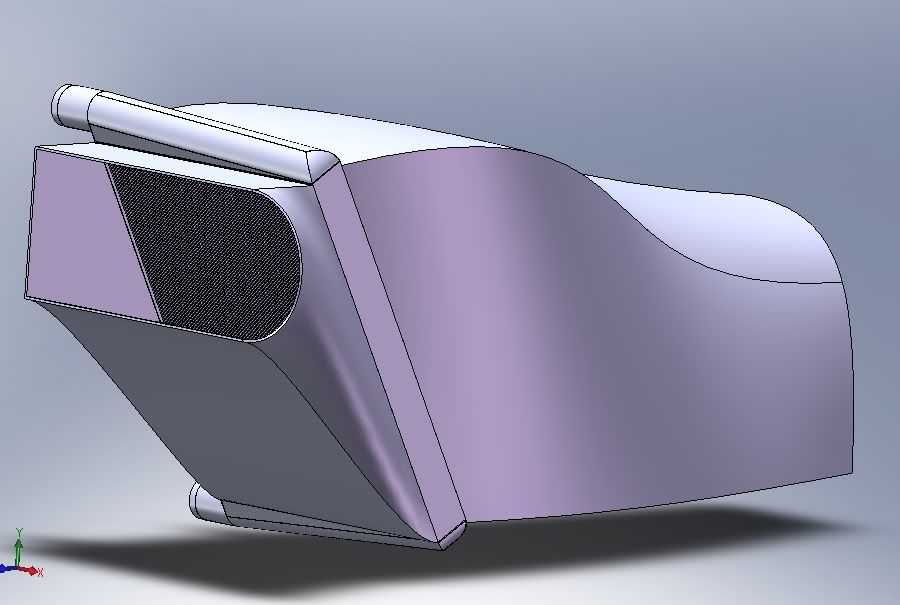
I am trying a setup in solid works.. I know this will put the thread all over the place and confuse things.. but I got around to making a Very simple radiator, inlet and exit. The exit is not very realistic though (It should really be a proper side pod) and there is no exhaust pipes, and I don't know how to setup an external simulation yet to test the drag..but that is above me right now since i don't have a car model.
Not very experienced at this yet.. so here goes. I am just going to try it with aluminium and copper. Then change the size of the radiator and inlet. Maybe test for the temperature drop of the liquid for each material then shrink the inlet size and radiator of the copper one to make the fluid temp similar to the ALuminum one. I guess this is supposed to be the advantage Low Cg and less drag.
I have a sketch for a Skin cooled one but i haven't drawn it yet. Take this with a grain of salt when i get around to running the simulation.. Not my specialty..lol
Re: Heatsinks maybe?
Posted: 23 May 2009, 05:56
by Conceptual
ISLAMATRON wrote:I too am very excited by the prospect of HERS... is here anything out there that turns heat into electric energy? possibly a chemical compound or molecule that takes the vibrations of the atoms and emits electrons readily.
peltier device
Re: Heatsinks maybe?
Posted: 23 May 2009, 06:09
by riff_raff
n smikle,
Nice model. But from an aero perspective, I don't know about your ducting. The inlet duct looks like it would be very turbulent, due to the extreme divergence of the lower portion.
With a heat exchanger duct, you first want to ensure a flow condition where you have higher pressure ahead of the core than behind it. With compressible flow, this is normally accomplished by creating a diffuser (divergent) duct ahead of the core, and a convergent duct aft of the core. In the diffuser, you are trading velocity for pressure. And in the exit duct, you are converting pressure to velocity.
You also want to size the exit duct so that the discharge velocity is at least as high as the passing ambient airflow velocity.
Finally, the duct inlet should be in an area on the chassis that is free from turbulent flows and has relatively high dynamic pressure. And the exit duct should be located in an area that has low dynamic pressure.
Good luck,
Terry