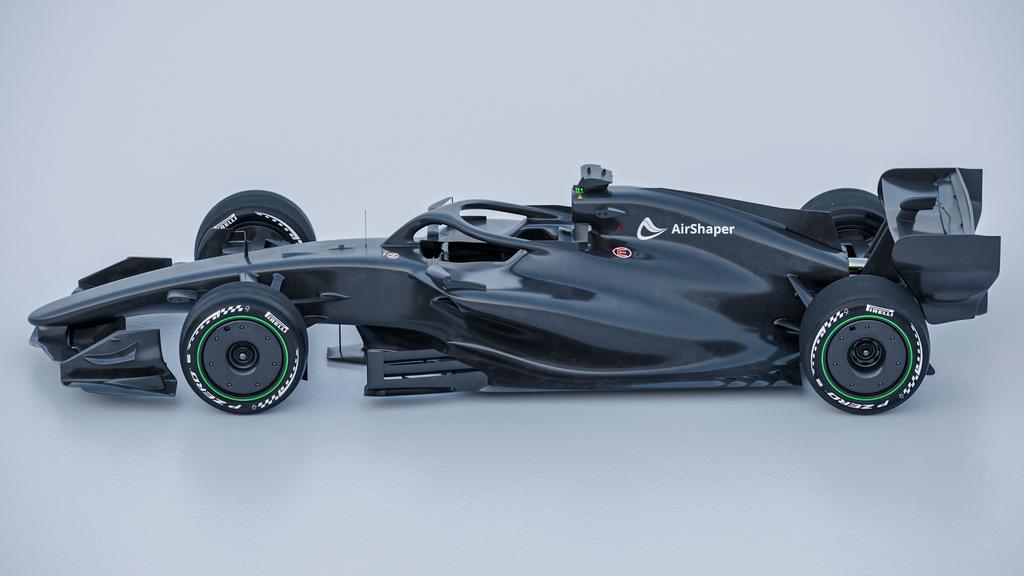
^ I came here to post that video. Basically he says as the rules are written , the main inwashing strake can be made porous so that the air can go right through it.
So the main element that the inwashing concept is based on, won't be inwashing anything at all.
We don’t get to see all the regs (e.g. the updates), so I do wonder if they’ve closed off some of these obvious loopholes.
So they hacked up the 2022 chassis and aero after just 4 years.
That's one thing. But instead of perfecting the underbody downforce dominant concept they're apparently just going back to something worse.
Yeah, it's not looking good. We need to also consider that drag is coming down massively (and in 2022-2025 it was already significantly lower compared to the 2017–2021 rules) which means the slipstream effect will be less effective, right?
Re: 2026 Aerodynamic & Chassis Regulations
Posted: 03 Jan 2026, 07:23
by TeamKoolGreen
Qvist design worked on this car for over a year and is the closest representation. Look at those inwash boards. The whole claim to fame of these regs is inwash and yet they couldn't even manage to get these boards to actually inwash. Air just goes right through them.
Why did they go away from the no endplate rear wing ? It is an Indycar wing. Did all the research into 2022 mean nothing ? Say what you want about the 2022 car but they could follow without burning off their tires. And that was the whole point.
So they hacked up the 2022 chassis and aero after just 4 years.
That's one thing. But instead of perfecting the underbody downforce dominant concept they're apparently just going back to something worse.
Yep. They could have evolved the concept. Introduce some more inwashing elements, maybe add some spec ride control, smaller front and rear wings.
But the underbody downforce had to go because the power units couldn't handle the drag. And that is also why we have active aero. And F1 is trying to cover it all up. They don't like admitting that all of this is because of the 50% electric gimmick. They are even saying now, that the underbody downforce kicked up too much water. As if any car going 300+ km/h isn't going to kick up water. Or even this driver comfort thing. Yes, the 2022 cars were low and stiff. And seemed to cross a line for the drivers in certain situations. But all F1 cars are low and stiff. All circuit race cars are low and stiff ffs.
We can hope is that it all fails so spectacularly that they will go back to an evolved 2022 concept in 2030.
Qvist design worked on this car for over a year and is the closest representation. Look at those inwash boards. The whole claim to fame of these regs is inwash and yet they couldn't even manage to get these boards to actually inwash. Air just goes right through them.
Why did they go away from the no endplate rear wing ? It is an Indycar wing. Did all the research into 2022 mean nothing ? Say what you want about the 2022 car but they could follow without burning off their tires. And that was the whole point.
So they hacked up the 2022 chassis and aero after just 4 years.
That's one thing. But instead of perfecting the underbody downforce dominant concept they're apparently just going back to something worse.
Yep. They could have evolved the concept. Introduce some more inwashing elements, maybe add some spec ride control, smaller front and rear wings.
But the underbody downforce had to go because the power units couldn't handle the drag. And that is also why we have active aero. And F1 is trying to cover it all up. They don't like admitting that all of this is because of the 50% electric gimmick. They are even saying now, that the underbody downforce kicked up too much water. As if any car going 300+ km/h isn't going to kick up water. Or even this driver comfort thing. Yes, the 2022 cars were low and stiff. And seemed to cross a line for the drivers in certain situations. But all F1 cars are low and stiff. All circuit race cars are low and stiff ffs.
We can hope is that it all fails so spectacularly that they will go back to an evolved 2022 concept in 2030.
Underbody downforce has the least drag penalty of any downforce generating device. They got rid of it because the teams were pushing it too far and the cars became less nimble and much less raceable.
His summary of dirtier air and more sensitive aero is also not encouraging...
That's one thing. But instead of perfecting the underbody downforce dominant concept they're apparently just going back to something worse.
We can hope is that it all fails so spectacularly that they will go back to an evolved 2022 concept in 2030.
Underbody downforce has the least drag penalty of any downforce generating device. They got rid of it because the teams were pushing it too far and the cars became less nimble and much less raceable.
That just isn't true though even though they have done a good job making up reasons like that. First they tried keeping the floors. Then came the active aero. It was all to reduce drag. Once they agreed to the Frankenstein PU, it was a slow death of the whole 2022 concept as they took more and more drag away to try and make it work.
The 2026 regulations will feature a return to flat floors in part to drastically reduce overall aerodynamic drag, which is necessary for the new hybrid power units to function efficiently on straights. The new power units shift to a near 50/50 split between combustion and electric power, requiring a significant reduction in aerodynamic resistance to manage energy effectively.
The 2026 regulations will feature a return to flat floors in part to drastically reduce overall aerodynamic drag, which is necessary for the new hybrid power units to function efficiently on straights. The new power units shift to a near 50/50 split between combustion and electric power, requiring a significant reduction in aerodynamic resistance to manage energy effectively.
What's the source on this?
The underbody is a lot more efficient in L/D than a wing, that is very much proven. That's why teams come up with skinny low drag wings for Monza and Vegas (until now, where there was only DRS in terms of active aero), not flat floors.
The guy's credentials read better than yours. There's rake and then there's RAKE.
Initially I thought that we would be back to the large rakes seen in 2021, but as these were primarily set-up to provide particular low-speed behaviours and to reduce drag at high speed. The drag reduction system as it will exist from 2026 removes the need (and probably ability) to do this anymore (the drag reduction/downforce reduction at speed will not provide the same loading as the pre-2022 cars (loading that was required to compress the large suspension travel to achieve the desired effect).
I would predict that we will only see a small amount of rake (as the elements required to control the floor edge vortices that helped to seal the floors when rake was being used have gone).
The underbody is a lot more efficient in L/D than a wing, that is very much proven.
sincerely, I disagree
because IIRC of what one of the proper aero people wrote so a few weeks ago
'very much proven' ?
The folks over at Symscape seem to agree:
In a brilliant example of lateral thinking the Lotus team applied the well known "airplane in ground effect" principle (reduced drag) to a racing car and found a significant increase in downforce with minimal increase in drag as a result.