Re: 2 stroke thread (with occasional F1 relevance!)
Posted: 18 Mar 2016, 06:27
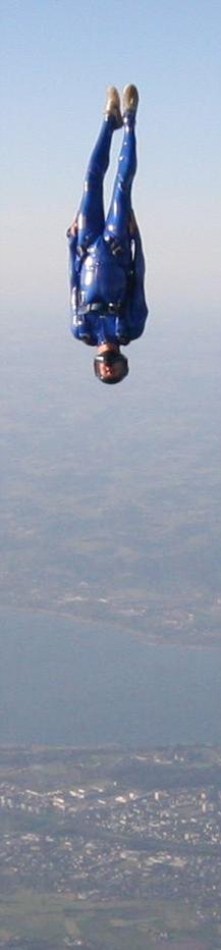
Nothing comes down faster than a vertical take off machine, upside down!

The problems from the counter rotating 'air screws' on the twin Mustang and the DH Hornet was a result of the prop wash effect on airflow over the fuselage (twin booms Mustang).J.A.W. wrote:Splendid developments Manolis..
Certain matters will have to await actual test-flying though.. such as sound levels..
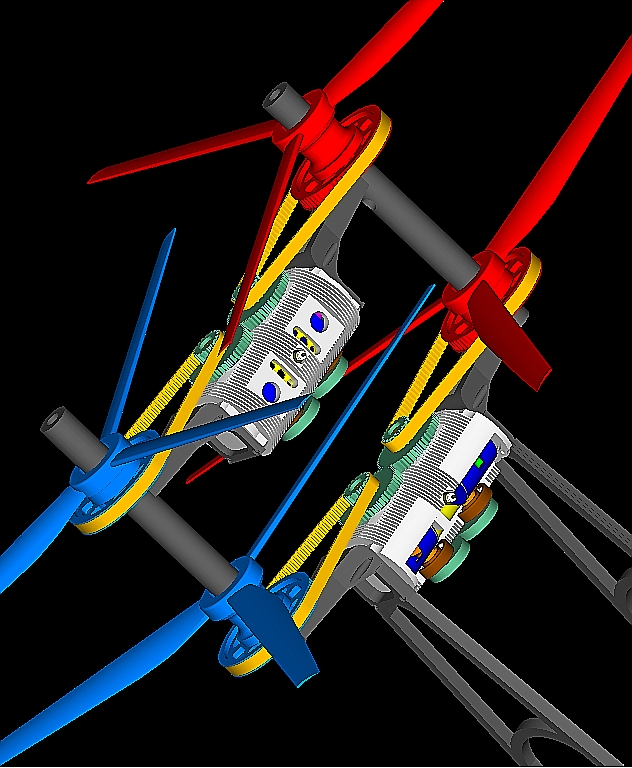
As for prop rotation, well, during WW2, certain twin-engined fighter planes ran 'handed' counter prop rotation..
Interestingly, both the P-82 Twin-Mustang & the DH Hornet had to swap the rotation sweep from
the original design setting - when flight tests showed up problems - that seemed counter-intuitive, but were real enough..
(in equivalent fixed wing aviation) propellors have composite-engineered structural properties giving some inherent pitch increase with flight speed ?manolis wrote: For high top speeds you need a lot of pitch.
On the other hand, with a big pitch (case of constant pitch rotors) the rotors require a lot of power from the engines at take-off and landing.
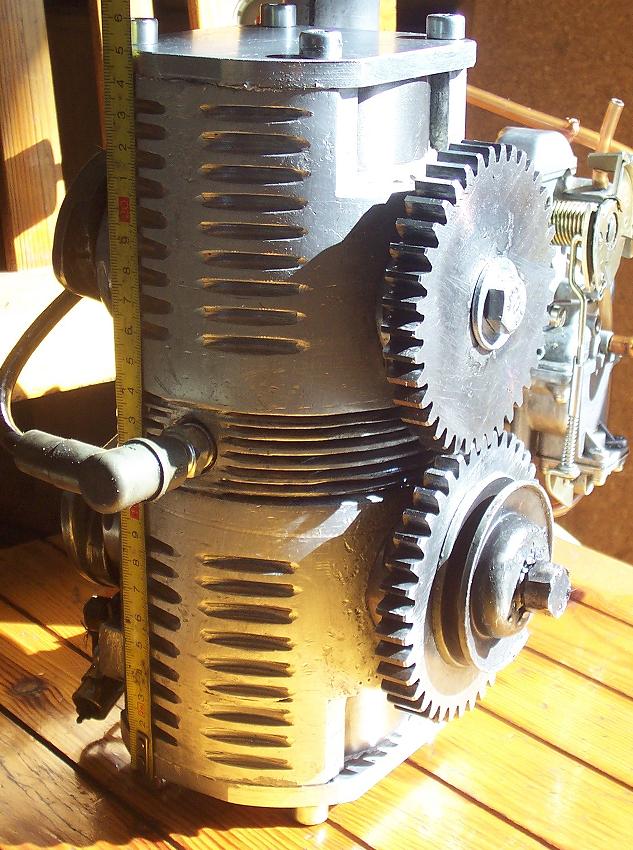
At take-off each propulsion unit alone (comprising an OPRE Tilting engine and the rotors it drives) has to provide a max thrust a little more than the total weight of the Portable Flyer
With the flyer strapped to your shoulders only, you will achieve neither the magnitude nor precision of thrust vectoring seen in that video.manolis wrote:Hello Gruntguru
Having the portable flyer secured on my shoulders / torso, I can move my shoulders a lot, changing the relative position / direction of body / rotors. I think there is more control with the shoulders than with the hands holding some handlebars.
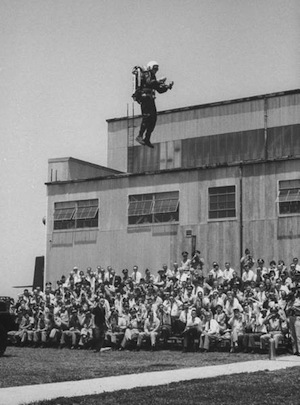
Here is a Jetpack similar to that of Rossy’s, with the difference that it can take-off the ground by its own, and it can land without a parachute. It uses, just like Rossy’s JetPack, four Jet Engines. The flight duration is similar to Rossy’s.
The pilot does hold handlebars.