Page 54 of 114
Re: Proposed 2017 F1 Aerodynamic Changes
Posted: 28 Nov 2016, 10:40
by Big Mangalhit
Andres125sx wrote:Just_a_fan wrote:Andres125sx wrote:How much shorter?
Considering the braking force of F1 cars some km/h slower top speed and some km/h faster corner speed entry will not change braking distance significantly. I don´t think this will affect overtaking sincerely, what they can or cannot do on a 100m braking will remain on a 90-95m braking
Really? Wow, that's a relief. There was me thinking that a car that brakes at 4-5g would require a noticeably shorter braking distance to go 300km/h to 100km/h than from 320km/h to 80km/h. Silly me.
After all, the current braking distances give the drivers lots of options to overtake. Indeed, overtaking is super-easy these days.
Oh no, wait...
You can use irony as much as you want, but that will not change the fact braking distances will be very similar and overtaking will be the same (in that regard).
Or did you find more overtaking this season due to the higher top speed cars are reaching this season wich means longer brakings? No, it was exactly the same...

Not that I think it was the braking distance but there was indeed a huge increase in OT this year, a 50% increase from 592 in 2015 to 924 this year. So I guess that argument is not the best
Re: Proposed 2017 F1 Aerodynamic Changes
Posted: 28 Nov 2016, 12:07
by Blackout
bhall II wrote:
Also, it's more or less guaranteed that next year's cars will produce less upwash than current models, because the rear wing's reduced height and the staggered arrangement of a diffuser kink line that's farther forward, a diffuser trailing edge that's unchanged, and a more aft placement of the rear wing's trailing edge simply will not allow it.
http://i.imgur.com/vgfNlSy.jpg
Unrealistic and greatly exaggerated to illustrate effect
That said, all bets are off if radically new design trends emerge.
But doesn't that mean that the front wing of the chasing car and the car will get a less clean air? because afaik the upwash takessome of the dirty air away...
Re: Proposed 2017 F1 Aerodynamic Changes
Posted: 28 Nov 2016, 14:18
by bhall II
As long as cars have a rear wing and a diffuser, sidewash will be a feature of their wake.
Re: Proposed 2017 F1 Aerodynamic Changes
Posted: 28 Nov 2016, 15:46
by Blackout
Yes, but I mean hence the upwash is lower, the turbulent air will hit the chasing car lower, am I right?
Re: Proposed 2017 F1 Aerodynamic Changes
Posted: 28 Nov 2016, 16:34
by bhall II
The theory isn't necessarily about upwash removing wake turbulence from the path of a trailing car as much as its the idea that sidewash introduces higher energy air flow from the freestream that the trailing car can then use to create downforce. I've seen it argued several different ways, though.
From my point of view, and in broad terms, the simple fact that upwash will be reduced means wake turbulence has to be reduced by default, because turning air flow is what drains it of potential energy.
Re: Proposed 2017 F1 Aerodynamic Changes
Posted: 29 Nov 2016, 18:29
by SectorOne
bhall II wrote:the simple fact that upwash will be reduced means wake turbulence has to be reduced by default,
So less drag as well?
Re: Proposed 2017 F1 Aerodynamic Changes
Posted: 29 Nov 2016, 21:00
by bhall II
Strictly speaking, there's no direct, immutable connection between wake and drag. However, there is such a connection between downforce and drag, and we know downforce will be higher. Exactly how that will play out in terms of its effect on wake turbulence depends upon the concepts the teams elect to use.
I suspect induced drag and parasitic drag will both be higher. But, your guess is as good as mine when it comes to proportionality.
Re: Proposed 2017 F1 Aerodynamic Changes
Posted: 30 Nov 2016, 11:23
by Paul
Wake and drag are very much connected as discussed, for example,
here.
Re: Proposed 2017 F1 Aerodynamic Changes
Posted: 30 Nov 2016, 12:28
by bhall II
Paul wrote:Wake and drag are very much connected as discussed, for example, here.
What I meant is that it's not possible to determine drag from wake, because there's no unchanging ("immutable") rule that binds them together. Both come in many different forms.
In other words, you can't say a smaller wake equals less drag or a larger wake equals more drag. Those things
might be true, but there's no way to predict one by way of the other.
Re: Proposed 2017 F1 Aerodynamic Changes
Posted: 30 Nov 2016, 14:13
by Paul
But there also isn't absolute connection between downforce and drag. There are more and there are less efficient ways of producing downforce. Wing or whole car A can produce more downforce, but be less draggy than wing/car B.
Re: Proposed 2017 F1 Aerodynamic Changes
Posted: 30 Nov 2016, 14:51
by bhall II
You can't increase downforce without increasing induced drag; that's absolute. Otherwise, I've not said anything that suggests the relationship between downforce and drag is static
However, there is such a connection between downforce and drag, and we know downforce will be higher. Exactly how that will play out in terms of its effect on wake turbulence depends upon the concepts the teams elect to use.
I suspect induced drag and parasitic drag will both be higher. But, your guess is as good as mine when it comes to proportionality.
Re: Proposed 2017 F1 Aerodynamic Changes
Posted: 30 Nov 2016, 15:40
by Paul
Here is what
NASAhave to say:
The induced drag coefficient Cdi is equal to the square of the lift coefficient Cl divided by the quantity: pi(3.14159) times the aspect ratio AR times an efficiency factor e.
They continue:
Considering the induced drag equation, there are several ways to reduce the induced drag. Wings with high aspect ratio have lower induced drag than wings with low aspect ratio for the same wing area. So wings with a long span and a short chord have lower induced drag than wings with a short span and a long chord.
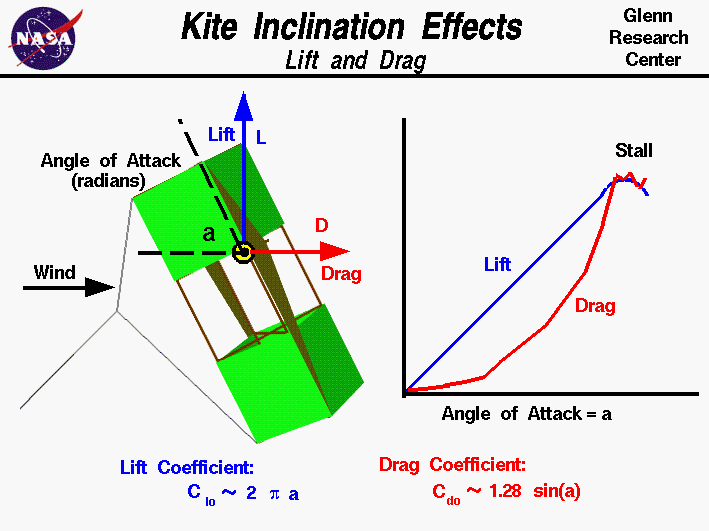
Which means that a better designed wing will produce more downforce with same drag or same downforce with lower drag compared to a shoddy one. Even single airfoil will change its efficiency depending on angle of attack as discussed
here:
Re: Proposed 2017 F1 Aerodynamic Changes
Posted: 30 Nov 2016, 16:07
by bhall II
also NASA (on the same page!) wrote:This additional force is called induced drag because it faces downstream and has been "induced" by the action of the tip vortices. It is also called "drag due to lift" because it only occurs on finite, lifting wings and the magnitude of the drag depends on the lift of the wing.
EDIT: Let's just go ahead and agree to disagree. I'm done arguing on this --- site.
Re: Proposed 2017 F1 Aerodynamic Changes
Posted: 30 Nov 2016, 16:17
by Paul
If we take a single wing and only change its angle of attack, then yes, it does, unless we also consider stall conditions. But if we have the possibility of switching elements and changing other parameters, then no.
I see no reason we can't reach a single conclusion. If you were talking about effects of changing the angle of attack for a wing without stalling it, then I agree with you. But since this is a thread about regulation changes which affect many parts of the car in drastic ways, I thought your statement was worth discussing further.
Re: Proposed 2017 F1 Aerodynamic Changes
Posted: 30 Nov 2016, 21:14
by mrluke
Paul wrote:If we take a single wing and only change its angle of attack, then yes, it does, unless we also consider stall conditions. But if we have the possibility of switching elements and changing other parameters, then no.
I see no reason we can't reach a single conclusion. If you were talking about effects of changing the angle of attack for a wing without stalling it, then I agree with you. But since this is a thread about regulation changes which affect many parts of the car in drastic ways, I thought your statement was worth discussing further.
You were the one that bought wings into, Bhall just stated that it is not possible to tell whether overall drag will be reduced or not simply because the upwash from the car will be reduced.