Just for passing technical interest, I'll try to shed some light on piezo vs ionic knock control systems...
It is actually very common for road car knock systems to operate at frequencies in the 10-20 kHz range, that is not hard.
The biggest problem on high performance/race engines is separating knock from mechanical noise - so some kind of in-cylinder solution is required, of which one is ionic.
(working ionic knock sensing for road engines have been available since early 1980s (at least) but it is excluded from most road engines due to cost vs requirement).
Re: Renault V6 Power Unit
Posted: 30 Apr 2015, 22:12
by langwadt
R_Redding wrote:I've no idea where stories of "knocking" have appeared from.
I'd be very surprised if they have a problem in relation to that.
Bosch and Magnetti-Marelli have been using Ion current detection and DSPs (Digital Signal Processing chips) to map the exact conditions in each spark event for some time now. I know Ferrari were using it in the early noughties when Siemens brought out 32bit micros under the Infineon umbrella.
Also..The standard auto acoustic Piezo knock sensors work at around 25 to 50hz .. which is okay on a family car but no where near fast enough for a highly strung modern racing engine where knock can be in the 11-16khz range. By the time a Piezo sensor detects knocking , an F1 engine would be toast.
I have been wondering if their "block" has been lightened too much and is flexing , causing the bore to grab a piston ring.
Rob
A knock sensor is really just a microphone, the interesting part is signal processing that detect the knocking from looking at frequency content the signals are in the audible range, something like 1-20kHz
The 25-50Hz output rate is just because the detection output is synchronized to the engine compression/combustion stroke
Re: Renault V6 Power Unit
Posted: 01 May 2015, 01:56
by Edis
langwadt wrote:
piast9 wrote:
Wayne DR wrote:Ahhh, now I see the light! At the boost pressures they are possibly running, Renault could be experiencing compression ignition/detonation/knocking. (cut)
I doubt that it is that simple. There are sensors that detect knocking. If they are used in the F1 engine then the ECU may alter the spark advance to prevent piston damage. I know that Renault is not doing well right now but they are not dumb people.
I'm not sure knock sensors would work very well in such a high reving noisy engine
F1 engines are equipped with cylinder pressure sensors on all six cylinders, so detecting knock shouldn't be a problem.
Re: Renault V6 Power Unit
Posted: 01 May 2015, 09:19
by tok-tokkie
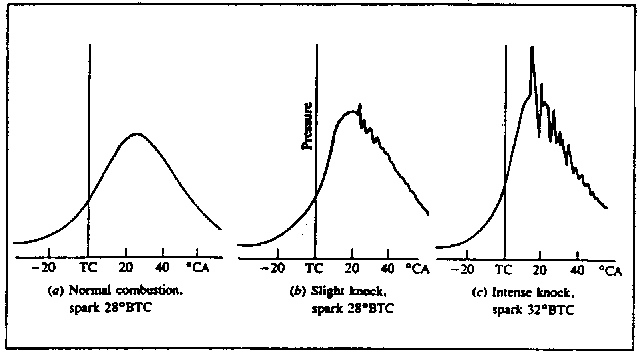
I am uninformed but surprised that the knocking pressure pulses are after peak cylinder pressure. I had thought knocking was a pre-ignition event. So, what happens during knocking?
Re: Renault V6 Power Unit
Posted: 01 May 2015, 09:50
by Brian Coat
You are not alone Tok-Tokkie.
Many people confuse pre-ignition and knock.
Knock is detonation of the end gas, ahead of the (already ignited) advancing flame front.
Re: Renault V6 Power Unit
Posted: 04 May 2015, 02:17
by Wayne DR
Brian Coat wrote:Many people confuse pre-ignition and knock.
Knock is detonation of the end gas, ahead of the (already ignited) advancing flame front.
Detonation: A violent uncontrolled burning of a fuel in the combustion chamber. Pre-ignition: Ignition taking place before the desired time in the operating cycle in spark-ignition engines.
Spark advance is linked to the "flame speed" for the advancing flame front. (Calculating the optimal time to "light the fire" is rudimentary, but flame speed is the key.)
If the flame speed is faster than expected (due to variations in fuel consistency - more light ends, variations in in-cylinder mixing - rich/lean spots, fuel is at a temperature higher than optimal - higher volatility, etc) causing a knock event. Would this be classified as pre-ignition or detonation? I am happy to use either...
I am not saying that this is Renault's issue, but these are all things that can vary between an engine on an engine dyno, and an engine in a race car...
Re: Renault V6 Power Unit
Posted: 04 May 2015, 05:05
by gruntguru
Wayne DR wrote:
Brian Coat wrote:Many people confuse pre-ignition and knock.
Knock is detonation of the end gas, ahead of the (already ignited) advancing flame front.
If the flame speed is faster than expected (due to variations in fuel consistency - more light ends, variations in in-cylinder mixing - rich/lean spots, fuel is at a temperature higher than optimal - higher volatility, etc) causing a knock event. Would this be classified as pre-ignition or detonation? I am happy to use either...
Probably neither.
Pre ignition is ignition of the mixture prior to the spark.
High flame speed of itself does not qualify as detonation. Detonation is usually combustion propagating at the speed of sound ie the pressure wave that normally moves out ahead of the flame front is actually igniting the mixture by raising its temperature above the ignition temperature.
Re: Renault V6 Power Unit
Posted: 05 May 2015, 05:27
by PlatinumZealot
Plus one on that.
I like to visualizs detonation like a bomb explosion insted of regular flame propgation.
On the knock sensors... I tend to agree, and think that they are pretty much useless to prevent the engine from blowing up. I am not saying that they cannot do the job of detecting knock on these engines, but these engines are operating on the bleeding edge of power and stability from months on the dyno with little room for safety if something does go wrong. Even at low power settings the engine is running very lean...detonation does not care... A lean mix is enough to make a bomb.
Re: Renault V6 Power Unit
Posted: 05 May 2015, 08:04
by gruntguru
If the knock sensor is capable of detecting the offending detonation (no doubt it can), the engine management system is capable of stopping the detonation.
First line of defence is retard the spark, second is reduce boost, third is reduce fuel (ie power).
If the detonation can't be stopped the programmers/mappers haven't done their job.
Re: Renault V6 Power Unit
Posted: 06 May 2015, 01:51
by strad
First line of defence is retard the spark, second is reduce boost, third is reduce fuel (ie power).
Yes and yes but no on the third. Want to add a bit of fuel to cool it off.
Re: Renault V6 Power Unit
Posted: 06 May 2015, 04:11
by Wayne DR
PlatinumZealot wrote:I like to visualizs detonation like a bomb explosion insted of regular flame propgation.
Normal flame propagation occurs at less than the speed of sound. A laminar (stable) flame cannot exceed the speed of sound. In explosive terms, this is referred to as deflagration.
Detonation is simply where the flame speed exceeds the speed of sound. Air turbulence at the flame front causes local pockets of congestion, allowing the flame speed to accelerate beyond the speed of sound in an uncontrolled manner (Bang!!).
Re: Renault V6 Power Unit
Posted: 06 May 2015, 09:51
by gruntguru
strad wrote:
First line of defence is retard the spark, second is reduce boost, third is reduce fuel (ie power).
Yes and yes but no on the third. Want to add a bit of fuel to cool it off.
No can do.
The engine is at full power and the fuel flow is limited to 100 kg/hr. ECU has already reduced the boost (to enrich the mixture.) If the engine is still detonating the only option remaining is to reduce power.
Re: Renault V6 Power Unit
Posted: 06 May 2015, 13:27
by Sevach
Not exactly scientific measuring of engine power, but there you go.
Re: Renault V6 Power Unit
Posted: 07 May 2015, 10:56
by Silent Storm
Renault will bring a modified engine this weekend.
PlatinumZealot wrote:I like to visualizs detonation like a bomb explosion insted of regular flame propgation.
Normal flame propagation occurs at less than the speed of sound. A laminar (stable) flame cannot exceed the speed of sound. In explosive terms, this is referred to as deflagration.
Detonation is simply where the flame speed exceeds the speed of sound. Air turbulence at the flame front causes local pockets of congestion, allowing the flame speed to accelerate beyond the speed of sound in an uncontrolled manner (Bang!!).