Page 7 of 240
Re: Mercedes Power Unit
Posted: 06 Feb 2016, 10:52
by Blackout
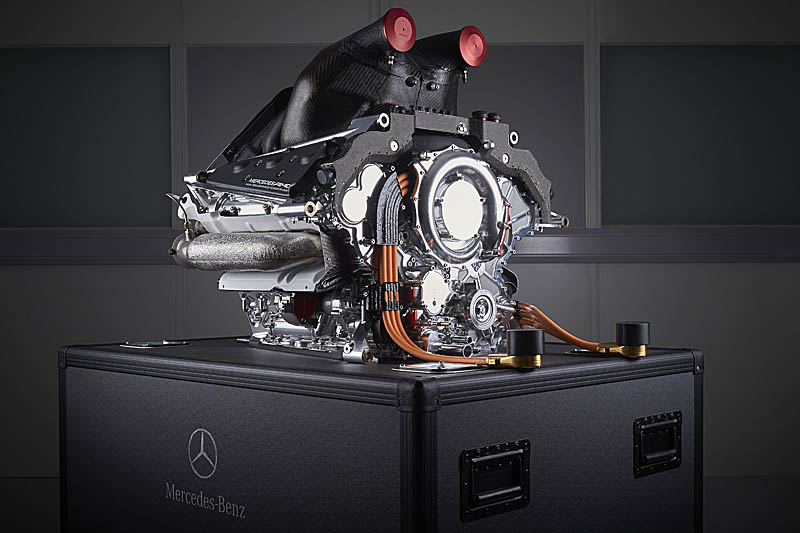
Facts Only wrote:Blaze1 wrote:I love the compactness and neatness of the Mercedes design. You don't see wiring looms, cables and piping snaking willy nilly all over the place.
That's because its all taken off to make it look nice for the press pictures.
Not really, fact is, even when installed in the car, the Merc 2014 and 2015 PU are very neatly packaged and finished and all the wiring and piping is very well tidied. The other PU look, as usual, like prototypes (but they made progress in that regard in 2015) whereas the Merc PU has almost industrial level finishing. It's clear, Merc has been working on the V6 hybrid turbo for a very long time with huge ressources.
Aside from that, the real/best 'size zero' engine, is the Merc IMO. The latter is almost as compact as the Honda, but without really compromising its compressor/turbine/MGU/CoG like the Honda...
Re: Mercedes Power Unit
Posted: 06 Feb 2016, 12:51
by henry
LookBackTime wrote:allstaruk08 wrote:"Software wise, when the car is on track, the systems now analyse the lap before to look for improvements in deployment and estimates the best locations for increased or reduced deployment, based on lap time gain"
is the car telling the driver when and where on track to deploy the extra power? kind of cutting out the driver to pit talking radio ban?
For every tack the Mercedes engine comes with a prepared maping setup.
The software is using this mapping as start up and using feedback from sensors will dynamically improving the maping of the engine on the fly.
More details about engine mapings :
http://www.jamesallenonf1.com/2011/06/f ... -answered/
I think it would also be useful to look at
http://www.f1technical.net/forum/viewto ... it=Control.
My guess is that one of the key mappings is Energy Store State of Charge vs track position. I would expect there to be a range of these. The mappings will initially be created by simulations. The simulations can only get so far. Track grip, wind direction, and I guess many other factors will affect it.
It would appear that Mercedes may be refining the ES SOC mapping in the software on the car.
Re: Mercedes Power Unit
Posted: 06 Feb 2016, 15:26
by PlatinumZealot
LookBackTime wrote:allstaruk08 wrote:"Software wise, when the car is on track, the systems now analyse the lap before to look for improvements in deployment and estimates the best locations for increased or reduced deployment, based on lap time gain"
is the car telling the driver when and where on track to deploy the extra power? kind of cutting out the driver to pit talking radio ban?
For every tack the Mercedes engine comes with a prepared maping setup.
The software is using this mapping as start up and using feedback from sensors will dynamically improving the maping of the engine on the fly.
More details about engine mapings :
http://www.jamesallenonf1.com/2011/06/f ... -answered/
Yeah. The different engine maps have to be fixed but the ERS maps are free I guess.
Re: Mercedes Power Unit
Posted: 06 Feb 2016, 15:29
by PlatinumZealot
Re: Mercedes Power Unit
Posted: 06 Feb 2016, 15:39
by PlatinumZealot
The 2014 compressor is very different - a bit shallower? but wider?
2014
2015

Re: Mercedes Power Unit
Posted: 06 Feb 2016, 16:07
by Jolle
Looks like they've taken the compressor off for this pic, something they don't want to share

Re: Mercedes Power Unit
Posted: 06 Feb 2016, 18:01
by timbo
PlatinumZealot wrote:The 2014 compressor is very different - a bit shallower? but wider?
Where was the oiltank located in 2014?
Re: Mercedes Power Unit
Posted: 08 Feb 2016, 04:03
by PlatinumZealot
Jolle wrote:
Looks like they've taken the compressor off for this pic, something they don't want to share
It is still there look closer. The bolt pattern is different but you can still see a part of the volute under the oil tank.
@timbo slice. I think the oil tank was removed in the 2014 image.
Re: Mercedes Power Unit
Posted: 08 Feb 2016, 06:05
by gruntguru
ringo wrote:I think the boost pressure/turbine speed limits come in above 10,500 rpm, where the fuel injection limit of 100kg/hr flattens. There is less demand for boost pressure at higher engine speeds, the turbines power will be best spent going to the MGUH. If you notice the engines rev to over 12k sometimes. I think this is where generator mode dominates.
The MGUH would be harvesting at much lower speeds than 10,500.
The ratio of crankshaft/turbine power would not change very much between 10,500 and 15,000.
I think both turbine and compressor are increased in size, also the MGUH located mid-shaft. Increasing size improves efficiency, reduces temperatures, and also capacity. The drawback is packaging and wieght, but who knows if mercedes have some kind of super lightweight turbo structure?
Compressor and turbine size would be changed only to match a change in airflow. A tiny increase in peak efficiency will result if the size is increased but there is no benefit unless the new size is an exact match for the airflow requirement.
Re: Mercedes Power Unit
Posted: 08 Feb 2016, 08:04
by Nickel
gruntguru wrote:
Compressor and turbine size would be changed only to match a change in airflow. A tiny increase in peak efficiency will result if the size is increased but there is no benefit unless the new size is an exact match for the airflow requirement.
Are you certain of this? It seems to me you should size the turbo based on airflow available, not airflow required. The compressor can and should be sized based on required airflow to the ICE, but the turbine should be sized to use up as much energy as possible in the exhaust flow. Extra turbine velocity* or inertia* is to be harvested by the mguh, which would keep the compressor spinning in the correct rpm range thus keeping combustion air pressure optimal. I'm of the mind this is part of what Honda got wrong.
* I'm unsure of the correct term to describe the potential energy stored in a spinning turbine...
Re: Mercedes Power Unit
Posted: 08 Feb 2016, 08:34
by gruntguru
Nickel wrote:gruntguru wrote:
Compressor and turbine size would be changed only to match a change in airflow. A tiny increase in peak efficiency will result if the size is increased but there is no benefit unless the new size is an exact match for the airflow requirement.
Are you certain of this? It seems to me you should size the turbo based on airflow available, not airflow required. The compressor can and should be sized based on required airflow to the ICE, but the turbine should be sized to use up as much energy as possible in the exhaust flow.
Perhaps "airflow selected" would be more appropriate. Within reason, these engines can flow whatever quantity of air the designer chooses. So the process is
1. Determine what combination of airflow/boost/exhaust backpressure produces the optimum balance of AFR, combustion efficiency, net work from the turbomachinery, pumping work in the reciprocating machine etc.
2. Size the turbomachinery to give the best efficiency compromise across the chosen operating range.
Extra turbine velocity* or inertia* is to be harvested by the mguh, which would keep the compressor spinning in the correct rpm range thus keeping combustion air pressure optimal. I'm of the mind this is part of what Honda got wrong.
* I'm unsure of the correct term to describe the potential energy stored in a spinning turbine...
Turbo inertia is of little consequence as far as harvesting is concerned ie the rotational kinetic energy of the turbo/MGUH would be equivalent to a fraction of a second at 120 kW.
Re: Mercedes Power Unit
Posted: 08 Feb 2016, 19:05
by Craigy
gruntguru wrote:Turbo inertia is of little consequence as far as harvesting is concerned ie the rotational kinetic energy of the turbo/MGUH would be equivalent to a fraction of a second at 120 kW.
Citation needed. How do you know what Mercedes did?
If they chose to make the MGUH/Turbine/Compressor/shaft assembly out of tungsten-weighted flywheels, it'd be an additional energy store...
Re: Mercedes Power Unit
Posted: 08 Feb 2016, 22:14
by jure
Craigy wrote:gruntguru wrote:Turbo inertia is of little consequence as far as harvesting is concerned ie the rotational kinetic energy of the turbo/MGUH would be equivalent to a fraction of a second at 120 kW.
Citation needed. How do you know what Mercedes did?
If they chose to make the MGUH/Turbine/Compressor/shaft assembly out of tungsten-weighted flywheels, it'd be an additional energy store...
And it would be extremely hard to control speed of rotation. It would accelerate and decelerate very slowly. There would also be cog consequences. Ice would also get quite a lot of back pressure because it would take time to spin the assembly.
Re: Mercedes Power Unit
Posted: 08 Feb 2016, 22:23
by PhillipM
jure wrote:Ice would also get quite a lot of back pressure because it would take time to spin the assembly.
Not really, just use the MGUH to spin it up when required.
Re: Mercedes Power Unit
Posted: 08 Feb 2016, 22:31
by Blackout
A nice article (about Merc and Honda) with some BS but some interstin numbers
http://www.motorsportmagazine.com/f1/op ... -obsolete/


