Re: 2 stroke thread (with occasional F1 relevance!)
Posted: 17 Jun 2016, 05:47
Hello J.A.W.
You write:
“Hi Manolis, why would a supercharged 2T PatRoVa be any more "complicated & expensive " - than if built as a 4T?
If every piston down-stoke is a power-stroke, & the PatRoVa head can deliver the required gas flow, then 'what's not to like?'”
Because with a PatRoVa cylinder head the 4-stroke gets not only better but also way simpler.
Either we talk for big, expensive and technologically advanced engines like the Ducati Desmodromic Panigale (here is its horizontal cylinder head exploded):

or we talk for small, push-rod engines like the fs56 4-stroke of OS for model airplanes:
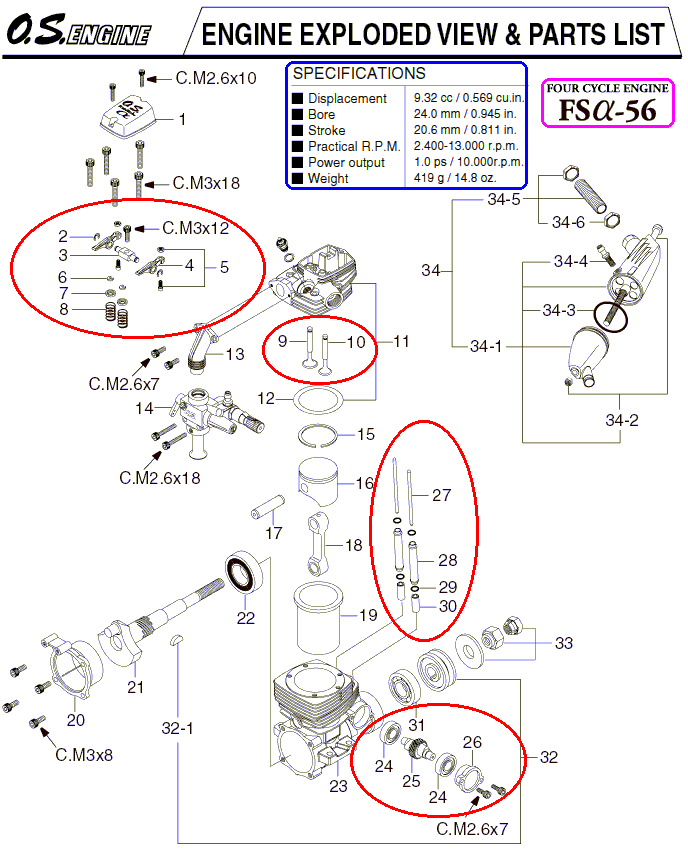
The valve train parts are in red ellipses:
Restoring springs, rocker arms and pivot shaft in the top left ellipse.
The intake and the exhaust poppet valves in the next ellipse.
Push rods and covers and seals and cam followers in the next ellipse.
Camshaft and bearings in the bottom ellipse.
All these parts for a 10cc single cylinder engine with peak power at 10,000rpm and red line at only 13,000rpm (9m/sec mean piston speed).
By replacing all these parts by a PatRoVa spool, the engine gets way simpler, the red line goes to, say, 30,000rpm, the power multiplies, etc.
By the way, does anybody know what is the red line of the 4-stroke model engines?
Is it limited by the valve train?
At http://www.pattakon.com/tempman/osmz211 ... cnitro.pdf it is the dyno test of the OS .18z 2-stroke model engine (750PS/lit) of the same company (OS) with rev limit above 40,000+ rpm (mean piston speed above 20m/sec).
Think of the size of a PatRoVa rotary valve for a 16mm bore model engine.
In comparison to the previous, with PatRoVa rotary valves in the cylinder head and an external supercharger driven by the crankshaft, a port-less 2-stroke gets complicated and expensive, being inferior than the 4-stroke as regards emissions (unless it is a Diesel) and load control (partial load operation, flat torque etc).
On the other hand, for Diesel engines, i.e. for engines based on the lean burn like the experimental 2-cylinder 2-stroke of Renault:
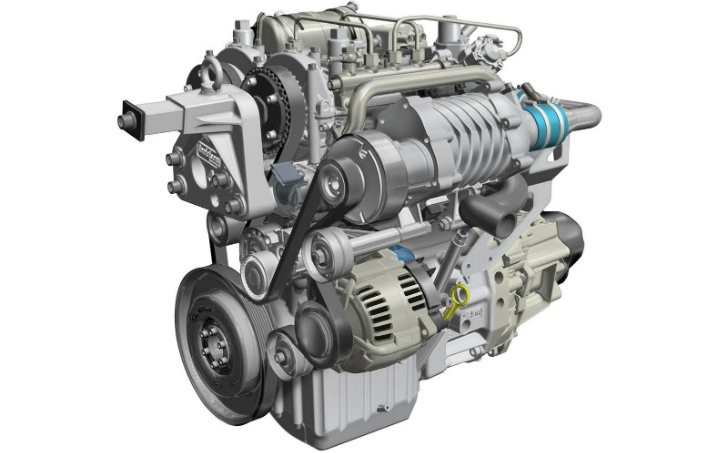
the use of high revving valves (like the PatRoVa rotary valves) is an obvious advantage and necessity.
Thanks
Manolis Pattakos
You write:
“Hi Manolis, why would a supercharged 2T PatRoVa be any more "complicated & expensive " - than if built as a 4T?
If every piston down-stoke is a power-stroke, & the PatRoVa head can deliver the required gas flow, then 'what's not to like?'”
Because with a PatRoVa cylinder head the 4-stroke gets not only better but also way simpler.
Either we talk for big, expensive and technologically advanced engines like the Ducati Desmodromic Panigale (here is its horizontal cylinder head exploded):
or we talk for small, push-rod engines like the fs56 4-stroke of OS for model airplanes:
The valve train parts are in red ellipses:
Restoring springs, rocker arms and pivot shaft in the top left ellipse.
The intake and the exhaust poppet valves in the next ellipse.
Push rods and covers and seals and cam followers in the next ellipse.
Camshaft and bearings in the bottom ellipse.
All these parts for a 10cc single cylinder engine with peak power at 10,000rpm and red line at only 13,000rpm (9m/sec mean piston speed).
By replacing all these parts by a PatRoVa spool, the engine gets way simpler, the red line goes to, say, 30,000rpm, the power multiplies, etc.
By the way, does anybody know what is the red line of the 4-stroke model engines?
Is it limited by the valve train?
At http://www.pattakon.com/tempman/osmz211 ... cnitro.pdf it is the dyno test of the OS .18z 2-stroke model engine (750PS/lit) of the same company (OS) with rev limit above 40,000+ rpm (mean piston speed above 20m/sec).
Think of the size of a PatRoVa rotary valve for a 16mm bore model engine.
In comparison to the previous, with PatRoVa rotary valves in the cylinder head and an external supercharger driven by the crankshaft, a port-less 2-stroke gets complicated and expensive, being inferior than the 4-stroke as regards emissions (unless it is a Diesel) and load control (partial load operation, flat torque etc).
On the other hand, for Diesel engines, i.e. for engines based on the lean burn like the experimental 2-cylinder 2-stroke of Renault:
the use of high revving valves (like the PatRoVa rotary valves) is an obvious advantage and necessity.
Thanks
Manolis Pattakos