When asked by GPUpdate.net if Mercedes was open to supplying McLaren in 2018, Wolff replied: "This is not our priority at the moment.
"First, we would like to see Honda and McLaren sorting out their relationship."
He added: "If you are being considered as the new bride, you want the couple to divorce first, before you jump into the bed."
Done deal imo
How does that denote a done deal? It implies they've made no move to end their relationship.
Yes it means they've spoken about a potential supply but that's common knowledge regardless. As far as I can glean from that, there's been no formal deals made at this point to secure a supply of Merc PU's.
There is something very interesting in engine design these days...
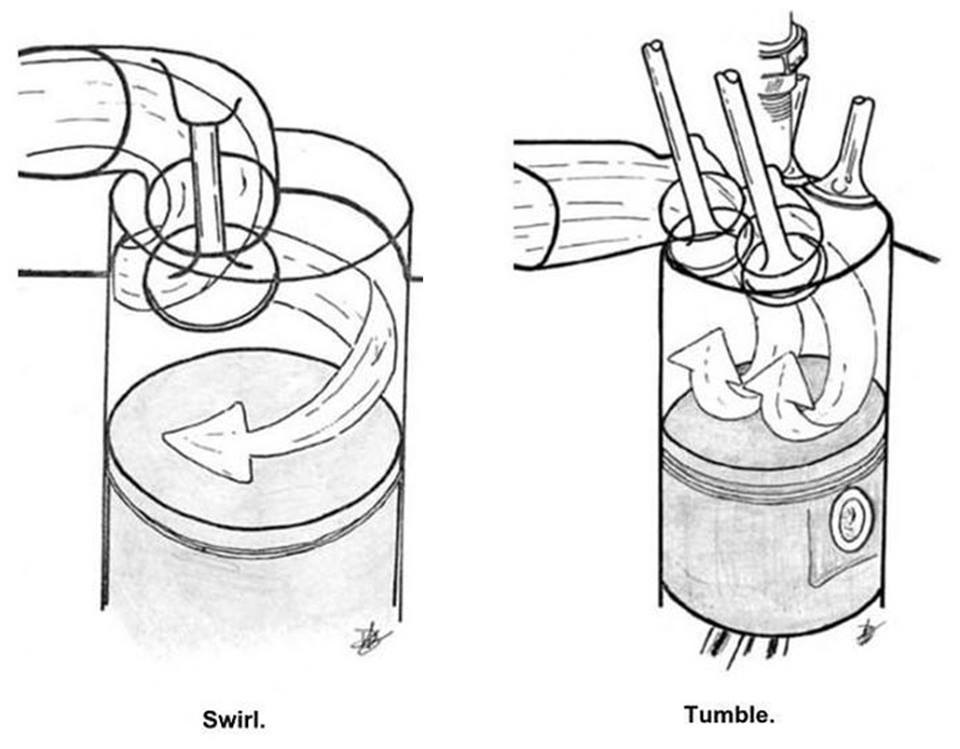
When we hear the word "swirl" we often just pass it off as fluid dynamics mumbo jumbo.... But it has big implications on the design of the intake runner and the inlet valve.
So yeah designing for swirl makes a totally different intake runner shape. A totally different look and almost against everything we have seen from the naturally aspirated days.
It makes me wonder how those NA engines would be with dual injection and optimized swirl design?
Honda of course has this design down pat. Because they use it in their road cars. Toyota utilizes it as well. Actually Toyota is probably the leader in overall combustion design i have heard. But anyway.. Imagine how these swirl patterns affect the TJI? So many little nuances...
Not sure if you meant this or not, but the charge motion that is used in almost all TC-GDI engines is tumble motion. Swirl is a rotation of the flow around the cylinder axis, usually used in modern Diesel engines. Tumble is a rotation of the flow around an axis perpendicular to that (like a drum laying down basically). Here's an illustration:
It leads to a much different intake port design than the so-called "filling ports" that have been used for NA engines.
Nothing new though, has been in the textbooks for about 30 years. Reason for tumble in TC-GDI is mainly mixture preparation. The tumble motion is most prominent when the piston is close to BDC. Since, for homogeneous operation, most of the fuel is injected during the suction stroke, you get an excellent mixture preparation (i.e. very homogeneous). During the compression stroke, the tumble motion actually breaks up and you end up with very small turbulent eddies. The key number at the ignition point is the "turbulent kinetic energy". Basically a measure of how much the charge is moving about. More TKE will help with combustion stability, reducing knock (sometimes also pre-ignition), increased EGR capability and in general also with burn duration. All sounds pretty nice, right?
Problem is, increased TKE or tumble motion comes at a cost, which is less flow through the valves, leading to more required boost pressure. Basically you want a filling port flow-wise and a high tumble-port charge motion wise. The compromise is obviously where the magic happens.
This for a short excursion about charge motion design
Reason for tumble in TC-GDI is mainly mixture preparation. The tumble motion is most prominent when the piston is close to BDC.
Nice post and pics.
I would think the main reason for tumble replacing swirl is the pent-roof chamber and the difficulty of producing swirl without reducing gas flow.
Tumble tends to extinguish rapidly as TDC is approached - unlike swirl. The "tumble racetrack" becomes a slim rectangle with two long straights. The "swirl racetrack" remains circular (with - in many designs - a reducing diameter which increases velocity. Think diesel with chamber in piston crown.)
Re: Honda Power Unit
Posted: 21 Jun 2017, 13:32
by aral
A number of posts have been removed as they have absolutely nothing to do with the Honda power unit. Speculation about whom Mclaren may use as an engine partner next year etc belongs to the team thread. Please restrict your posts to specifics of the power unit.
Reason for tumble in TC-GDI is mainly mixture preparation. The tumble motion is most prominent when the piston is close to BDC.
Nice post and pics.
I would think the main reason for tumble replacing swirl is the pent-roof chamber and the difficulty of producing swirl without reducing gas flow.
Tumble tends to extinguish rapidly as TDC is approached - unlike swirl. The "tumble racetrack" becomes a slim rectangle with two long straights. The "swirl racetrack" remains circular (with - in many designs - a reducing diameter which increases velocity. Think diesel with chamber in piston crown.)
What if they're using a wedge/pent roof hybrid chamber, instead of having a separate pre-chamber?
Re: Honda Power Unit
Posted: 21 Jun 2017, 16:28
by Singabule
I dont think creating swirl is necessary if mated with TJI, plasma or flare is designed to reach all of CC. Swirl or cyclone only increase the Flow resistance, and they need Flow as efficient as possible. TC would work extra with cyclone, and back prepare from turbine is enough to control CO2 level on CC. They need controlled CO2 since it is lean burn engine, as in every modern engine
Re: Honda Power Unit
Posted: 21 Jun 2017, 20:42
by godlameroso
Fire is ionized gas, or plasma anyway. The fuel is becoming oxidized which means the reactants are either losing hydrogen or gaining oxygen atoms. The process of combustion is hydrocarbons reacting with oxygen in the air, at higher temperatures nitrogen gets involved as well, and there's other gases in the air as well. When the carbon bonds in gasoline are broken by some means(some heat to get the chain reaction in motion) the carbon starts binding to the oxygen, the hydrogen starts bonding with other stuff, and electrons are getting ripped apart as the unstable reactants decay exactly like short lived radioactive isotopes. Even though everyone is convinced they aren't.
We don't see heat, we don't naturally have infrared vision, so it's hard for us to visualize what is actually happening with a combustion reaction. At an atomic level, there is some electromagnetic radiation involved. Just like coal ash produces radioactive by-products, so too does gasoline/petrol combustion.
Oil Rig
Oxidation is loss(of electrons),or having higher positive charge, Reduction is gain(of electrons) or becoming more negatively charged.
I dont think creating swirl is necessary if mated with TJI, plasma or flare is designed to reach all of CC. Swirl or cyclone only increase the Flow resistance, and they need Flow as efficient as possible. TC would work extra with cyclone, and back prepare from turbine is enough to control CO2 level on CC. They need controlled CO2 since it is lean burn engine, as in every modern engine
So you're saying there's some secret sauce power lurking behind nailing the EGR levels under different conditions?
Re: Honda Power Unit
Posted: 21 Jun 2017, 21:32
by PlatinumZealot
A bit like this..
Re: Honda Power Unit
Posted: 22 Jun 2017, 01:27
by GoranF1
Terrorists have hacked into Honda PU software during Canadian GP whit a series of viruses
The viruses have failed to do their jobs, and are now experiencing big vibrations.
Some interesting stuff on their efforts to increase tumble:
1. Reduced bore and wider valve angle to shorten the "straights" and smooth the bends of the gas path "racetrack" at TDC.
2. Wider valve angle makes intake flow "more horizontal" (and so more tangential to the CC).
3. Obstructed intake port "short-side" makes intake flow "more horizontal".
4. Lower intake port and wider valve angle makes intake flow "more horizontal".
Re: Honda Power Unit
Posted: 22 Jun 2017, 03:03
by godlameroso
Honda's new turbo gas engines for the FK8 Civic and new Accord also have similar intake manifolds. No doubt both Toyota and Honda are experimenting with this configuration in racing.
Reason for tumble in TC-GDI is mainly mixture preparation. The tumble motion is most prominent when the piston is close to BDC.
Nice post and pics.
I would think the main reason for tumble replacing swirl is the pent-roof chamber and the difficulty of producing swirl without reducing gas flow.
Tumble tends to extinguish rapidly as TDC is approached - unlike swirl. The "tumble racetrack" becomes a slim rectangle with two long straights. The "swirl racetrack" remains circular (with - in many designs - a reducing diameter which increases velocity. Think diesel with chamber in piston crown.)
The charge motion is not due to the piston or combustion chamber shape, it's rather the other way round. However, the charge motion itself also isn't the root cause for all of this.
The big difference between Diesel (swirl) and Otto (tumble) is, that a Diesel engine needs macroscopic charge motion at/around TDC, because, at least close enough, injection = ignition. So the mixture formation or preparation happens at/around TDC. For an Otto combustion system, the injection happens (mostly) during the suction stroke, thus giving loads of time till ignition. So you need macroscopic charge motion during the suction stroke and at the beginning of the compression stroke. However, for the combustion itself you want microscopic charge motion to increase the burn speed or reduce the burn duration. With that you get closer to isochoric combustion, which is generally beneficial for your thermal efficiency. So you break up the macroscopic tumble motion and end up with microscopic small-scale turbulence (i.e. eddies) with a very high turbulent kinetic energy.
Maybe as a general sidenote: Combustion in piston-engines only works in a range of engine speeds because it is a turbulent combustion. The turbulence increases with engine speed, and with that the turbulent combustion velocity increases. The laminar combustion velocity stays pretty much the same, so with laminar combustion you wouldn't be able to speed up.
With that being clear (hopefully), it is clear, why you want as much turbulence as possible for pure combustion efficiency (isochoric combustion as somewhat ideal). However, you have to balance that with the effort to create this turbulence, as mentioned by someone.
But you can actually give up quite a lot of flow efficiency of the intake ports to achieve more tumble. There are (good) TC engines out there that loose up to 30% of flow coefficient of the intake ports/valves compared to really good NA engines and end up with state-of-the-art efficiencies. You have to design the turbocharger accordingly, obviously.
Re: Honda Power Unit
Posted: 22 Jun 2017, 12:33
by f1rules
sources close to the attack confirm " due to honda running hondows xp(hondas own system), and the way their system was setup, the virus attack was unsuccesfull and the harmfull attack was avoided. A honda spokesperson. "This prove that, following our own logiq and methods are the right way to go". Reports suggest, the virus was completely lost when finally escaping the honda system, aparently unable to find any logiq in hondas logiq and hence unable to attack
Terrorists have hacked into Honda PU software during Canadian GP whit a series of viruses.
The viruses have failed to do their jobs, and are now experiencing big vibrations.
Anyone from 24h Honda lawyers that de rated the post(joke) can bite me!