Page 624 of 668
Re: 2014-2020 Formula One 1.6l V6 turbo engine formula
Posted: 10 Jan 2019, 13:45
by saviour stivala
In 1995 Mercedes produced the M196 2.5l eight direct fuel injected engine, nozzle position was at a point on the cylinder wall just below the intake valve, with the centerline of the nozzle angled upward at 12.5 degrees, Fuel flow began 30 degrees after TDC on the inlet stroke and continued for 160 degrees.
Re: 2014-2020 Formula One 1.6l V6 turbo engine formula
Posted: 19 Jan 2019, 07:39
by Blackout
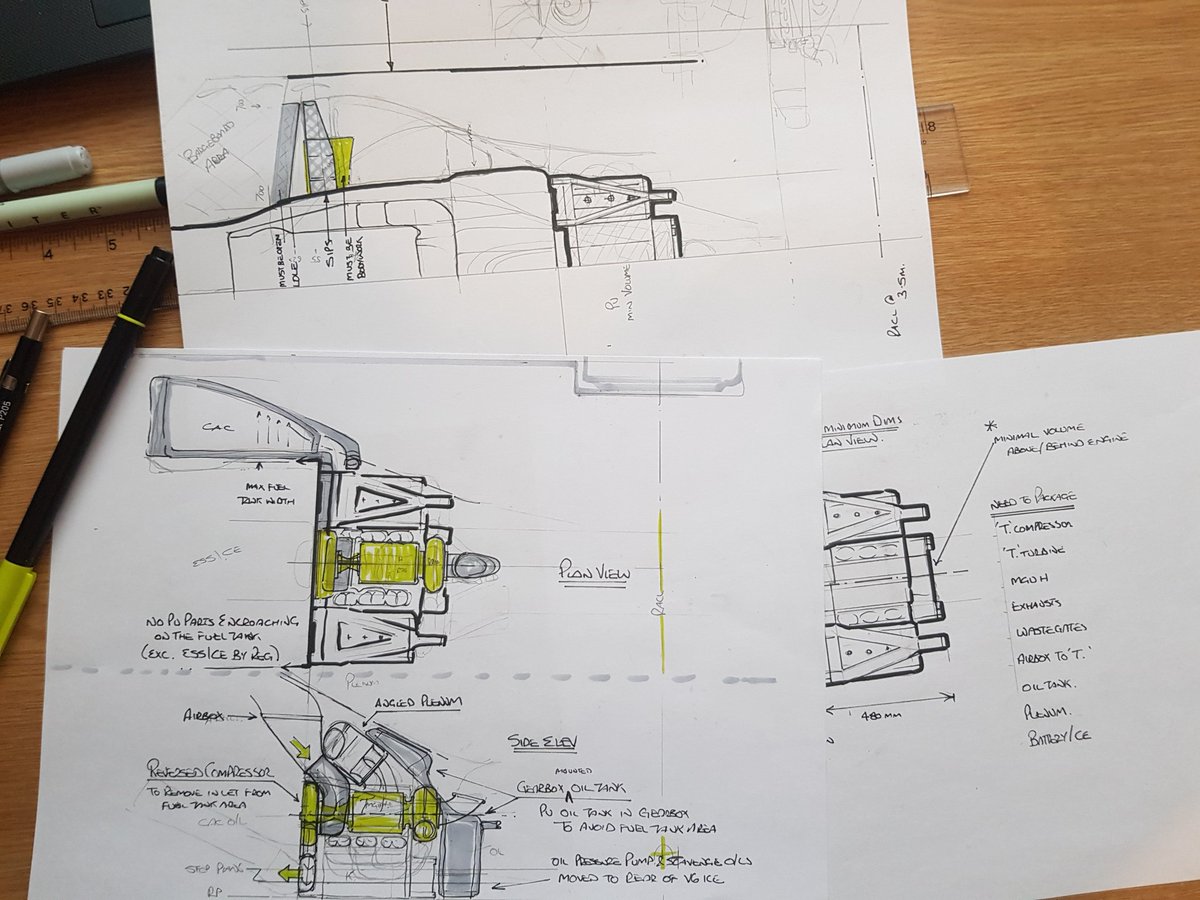
A nice packaging concept from Scarbs which aims to clean up the front of the PU as much as possible in order to move the PU forward and reduce the volume of the fuel tank area etc, thanks to F14t-like oil tank, a reversed compressor etc
https://twitter.com/ScarbsTech/status/1 ... 0043603968
Re: 2014-2020 Formula One 1.6l V6 turbo engine formula
Posted: 06 Feb 2019, 20:50
by erikejw
My own creative suggestion for optimal use of the energy storage.
Teams are allowed to use battery energy to keep the turbo turbine run at an optimal rotation.
Is it possible to use battery energy in short bursts to "turboload" (extra load) the turbo to gain additional hp where it is most beneficial.
My idea originates from the Ferrari last year, that it gained hp in the early acceleration phase when it was not traction limited. That phase is most important to gain laptime in an engine related way since you'll keep the extra speed all the way until breaking.
Maybe that's why other teams was suspicious last year?
Maybe thats why Ferrari had two batterys and needed double measurements. One for the mgu-k limit, the other for energizing the turbo and keep track of energy usage, maybe the two mgu-k and turbo load need different energy storage for optimisation of the different use cases.
1. Is it allowed?
2. Is it a viable working solution?
3. Do any team use it as of today?
Re: 2014-2020 Formula One 1.6l V6 turbo engine formula
Posted: 06 Feb 2019, 23:58
by 63l8qrrfy6
erikejw wrote: ↑06 Feb 2019, 20:50
My own creative suggestion for optimal use of the energy storage.
Teams are allowed to use battery energy to keep the turbo turbine run at an optimal rotation.
Is it possible to use battery energy in short bursts to "turboload" (extra load) the turbo to gain additional hp where it is most beneficial.
How does this work ? Where does the extra hp come from ?
Re: 2014-2020 Formula One 1.6l V6 turbo engine formula
Posted: 07 Feb 2019, 01:06
by gruntguru
erikejw wrote: ↑06 Feb 2019, 20:50
My own creative suggestion for optimal use of the energy storage.
Teams are allowed to use battery energy to keep the turbo turbine run at an optimal rotation.
Is it possible to use battery energy in short bursts to "turboload" (extra load) the turbo to gain additional hp where it is most beneficial.
My idea originates from the Ferrari last year, that it gained hp in the early acceleration phase when it was not traction limited. That phase is most important to gain laptime in an engine related way since you'll keep the extra speed all the way until breaking.
Maybe that's why other teams was suspicious last year?
Maybe thats why Ferrari had two batterys and needed double measurements. One for the mgu-k limit, the other for energizing the turbo and keep track of energy usage, maybe the two mgu-k and turbo load need different energy storage for optimisation of the different use cases.
1. Is it allowed?
2. Is it a viable working solution?
3. Do any team use it as of today?
1. Yes it is allowed.
2. Yes.
3. Yes. It is called electric supercharger mode, quali mode, balls-out mode . . .
Extra boost does not make extra horsepower in these engines. Extra boost increases airflow into the engine but the rules do not allow the extra fuel needed to combust with that air. Electric Supercharger Mode (ESM) increases power by eliminating exhaust back pressure - reducing pumping work on the exhaust stroke while retaining the beneficial pumping work of the intake stroke. In theory the BMEP of the PU will increase by an amount equal to the improvement in pressure drop across the engine. For example if the usual manifold pressure (MAP) is 5 bar absolute and the usual exhaust back pressure (EAP) is 4 bar absolute (a differential of +1) and ES mode reduces EAP to 1 bar while retaining 5 bar MAP (differential = +4), the BMEP of the PU will increase by about 3 bar - a power increase of about 8.5%
It is possible the teams run higher boost in ESM to create a bigger increase still.
ESM is very energy hungry and depletes the ES rapidly.
Re: 2014-2020 Formula One 1.6l V6 turbo engine formula
Posted: 07 Feb 2019, 18:47
by godlameroso
There is a compromise to be made with wastegate opening and electric supercharging mode, along with bumping up compression and playing with the valve timing and duration. A sort of hybrid Miller Atkinson cycle, where geometric compression ratio is high, but effective compression ratio is somewhat lower. The regulations limit geometric compression ratio to 18:1, which would be incredibly hard to pull off with nearly 4 bar of boost pressure. One benefit of a high GCR is good turbine efficiency. The trend for tuning engines today, now that our tuning tools are much better than 5 years ago, is to go high compression(mind you 11:1 isn't very high but is when it comes to turbo applications). It improves turbo response, and allows small displacement engines to spool big @$$ turbos.
Re: 2014-2020 Formula One 1.6l V6 turbo engine formula
Posted: 07 Feb 2019, 23:31
by saviour stivala
‘Free load mode’ electric supercharging mode with waste gates open and at max fuelling with MGU-K and MGU-H sharing ES power, when in this mode the power unit is producing the maximum power possible, a system mode that was part of the design of the new hybrid turbocharged 1.6l V6 from before the new for 2014 power unit ran on dyno for the first time. Refer to ‘McCabism=optimal control theory and FERRARI’s turbo-electric hybrid’.
Re: 2014-2020 Formula One 1.6l V6 turbo engine formula
Posted: 08 Feb 2019, 13:34
by Tommy Cookers
godlameroso wrote: ↑07 Feb 2019, 18:47
..... One benefit of a high GCR is good turbine efficiency....
how wouldn't power available to turbine be lower if cylinder GCR is higher ?
Re: 2014-2020 Formula One 1.6l V6 turbo engine formula
Posted: 08 Feb 2019, 14:14
by Tommy Cookers
Tommy Cookers wrote: ↑08 Feb 2019, 13:34
godlameroso wrote: ↑07 Feb 2019, 18:47
..... One benefit of a high GCR is good turbine efficiency....
how would that benefit happen ?
(we could easily think the opposite happens)
but ok the matter eg of EVO timing relative to GCE (ER really) is a big unknown
Re: 2014-2020 Formula One 1.6l V6 turbo engine formula
Posted: 08 Feb 2019, 14:45
by godlameroso
Tommy Cookers wrote: ↑08 Feb 2019, 13:34
godlameroso wrote: ↑07 Feb 2019, 18:47
..... One benefit of a high GCR is good turbine efficiency....
how wouldn't power available to turbine be lower if cylinder GCR is higher ?
I have no working theory, its just my experience that running higher compression improves turbo response while on boost. Maybe its higher gas velocity due to higher TE. As you say EVO can influence this a great deal.
Re: 2014-2020 Formula One 1.6l V6 turbo engine formula
Posted: 08 Feb 2019, 15:00
by 63l8qrrfy6
Very good point GG. It seems more desirable to have a higher output MGUH that would deliver higher boost in ESM for a shorter duration in order to provide higher crank power in the initial phase of acceleration.
I can't seem to make up my mind over EGR.
On one hand the amount of internal EGR displaces air so the mixture is effectively richer right ?
On the other hand its thermal capacitance is greater so the gas temperature should be lower which means reduced heat flux (and hence heat rejection) to combustion surfaces ?
Edit - just realized previous posts were discussing compression ratio rather than EGR. Anyway, the point still stands - what does EGR do ?
Re: 2014-2020 Formula One 1.6l V6 turbo engine formula
Posted: 08 Feb 2019, 16:22
by godlameroso
Mudflap wrote: ↑08 Feb 2019, 15:00
Very good point GG. It seems more desirable to have a higher output MGUH that would deliver higher boost in ESM for a shorter duration in order to provide higher crank power in the initial phase of acceleration.
I can't seem to make up my mind over EGR.
On one hand the amount of internal EGR displaces air so the mixture is effectively richer right ?
On the other hand its thermal capacitance is greater so the gas temperature should be lower which means reduced heat flux (and hence heat rejection) to combustion surfaces ?
Edit - just realized previous posts were discussing compression ratio rather than EGR. Anyway, the point still stands - what does EGR do ?
I always thought EGR is mixture dilution, and to lower EGTs.
Re: 2014-2020 Formula One 1.6l V6 turbo engine formula
Posted: 08 Feb 2019, 16:28
by Tommy Cookers
(Godl - that is external EGR ie with cooled exhaust gas)
my suggestions of 5 years ago ......
if the ICEs are designed to optimally efficient leanness at 10500 rpm and 100 kg/hr - what do they do at 11550 rpm (or more) ?
if maintaining boost they must lean AFR 10% (or more) - so increasing misfiring aka reducing combustion efficiency
if maintaining AFR they must reduce boost 10% (or more) - not the worst thing
(NOTICE TO SELF - design for eg 94 kg/hr at 10500 rpm and 100 kg/hr at 11170 rpm etc is the 'Bonneville argument')
but ....
if they increase back pressure producing managed underscavenge aka internal EGR .....
this helps combustion efficiency and turbine recovery
regarding expansion ratio
we don't want EVO 1 degree too early or 1 degree too late - but 'correct' EVO will vary with massflow ie with 'boost'
but most usefully we can largely compensate for non-variability of EVO timing by variation of MGU-H load
Re: 2014-2020 Formula One 1.6l V6 turbo engine formula
Posted: 08 Feb 2019, 17:34
by godlameroso

Yes! Exactly! I wonder how much experimentation happens along these lines. The trial and error to arrange all these compromises to get the most net benefit must be both exiting and frustrating.
Re: 2014-2020 Formula One 1.6l V6 turbo engine formula
Posted: 08 Feb 2019, 17:56
by Zynerji
godlameroso wrote: ↑08 Feb 2019, 17:34
Yes! Exactly! I wonder how much experimentation happens along these lines. The trial and error to arrange all these compromises to get the most net benefit must be both exiting and frustrating.
In today's world, wouldn't this be solved with TensorFlow controlling the variables during the dyno runs?
I would expect machine learning to be well advanced in all aspects of F1 design and operation.