Page 667 of 668
Re: 2014-2020 Formula One 1.6l V6 turbo engine formula
Posted: 04 Jul 2023, 01:36
by vorticism
True. Ignoring development cost, if they were given the option, TT would give some packaging advantages (mass center height, runner length, cooling). Good enough to warrant their use, I won't say. In the 80s all the V6s were TT; granted they didn't have a fuel flow limit but would still have been interested in efficiency. The four cylinders of the same era (i.e. similar flow rates) were single turbo, which suggests lag alone wouldn't have ruled out single turbo on a six cylinder. Would an I4 not have benefitted from TT in the same way a V6 of similar output would?
Re: 2014-2020 Formula One 1.6l V6 turbo engine formula
Posted: 04 Jul 2023, 01:57
by Hoffman900
vorticism wrote: ↑04 Jul 2023, 01:36
True. Ignoring development cost, if they were given the option, TT would give some packaging advantages (mass center height, runner length, cooling). Good enough to warrant their use, I won't say. In the 80s all the V6s were TT; granted they didn't have a fuel flow limit but would still have been interested in efficiency. The four cylinders of the same era (i.e. similar flow rates) were single turbo, which suggests lag alone wouldn't have ruled out single turbo on a six cylinder. Would an I4 not have benefitted from TT in the same way a V6 of similar output would?
No because they want more work performed on the turbo to balance out fluctuations in rpm and reduce pumping losses.
I have a RET article where Audi talks about exactly this with their LeMans diesels.
The turbos in the current engines move A LOT of air. People quote 5.5 bars but remember, boost is a measurement of resistance. The current turbos are moving a ton more mass air than turbos of old. Take a look at the compressor map here:
https://www-jsae-or-jp.translate.goog/e ... r_pto=wapp
About the turbo and their size, translated from Honda
As mentioned above, the pressure ratio and flow rate required for turbochargers increased dramatically during the development process. In order to satisfy these demands with high operating point efficiency, including high altitude circuits, it is necessary to increase the rotation speed of the compressor and turbine, or increase the impeller peripheral speed by increasing the diameter of the impeller. , Since the maximum rotation speed is regulated by regulation, the only option this time was to increase the diameter. In order to install the large-diameter compressor in the engine, it was necessary to place it in front of the engine block and connect it to the turbine with a long shaft via MGU-H
You would lose that with smaller TT’s. They are making up for shaft rpm limits with a larger diameter (tip speed would be faster in terms of velocity).
Like most things in F1, it’s all just creative ideas to work inside some inane box the rules makers created. A no rule set series and none of this stuff would look like it does.
Re: 2014-2020 Formula One 1.6l V6 turbo engine formula
Posted: 04 Jul 2023, 02:32
by vorticism
+1 Thank you. I meant to ask that last question in isolation. Reworded: Would an 80s F1 I4 not have benefitted from TT in the same way an 80s F1 V6 of similar output would have? TAG Porsche and Honda made their decision primarily from a standpoint of packaging or to address lag/spool up.
Re: 2014-2020 Formula One 1.6l V6 turbo engine formula
Posted: 04 Jul 2023, 05:59
by gruntguru
Main problem with V6 single turbo is length of plumbing and heat loss.
Small turbos were pretty low efficiency in the 80's too. I think the BMW might have lost a noticeable amount of power with twins.
Re: 2014-2020 Formula One 1.6l V6 turbo engine formula
Posted: 04 Jul 2023, 10:57
by Holm86
gruntguru wrote: ↑04 Jul 2023, 05:59
Main problem with V6 single turbo is length of plumbing and heat loss.
Small turbos were pretty low efficiency in the 80's too. I think the BMW might have lost a noticeable amount of power with twins.
Can't most of the heat loss be negated by modern ceramic coatings and heat shielding?
Re: 2014-2020 Formula One 1.6l V6 turbo engine formula
Posted: 04 Jul 2023, 11:27
by Tommy Cookers
peripheral gas leakage is larger (relatively) in smaller turbines and compressors
for exhaust waveform the best number of cylinders per turbo is 3 (ie not 1 2 4 5 6 etc)
Re: 2014-2020 Formula One 1.6l V6 turbo engine formula
Posted: 04 Jul 2023, 15:37
by Hoffman900
Tommy Cookers wrote: ↑04 Jul 2023, 11:27
peripheral gas leakage is larger (relatively) in smaller turbines and compressors
for exhaust waveform the best number of cylinders per turbo is 3 (ie not 1 2 4 5 6 etc)
Um, elaborate? Because this doesn’t make any sense. If you can keep spacing evenly apart, the more cylinders, the better.
Re: 2014-2020 Formula One 1.6l V6 turbo engine formula
Posted: 04 Jul 2023, 15:59
by Zynerji
Hoffman900 wrote: ↑04 Jul 2023, 15:37
Tommy Cookers wrote: ↑04 Jul 2023, 11:27
peripheral gas leakage is larger (relatively) in smaller turbines and compressors
for exhaust waveform the best number of cylinders per turbo is 3 (ie not 1 2 4 5 6 etc)
Um, elaborate? Because this doesn’t make any sense.
My reading agreed with the 3cyl->1 turbo, as the pulses are 120 degrees apart. An inline 6 could also port the twinned cylinders into a manifold for the same outcome.
Re: 2014-2020 Formula One 1.6l V6 turbo engine formula
Posted: 04 Jul 2023, 16:20
by Hoffman900
The Audi V6 diesel LeMans engine used a dual feed turbo, so each side was fed one 3 cylinder bank, which allows equal 240* spacing of pulses. The advantage of now a single turbo is you have better thermal loading and gas loading, as I mentioned before.
To quote Ulrich Baretzky Audi on the reason for choosing a 120* even-fire V6:
“the twin-entry turbine allows for a very harmonic interaction between the engine and the turbine” … he notes a six into one manifold would have been a nightmare in terms of system reliability, with the cylinders fighting each other.
Their solution to Grunt’s point is the intake is where the exhaust typically is and the exhaust ports exit into the valley, where the turbo is. Diesels are low revving enough that they prefer split / smaller plenums, so they’re not as penalized power wise by splitting them up like that.
This is Race Engine Technology Issue 100. It’s a deep dive dossier on the Audi diesel LeMans engines, which are VERY like the current F1 rule set, except they obviously ran on diesel and were much larger in displacement.
The Porsche 919 was a twin feed as is every F1 engine as well.
Re: 2014-2020 Formula One 1.6l V6 turbo engine formula
Posted: 04 Jul 2023, 16:34
by Hoffman900
Holm86 wrote: ↑04 Jul 2023, 10:57
gruntguru wrote: ↑04 Jul 2023, 05:59
Main problem with V6 single turbo is length of plumbing and heat loss.
Small turbos were pretty low efficiency in the 80's too. I think the BMW might have lost a noticeable amount of power with twins.
Can't most of the heat loss be negated by modern ceramic coatings and heat shielding?
The heat loss shouldn’t be too great these days. The F1 engines are only 1.6L (rules mandated 101.2mm +/- mm bore spacing) so their overall length is very short, so the front banks to the rear of the engine (to the hot side of the turbo) is short. No one is using ceramic coating on the exhausts, they’re inconel and are ceramic heat shield cladded to protect the everything else nearby (body work and whatever else is packaged nearby).
With the rpm used, and the short length of a 1.6L V6, I bet they can barely get the tuned length of the primaries they want. Remember when Mercedes and Honda switched from a log to a 3-1 manifold? There is power there focusing on that.
You can see the Honda layout evolution and exhaust / turbo packaging here:
https://www-jsae-or-jp.translate.goog/e ... r_pto=wapp
One thing to remember is the F1 rules are very restrictive. They all are pretty similar designs as mandated by the rules. F1 is way more spec under than many think.
Re: 2014-2020 Formula One 1.6l V6 turbo engine formula
Posted: 04 Jul 2023, 18:23
by vorticism
Holm86 wrote: ↑04 Jul 2023, 10:57
gruntguru wrote: ↑04 Jul 2023, 05:59
Main problem with V6 single turbo is length of plumbing and heat loss.
Small turbos were pretty low efficiency in the 80's too. I think the BMW might have lost a noticeable amount of power with twins.
Can't most of the heat loss be negated by modern ceramic coatings and heat shielding?
Not as readily available in the 80s. Yes, wraps and coatings did exist by that point already, but they have fairly sophisticated layered foil wraps these days, fully shaped and fitted, not just panels; I don't recalls seeing those often until the 00s. Probably not prime importance wrt which areas you'd optimize for efficiency, in those days. And with the high a:f ratios of today's engines, I do wonder how problematic heat transferal actually is.
Tommy Cookers wrote: ↑04 Jul 2023, 11:27
peripheral gas leakage is larger (relatively) in smaller turbines and compressors
for exhaust waveform the best number of cylinders per turbo is 3 (ie not 1 2 4 5 6 etc)
More generally, I'd say it depends on pulse size and frequency relative to turbine features. An I4 delivers every 180* vs 240* for one V6 bank, although both the exhaust volume and turbine are smaller (for equal output equal displacement engines) on the V6 which ultimately determines responsiveness. Which is to say, the 80s TT V6s may not have been about reducing lag, rather more about packaging and prioritization of cylinder count and arrangement.
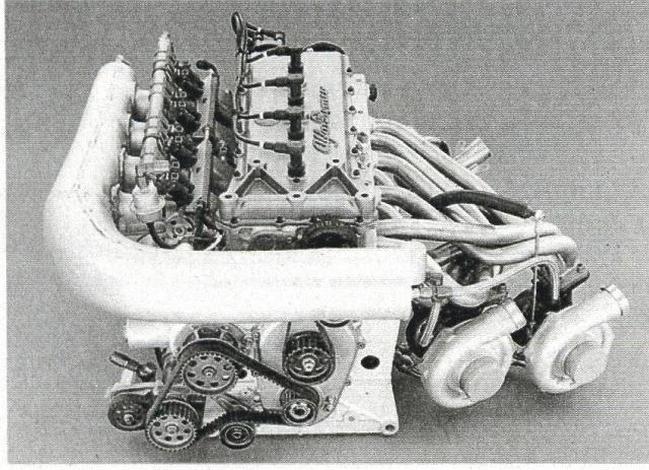
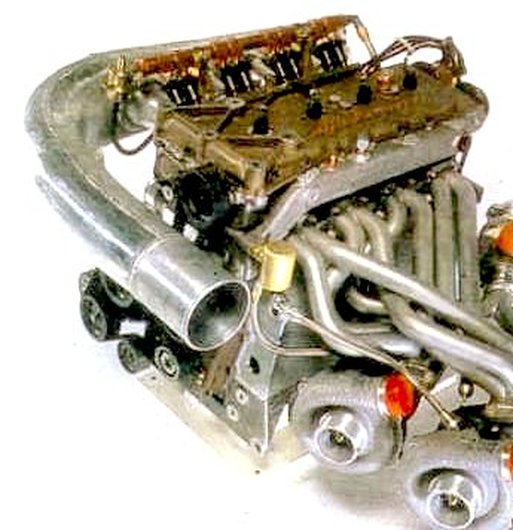
One team did investigate TT I4. Alfa Romeo, although it never raced afaik. I'd say this was strictly about inertia; they wanted responsiveness and made it happen. Although you'd think a wye pipe would have been easier to fabricate.
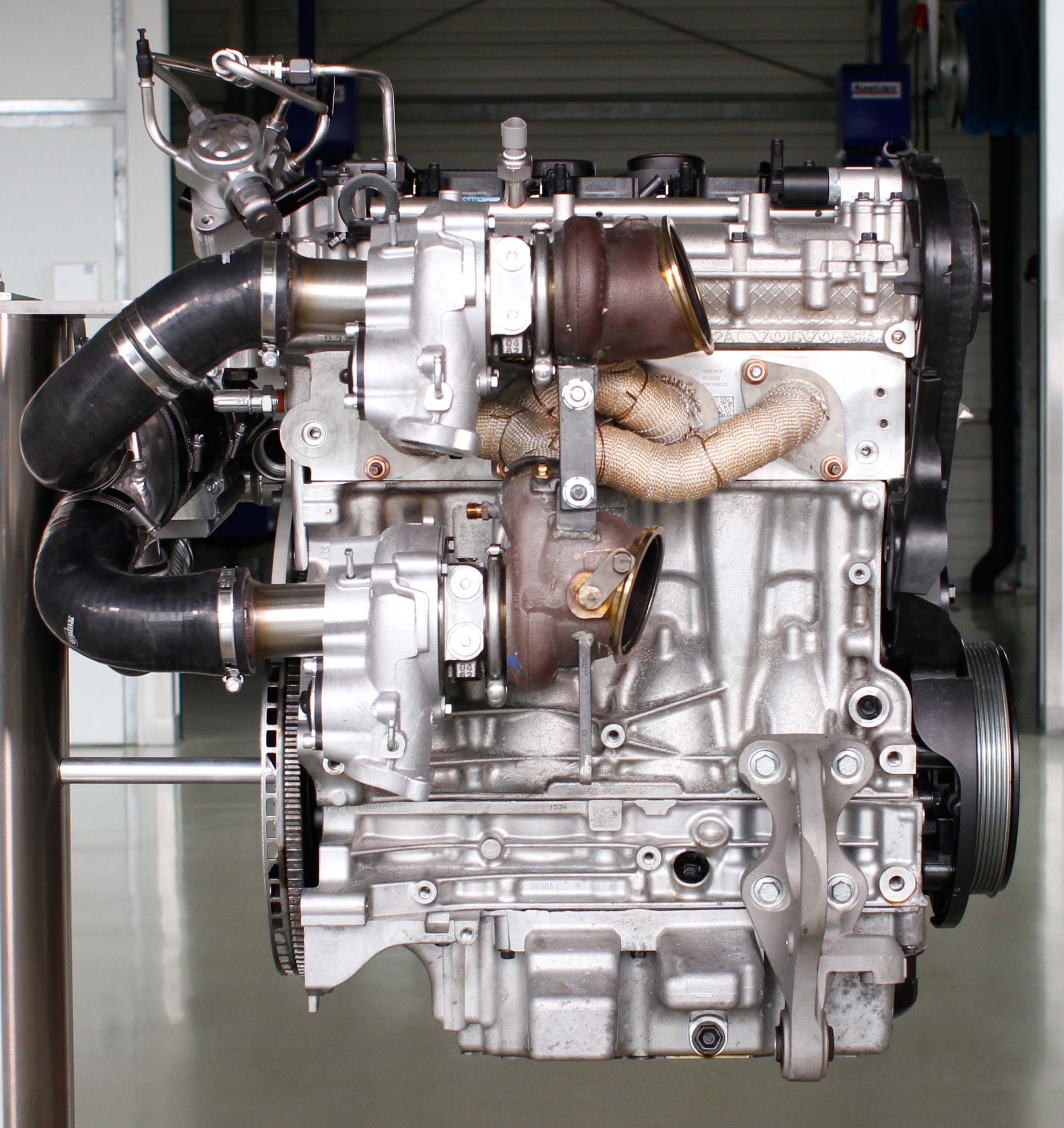
In the production world, Volvo did some work on an I4 TT.
Re: 2014-2020 Formula One 1.6l V6 turbo engine formula
Posted: 06 Jul 2023, 03:05
by gruntguru
Hoffman900 wrote: ↑04 Jul 2023, 15:37
Tommy Cookers wrote: ↑04 Jul 2023, 11:27
peripheral gas leakage is larger (relatively) in smaller turbines and compressors
for exhaust waveform the best number of cylinders per turbo is 3 (ie not 1 2 4 5 6 etc)
Um, elaborate? Because this doesn’t make any sense. If you can keep spacing evenly apart, the more cylinders, the better.
TC is correct although I would modify his statement to say
for exhaust waveform the best number of cylinders per turbine nozzle is 3 (ie not 1 2 4 5 6 etc).
The reasoning goes like this:
Less than 3 (per turbine) results in large pressure fluctuations and likewise stress and speed fluctuations in the turbine.
More than 3 (per nozzle) means exhaust pulses from different cylinders will overlap, increasing backpressure during mid and late exhaust stroke. (port pressure during blowdown is much higher than it is mid to late stroke)
Re: 2014-2020 Formula One 1.6l V6 turbo engine formula
Posted: 18 Mar 2024, 01:16
by PlatinumZealot
latest research uncovers even more pote
Tial for combustion engines:
https://phys.org/news/2024-03-theory-li ... admap.html
Basically the koreans have identified that there is more than one steady state solution for ignition in subsonic and supersonic regimes and that these consider the ignition wave. So if my intereptation is correct engine researches will now start finetuning experiments around these solutions by manipulating the ignition waves. Could expect obviously more efficient combustion.
Re: 2014-2020 Formula One 1.6l V6 turbo engine formula
Posted: 21 Mar 2024, 07:52
by ispano6
PlatinumZealot wrote: ↑18 Mar 2024, 01:16
latest research uncovers even more pote
Tial for combustion engines:
https://phys.org/news/2024-03-theory-li ... admap.html
Basically the koreans have identified that there is more than one steady state solution for ignition in subsonic and supersonic regimes and that these consider the ignition wave. So if my intereptation is correct engine researches will now start finetuning experiments around these solutions by manipulating the ignition waves. Could expect obviously more efficient combustion.
Koreans? Tohoku University and all of the named researchers are Japanese.
Re: 2014-2020 Formula One 1.6l V6 turbo engine formula
Posted: 22 Mar 2024, 02:11
by PlatinumZealot
ispano6 wrote: ↑21 Mar 2024, 07:52
PlatinumZealot wrote: ↑18 Mar 2024, 01:16
latest research uncovers even more pote
Tial for combustion engines:
https://phys.org/news/2024-03-theory-li ... admap.html
Basically the koreans have identified that there is more than one steady state solution for ignition in subsonic and supersonic regimes and that these consider the ignition wave. So if my intereptation is correct engine researches will now start finetuning experiments around these solutions by manipulating the ignition waves. Could expect obviously more efficient combustion.
Koreans? Tohoku University and all of the named researchers are Japanese.
The fact that Tohoku University is in Japan has nothing to do with my "false memory" as I typed my post.
Goes to show the global impact that the Koreans are having in automotive right now. My mind easily replaced Japanese with the Koreans just after reading an automotive reaearch paper.... Go figure!