Page 1 of 3
Helmholtz Exhaust 2012
Posted: 24 May 2012, 04:15
by PlatinumZealot
Just an exploratory discussion about using closed ended resonating chambers on the exhaust. It has been applied in F1 by Ferrari in 2011 as far as I can tell. I have seen these before Many Years ago on the internet but I cannot seem to find the picture. It was done on a BMW M3 with each exhaust header runner having it's own closed end cannister.
Some users believe that this kind of exhaust setup is used for engine output, and others believe it may be used indirectly for aerodynamic gain. It remains to be confirmed.
Nevertheless I have come across a few closely related picture and articles.
Here is and old drawing of the concept on wikipedia. I don't know who or what entity invented it.
Helmholtz resonator exhaust manifold (Autocar Handbook, 13th ed, 1935
http://commons.wikimedia.org/wiki/File: ... 935%29.jpg

An article on Import Tuner. they put it on a 350z where It does quite well In "cat-back" exhaust Vs stock. But it seems not that much better than a regular exhaust... Then again this source is just an import tuner magazine which is not that scientific.
http://www.importtuner.com/tech/impp_10 ... r_fiction/

Re: Helmholtz Exhaust - as seen on Ferrari F150/F2012
Posted: 24 May 2012, 04:19
by PlatinumZealot
More pictures.
It seems more and more that this Helmholtz resoantor is pretty standard in modern muffler design as seen here on this BMW e46 M3 muffler. Still not the picture I was looking for though. The picture I saw was directly attached to the headers just like on the Ferrari F2012. Any assistance appreciated.
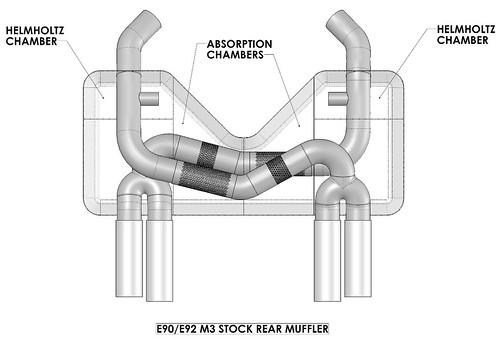
Though possibly not the application I am looking for, the purpose of the HelmHoltz chamber i the muffler is still not clear from the above picture. Any guesses? I have a link for muffler application here.
http://accessscience.com/content/Muffler/437600
Nice read, but I don't suppose Ferrari are using it for a muffler are they?

Re: Helmholtz Exhaust - as seen on Ferrari F150/F2012
Posted: 24 May 2012, 04:32
by bhall
Cool. If someone hadn't started a new thread, I was going to.
In the light research I've done on the topic this evening, I haven't seen much that would indicate that the chambers applied to the Ferrari exhaust are for tuning torque response. Then again, I'm also half-moron.
Chambers for that purpose seem to be fitted to the exhaust header. Chambers fitted further down the exhaust seem to be used for tuning exhaust sound.
Here's a link to Scarbs' interpretation.
Here's a picture of Mercedes' exhaust chamber as seen at the Abu Dhabi test last year.
Below is Ferrari's implementation.

Re: Helmholtz Exhaust - as seen on Ferrari F150/F2012
Posted: 24 May 2012, 04:44
by bill shoe
It was invented by Helmholtz.
Helmholtz is a name used for a variety of tuners that probably go beyond strictly helmholtz types, so if you research more it can get confusing. "Helmholtz" is almost interchangable with "wave tuner" in the way "Kleenex" is interchangable with "tissue".
Helmholtz tuners are generally designed to cancel a frequency in the tube or device it is attached to. Typical example is cancelling a loud resonant wave that occurs in an intake manifold at a certain frequency (rpm).
Exhaust on high performance engines is tuned to create waves that result in low pressure at the exhaust valve during the valve opening. This tuning is only optimized at a certin rpm. I think at half of that rpm you would get a wave that was exactly the opposite of what you want, meaning high pressure at the exhaust valve during its opening. If you tune your exhaust to be optimized at rpm x, and you also wanted good torque at 0.5 x, then you could add some kind of wave tuner that cancelled the "bad" wave at 0.5 x.
If this guess is roughly correct then I think it would have little application in F1 because the engines are almost always run at more than 50% of the redline. The Renault press release for Monaco talks about engine drivability being optimized for 15-17K rpm rather than the usual 16-18K rpm.
I'd love to hear from someone who designs exhaust.
Re: Helmholtz Exhaust - as seen on Ferrari F150/F2012
Posted: 24 May 2012, 04:51
by bhall
What role does the chamber's location on the exhaust play, if any?
Re: Helmholtz Exhaust - as seen on Ferrari F150/F2012
Posted: 24 May 2012, 09:27
by Caito
bhallg2k wrote:What role does the chamber's location on the exhaust play, if any?
Out of my head I think it would affect the phase of the wave. But it's an unsupported theory.
Re: Helmholtz Exhaust - as seen on Ferrari F150/F2012
Posted: 24 May 2012, 10:23
by tok-tokkie
I think a Helholz resonator will be 'in tune' at each frequency doubling (or halving) so at half frequency there would again be low pressure at the exhaust valve. At 1.5 times (& similar multiples) the pressure would be at maximum. Hence the narrow band of optimum performance.
EDIT: On second thoughts I think the sub-harmonics don't give the same effect as the plus harmonics. Halving the speed will not give the desired result I fear.
Re: Helmholtz Exhaust - as seen on Ferrari F150/F2012
Posted: 24 May 2012, 16:03
by PlatinumZealot
bill shoe wrote:It was invented by Helmholtz.
Helmholtz is a name used for a variety of tuners that probably go beyond strictly helmholtz types, so if you research more it can get confusing. "Helmholtz" is almost interchangable with "wave tuner" in the way "Kleenex" is interchangable with "tissue".
Helmholtz tuners are generally designed to cancel a frequency in the tube or device it is attached to. Typical example is cancelling a loud resonant wave that occurs in an intake manifold at a certain frequency (rpm).
.
Interesting that you mentioned Resonance. I know resonance can have damaging effects on a machine. So I am going to put another view out there:
Could these chambers be used in formula 1 to prevent the exhaust from cracking due to resonance? In other words to increase the life of the exhaust. Paddy Low said that a typical F1 exhaust only last about 1000km.
Re: Helmholtz Exhaust - as seen on Ferrari F150/F2012
Posted: 24 May 2012, 17:57
by hardingfv32
Don't we want high wave resonance for maximum exhaust scavenging?
I am not sure the longevity of the exhaust system is that big an issue. I would say thermal shock and engine vibration would be the bigger issues. They are .025 wall Inconel. My set is marked 1850 km.
Brian
Re: Helmholtz Exhaust - as seen on Ferrari F150/F2012
Posted: 24 May 2012, 19:23
by olefud
I recall David Blizzard discussing this at a seminar some time ago. My recollection though is that the resonator was on the intake side. This suggests the purpose is for pressure wave tuning. But it could probably be tune to null unwanted frequencies.
Re: Helmholtz Exhaust - as seen on Ferrari F150/F2012
Posted: 24 May 2012, 20:29
by Paul
Any chance it could be used to "even out" the pulse nature of exhausts? That could be beneficial, not least because it would be easier to model in CFD...
Re: Helmholtz Exhaust - as seen on Ferrari F150/F2012
Posted: 25 May 2012, 03:46
by PlatinumZealot
One might argue that evening out might not be needed for an 18000 rpm V8 race engine. That's 600 pulses per second at near 100% VE. Should be a pretty smooth flow. But yeah, still plausible.
hardingfv32 wrote:Don't we want high wave resonance for maximum exhaust scavenging?
I am not sure the longevity of the exhaust system is that big an issue. I would say thermal shock and engine vibration would be the bigger issues. They are .025 wall Inconel. My set is marked 1850 km.
Brian

Wow that's really thin! Almost paper thin!
0.065" wall stainless is pretty difficult to weld as it is. I wonder how they weld that?
Re: Helmholtz Exhaust - as seen on Ferrari F150/F2012
Posted: 25 May 2012, 04:04
by aussiegman
Helmhotz resonators are typically used to "tune" intake noise to meet drive by noise regulations.
In an exhaust system, a Helmhotz Resonator tube could be used to increase the efficiency of the "Kadenacy Effect" in a specific RPM range of the engine.
The Kadenacy effect is an effect that forms from pressure-waves in gases. For an IC engine, it is when the the momentum of the exhaust gases exiting the cylinder creates an internal pressure-drop within the cylinder, assisting cylinder filling during the intake event. This can be maximised by the tuning of intake and exhaust manifolds to coincide with the pulse wave reversion of through tuned length tubes (exhaust headers or intake runners) to assist in scavenging and increase the pressure drop across the intake and exhaust valve area within a specific RPM range.
A Helmholz Resonator tube could be used to increase this effect with careful tuning. By altering the volume of the closed end tube, you can effectively alter the tuning range (RPM) at which the resonance effect is either most beneficial OR at which the resonance cancels out those pressure waves which are most detrimental.
As such it could be used to allow more low/mid RPM performance through removing unwanted pulse waves at the exhaust valve face where the exhaust runners are tuned for higher RPM efficiency or to increase the performance of the engine in a specific RPM range that matches or compliments the tuning of the exhaust header lengths or diameter changes.
I doubt its primary purpose is to alter the sound of the exhaust unless it is trying to mask something that Ferrari does not want detectable via audio analysis (max RPM as example), however it would remain detectable via ECU data logging so would be of little use IMHO...
Re: Helmholtz Exhaust - as seen on Ferrari F150/F2012
Posted: 25 May 2012, 05:26
by zorog
n smikle wrote:
Wow that's really thin! Almost paper thin!
0.065" wall stainless is pretty difficult to weld as it is. I wonder how they weld that?
All by hand as far as I know, fine art by a skilled craftsman.
Re: Helmholtz Exhaust - as seen on Ferrari F150/F2012
Posted: 25 May 2012, 05:51
by bhall
aussiegman wrote:The Kadenacy effect is an effect that forms from pressure-waves in gases. For an IC engine, it is when the the momentum of the exhaust gases exiting the cylinder creates an internal pressure-drop within the cylinder, assisting cylinder filling during the intake event. This can be maximised by the tuning of intake and exhaust manifolds to coincide with the pulse wave reversion of through tuned length tubes (exhaust headers or intake runners) to assist in scavenging and increase the pressure drop across the intake and exhaust valve area within a specific RPM range.
So, what's the difference between placing a Helmholtz resonator on the exhaust header (manifold) and placing one further down the exhaust pipe (where Ferrari have placed their chamber)? At what point along the exhaust is the Kadenacy effect no longer applicable?