Page 1 of 2
Tire drag of a tricyle
Posted: 15 Jun 2012, 14:26
by MadMatt
Hello guys,
I have read some stuff about slip angle, but I would need to know how to calculate it so I can find the tire drag ! Following the "Magic Formula" which can be found in "PACEJKA, H. B. (2002). Tyre Mechanics and Vehicle Dynamics" I have few problems understanding the principle.
The car is a tricycle consisting of 1 steer wheel at the back and 2 non-steer wheels at the front, separated by a distance.
Knowing the properties of the tyre, the corner radius, the steering angle applied to negociate the corner and the tangential vehicle speed at any point in the corner, how can I calculate the slip angle ? For a 1 wheel vehicle (therefore theoretical model), it is said the formula is given by :
alpha = (Ca - fr * M *g * (pi/180)) = M * (v^2/R)
Where Ca is a parameter given by the tyre manufacturer, fr the friction coef, M the vehicle mass, R the radius of the corner, and v the vehicle speed. I know there is no simple answer, but is there any information on how to calculate the slip angle of such vehicle ?
I know this isn't maybe the everyday talk but we are on technical forum after all. Thanks for reading !

Re: Slip angle of a tricyle
Posted: 15 Jun 2012, 17:39
by olefud
I would srart with the corner(ing) radius and the steering angle.
Re: Slip angle of a tricyle
Posted: 15 Jun 2012, 17:56
by Jersey Tom
Hasn't this been posted before? I know I've seen it.
First things first... what do you mean by THE slip angle? Each tire will be at a different slip angle.
Pretty simple solution in any event. At a given location in the corner, if you know the speed and path curvature you can get the lateral acceleration. If you know the lateral acceleration and mass of the front and rear halves of the car you can figure out how much force each axle needs to generate. If you know how much lateral force is required at each axle, and the Fy vs SA curve of each tire, you can arrive at the slip angles.
Re: Slip angle of a tricyle
Posted: 17 Jun 2012, 21:54
by MadMatt
Jersey Tom wrote:Hasn't this been posted before? I know I've seen it.
You are right :
viewtopic.php?p=239392&f=6
So I let the mods feel free to merge the thread or not !
Jersey Tom wrote:First things first... what do you mean by THE slip angle? Each tire will be at a different slip angle.
You are right, each tire has its own one. Ideally I would have to calculate the slip angle for each of the 3 tires which is what I am going to do !
Jersey Tom wrote:Pretty simple solution in any event. At a given location in the corner, if you know the speed and path curvature you can get the lateral acceleration. If you know the lateral acceleration and mass of the front and rear halves of the car you can figure out how much force each axle needs to generate. If you know how much lateral force is required at each axle, and the Fy vs SA curve of each tire, you can arrive at the slip angles.
Knowing the lateral force wouldn't be a problem because I know the tangential speed of the car and the corner radius. The problem is knowing the 3 steering angles. I know the angle at any point in the corner that the car HAS to follow otherwise he's leaving the track (I used 3 points in the corner to calculate this), but I don't know how to get those 3 steering angles.
As soon I as can get them, I know pretty much how to calculate the tire drag !
Re: Slip angle of a tricyle
Posted: 17 Jun 2012, 22:03
by Jersey Tom
MadMatt wrote:Knowing the lateral force wouldn't be a problem because I know the tangential speed of the car and the corner radius. The problem is knowing the 3 steering angles. I know the angle at any point in the corner that the car HAS to follow otherwise he's leaving the track (I used 3 points in the corner to calculate this), but I don't know how to get those 3 steering angles.
As soon I as can get them, I know pretty much how to calculate the tire drag !
Re read my original post.. it is a pretty simple solution if we are in agreement that finding the required lateral force is easy.
Lets say this is the Fy vs SA curve you get from your tire manufacturer:
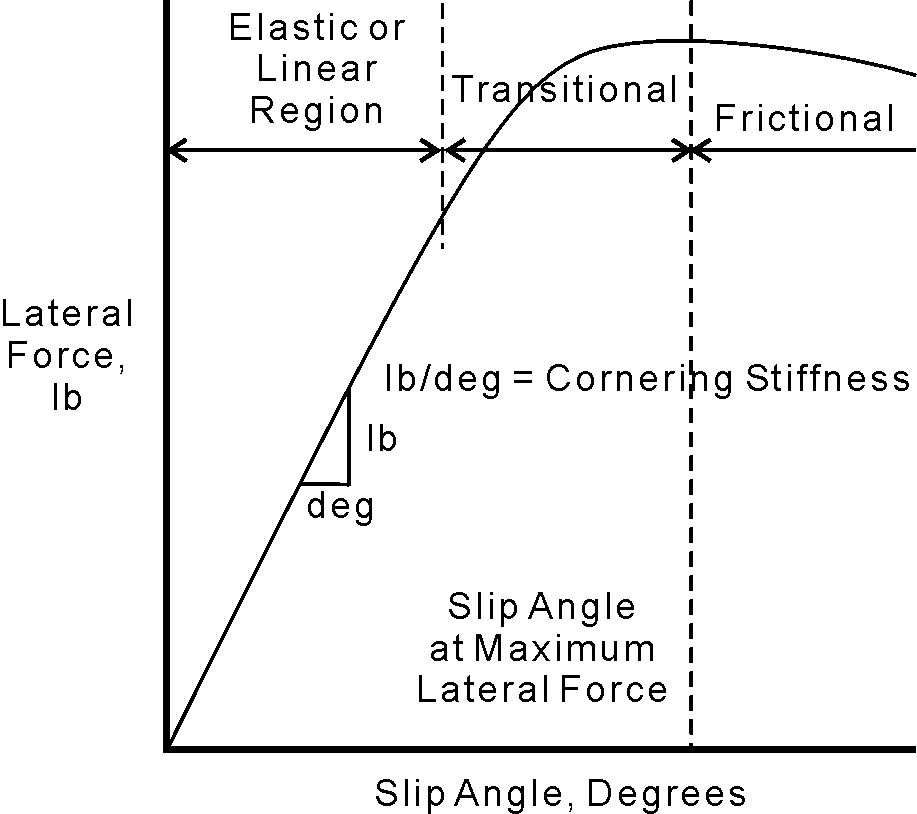
If you know how much lateral force you have to be generating, just look to find what slip angle is required to generate that force. Done.
Re: Slip angle of a tricyle
Posted: 18 Jun 2012, 00:07
by MadMatt
Yes, this I understood very well, and I have seen this type of graph already. Thing is I am unsure if I can get it for the tire I have !
I want to precise that I am more interested in the
tire drag than the slip angle. I need that slip angle to get the tire drag, but I can get the slip angle by using Pacejka's formulas :
Cα = (a30 + a31 P) sin (2 tan -1 (Fz / a40 + a41 P))
α = (m v2 / R )/(Cα - Cr Fz π/180)
a30, a31, a40 and a41 are coefficients given by Michelin, P is the tire pressure and Fz the load. Then when you get Cα, you can calculate the "real" α.
I assume that from the steering angle that I have (as I explained before), I have to subtract that α value to get the real steering value that I can use in the 6 equation system that I have (3 forces, 3 moments), to finally find the tires drag forces.
Do you see the method or should I give more details about it ?
Re: Slip angle of a tricyle
Posted: 18 Jun 2012, 00:23
by Jersey Tom
Steering angle makes no difference. All you need is slip angle and Fy to calculate tire drag.
Re: Slip angle of a tricyle
Posted: 18 Jun 2012, 00:29
by MadMatt
Ok thank you for your answer ! I had a schema but it was not really self-explaining, especially on the angles. Now I get it !
Re: Slip angle of a tricyle
Posted: 18 Jun 2012, 09:04
by fastback33
As with anything math related there is always more than one road to the same solution.
You may have figured it out already but I find getting your SA from the car geometry to be more straight forward and less dependent on your tire model. From Milliken you can use beta+(a/R)-Delta= front SA and for the rear beta-(b/R)= rear SA.
These equations are for a bicycle model but it is pretty easy to expand it for the whole car. In your case a three wheeled vehicle. Just look at the geometry and add up the corner radius + front/rear track.
EDIT: no pun intended on the first sentence....


Re: Slip angle of a tricyle
Posted: 18 Jun 2012, 10:38
by MadMatt
Thanks for your input !
I understood Tom's concept but at the moment I have no map of the slip angle depending on the lateral force so I am trying to follow the geometric method based on forces/moments. If you look at this book page 82 :
http://www.scribd.com/doc/63721078/Most ... icleCH1tm7
They know the delta angles. But again the tricycle I have has no front steering wheels. The thing is that I do not, or at least I haven't found the way to get these 3 angles, which would make sense if only the rear wheel is steering (the front wheels have no delta angles). I only know the angle the vehicle has to take (which depends on the track of course). Also I don't know how can they know the beta value at the moment. A bit of confusion there !

Fastback, who is Milliken ? Have you got the source of this ? Delta angle is the angle the vehicle has to take (read below) ? I had no teaching on this subject and I find difficult to get into Pacejka's concept and the overall concept of the slip angle. Oh and no offense taken heh
EDIT : I changed the thread title, since I didn't make it clear that what I wanted to get was the tires drag and not the slip angle (although I need the slip angle to get the tire drag).
Re: Tire drag of a tricyle
Posted: 18 Jun 2012, 14:54
by Jersey Tom
Using steering data (ie from data acquisition) you can infer the difference between front and rear slip angles, but not the absolute magnitudes - which you need to calculate cornering drag.
Only way to get the absolute magnitudes is with tire data, namely a Fy vs SA curve.
I have no map of the slip angle depending on the lateral force
No? You just said you had some F&M data from Michelin:
Cα = (a30 + a31 P) sin (2 tan -1 (Fz / a40 + a41 P))
α = (m v2 / R )/(Cα - Cr Fz π/180)
a30, a31, a40 and a41 are coefficients given by Michelin, P is the tire pressure and Fz the load. Then when you get Cα, you can calculate the "real" α.
Re: Tire drag of a tricyle
Posted: 18 Jun 2012, 19:40
by MadMatt
I'm sorry Tom I think I first have to consider that bicycle model before going further.Take the
page 78 of the link I posted in my previous message as a platform for what I'm gonna write here.
I can get until the point where I have 7 equations with 7 unknown variables (bottom of
page 78), but then I'm struck ! They say we don't know
Fxr and
Fxf but we know these 2 variables ! We can get them with the 3.9 equation on
page 59 (I know
Fz and
fr for the front and rear wheels).
Then equations 4.15, 4.16 and 4.17 on the next page combined together are 3 equations with 3 unknown variables (most of them are angles), because here are the variables I know from these 3 equations :
(delta - alphaf),
L,
R,
xg.
If I can get
delta, I can get
alphaf (or the other way around). And if I can get
beta, I can get
e and then
alphar. As soon as I have this, I can find
Fyf,
Fyr (with equations 4.18 and 4.19). And then of course I can get the
T value which is what I am looking for.
So basically there are 2 things which causes me problems :
1) They say
Fxr and
Fxf are unknown values, but we can calculate them so what am I missing ?
2) How can I get the at least 1 variable that I don't know out of the 3 equations 4.15, 4.16 and 4.17 ?
Now to answer your question (I repeat that I'm gonna let for now the tricycle and focus on bicycle), I am afraid I didn't use the right formula for the new slip angle (I took this formula from the single wheel model).
Thank you for your help anyway, I really appreciate it !
Re: Tire drag of a tricyle
Posted: 19 Jun 2012, 03:18
by Jersey Tom
I still think you're over complicating this. It should be a simple solution. Unfortunately I don't have a subscription to the link you posted so I don't know what equations were there.
Process should still be this:
1. Find lateral acceleration at the point of interest
2. Using knowledge of the vehicle mass distribution, figure out the total axle lateral forces required at that point in time
3. Using your data from Michelin, establish what front and rear slip angles meet those force requirements
4. Once you have the slip angles and lateral force, drag = Fy * sin(SA).
Re: Tire drag of a tricyle
Posted: 19 Jun 2012, 10:29
by spacer
Matt, I think the missing point here is that you think you don't have the Fy vs SA curve.
Since these tires are designed for a race in which the cars never even come close to the limits of lateral acceleration the tires can handle, Michelin handles you that part of the data that's relevant.
Look at the formula you posted, you have the cornering stiffnes Ca, in N/deg.
Now look at the curve JT posted: this Ca holds perfectly fine for the linear part of the curve. So you actually have the first (and for this application, most important) part of the curve.
If you want to model your cars behavior in the higher regions of the curve (in which the lineair constant would not be sufficient), there's something wrong with your race strategy... even at the Rotterdam circuit

.
Re: Tire drag of a tricyle
Posted: 19 Jun 2012, 19:38
by MadMatt
For some reason still unknown to me at the moment, I forgot that I knew the lateral force for each tire. I guess it happens when you spend 18 hours per day on a project. You lose the general view of the things which mean I should have a day off on this.
Now it looks very simple of course and I look even more stupid not having understood this earlier. Sometimes I really hate myself for being so slow to understand easy principles.
Thank you spacer and of course thank you Tom for your help, it has been very helpful ! I also want to apologize to you Tom, I remember I was being rude in a thread regarding aerodynamics. The slip angle concept must be obvious to you, and you seem to know quite a lot of mechanical things (if I look at the messages you are posting on this forum), so don't take what I said too badly (I bet you didn't anyway), I was just stunted by what you wrote, because I've learned different things.
I don't know your life path, where you've worked and so on, so again please forgive my language, I don't know what happened to me at that moment when I posted that message.